
🚀 宇宙の記憶・カレンダー検索
🚀 象徴的な写真:
APOD第1回
🚀 創造の柱
🚀 スピリット火星着陸
🚀 ハッブル超深宇宙
🚀 地球へようこそ|ブルー・マーブル
🚀 エンケラドス
🚀 ベテルギウス
🚀 火星着陸
🚀 青い夕焼け
🚀 冥王星のハート
🚀 皆既日食
🚀 アースライズ再構築
🚀 ブラックホール
🚀 ウェッブ初画像
🚀 アポロ11着陸
APOD30周年(2025年6月16日)
M57:ハッブル宇宙望遠鏡が捉えた環状星雲
M57: The Ring Nebula from Hubble
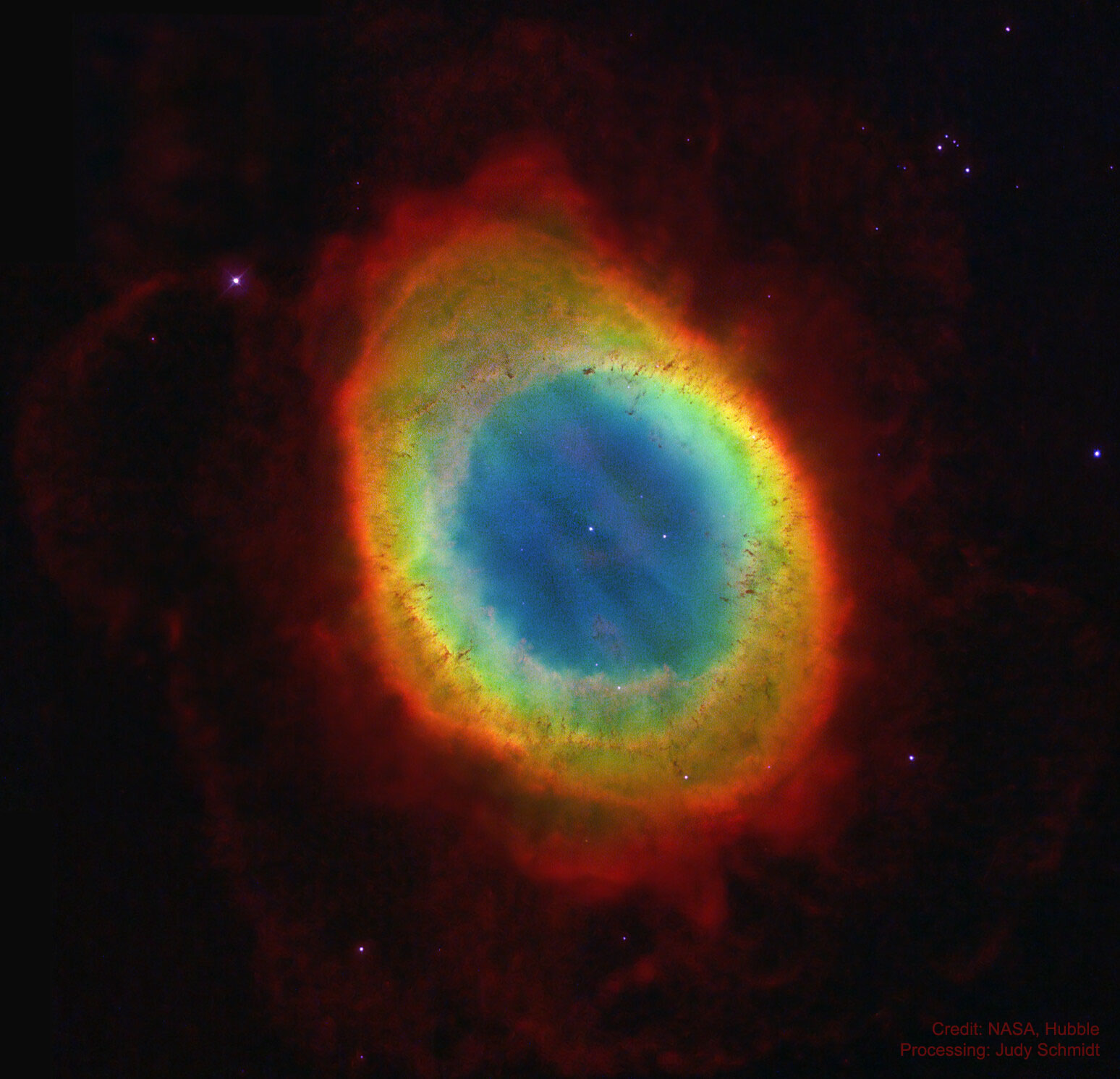
数百年前、その特異な形状を理解できなかった天体観測者たちがそれに気づきました。それは空に浮かぶリングのように見えました。土星の環を除けば、環状星雲(M57)はおそらく最も有名な天体の円でしょう。今ではそれが何であるか、そしてその象徴的な形状は幸運な視点によるものであることがわかっています。ハッブル宇宙望遠鏡の鮮明な画像に基づいて最近行われた、膨張する星雲の3D構造のマッピングによると、この星雲は、(アメリカン)フットボールの形をした輝くガスの雲の中心を囲む、比較的密度の高いドーナツ状のリングであることが示されています。地球からの私たちの視点は、フットボールの長軸に沿って、リングに正面から向いています。もちろん、このよく研究されている惑星状星雲の例では、輝く物質は惑星から来ているわけではありません。代わりに、ガス状の覆いは、かつて太陽のような星だった死にゆく星から放出された外層を表しており、その星は現在、星雲の中心に小さな光の点として見えます。中心にある高温の恒星から発せられる強烈な紫外線が、ガス中の原子を電離させる。環状星雲は直径約1光年、地球からの距離は約2500光年である。
原文(English)
It was noticed hundreds of years ago by stargazers who could not understand its unusual shape. It looked like a ring on the sky. Except for the rings of Saturn, the Ring Nebula (M57) may be the most famous celestial circle. We now know what it is, and that its iconic shape is due to our lucky perspective. The recent mapping of the expanding nebula's 3-D structure, based in part on this clear Hubble image,indicates that the nebula is a relatively dense, donut-like ring wrapped around the middle of an (American) football-shaped cloud of glowing gas. Our view from planet Earth looks down the long axis of the football, face-on to the ring. Of course, in this well-studied example of a planetary nebula, the glowing material does not come from planets. Instead, the gaseous shroud represents outer layers expelled from the dying, once sun-like star, now a tiny pinprick of light seen at the nebula's center. Intense ultraviolet light from the hot central star ionizes atoms in the gas. The Ring Nebula is about one light-year across and 2,500 light-years away.
\ この感動を宇宙仲間にシェア /
宇宙をXでシェア
© NASA / APOD