
🚀 宇宙の記憶・カレンダー検索
🚀 象徴的な写真:
APOD第1回
🚀 創造の柱
🚀 スピリット火星着陸
🚀 ハッブル超深宇宙
🚀 地球へようこそ|ブルー・マーブル
🚀 エンケラドス
🚀 ベテルギウス
🚀 火星着陸
🚀 青い夕焼け
🚀 冥王星のハート
🚀 皆既日食
🚀 アースライズ再構築
🚀 ブラックホール
🚀 ウェッブ初画像
🚀 アポロ11着陸
APOD30周年(2025年6月16日)
CFHTから見たヘリックス星雲
The Helix Nebula from CFHT
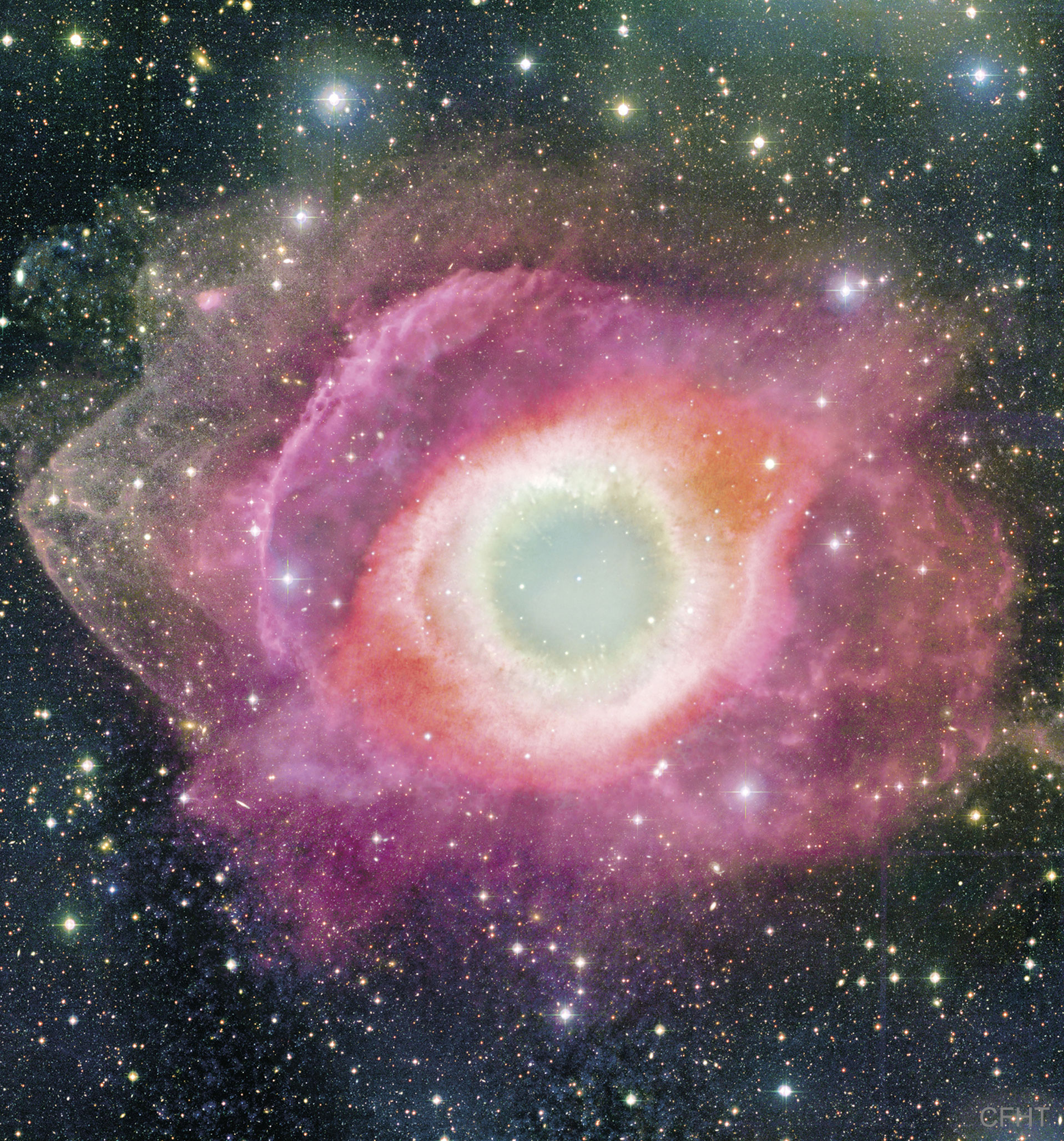
私たちの太陽もいつかこんな風になるのでしょうか? ヘリックス星雲は、太陽のような恒星の生涯の終わりに形成されるガス雲である惑星状星雲の中でも、最も明るく、地球に最も近い例の一つです。恒星の外層ガスが宇宙空間に放出されると、地球から見るとまるで螺旋を見下ろしているように見えます。白色矮星になる運命にある中心の恒星核は、非常に強い光を放ち、放出されたガスを蛍光発光させます。NGC 7293という技術的な名称が付けられたヘリックス星雲は、水瓶座(みずがめ座)の方向に約700光年離れたところに位置し、直径は約2.5光年です。掲載されている写真は、アメリカ合衆国ハワイ州の休火山の頂上にあるカナダ・フランス・ハワイ望遠鏡(CFHT)で撮影されました。らせん星雲の内縁部のクローズアップ画像には、起源不明の複雑なガスの塊が写っている。
原文(English)
Will our Sun look like this one day? The Helix Nebula is one of brightest and closest examples of a planetary nebula, a gas cloud created at the end of the life of a Sun-like star. The outer gasses of the star expelled into space appear from our vantage point as if we are looking down a helix. The remnant central stellar core, destined to become a white dwarf star, glows in light so energetic it causes the previously expelled gas to fluoresce. The Helix Nebula, given a technical designation of NGC 7293, lies about 700 light-years away towards the constellation of the Water Bearer (Aquarius) and spans about 2.5 light-years. The featured picture was taken with the Canada-France-Hawaii Telescope (CFHT) located atop a dormant volcano in Hawaii, USA. A close-up of the inner edge of the Helix Nebula shows complex gas knots of unknown origin.
\ この感動を宇宙仲間にシェア /
宇宙をXでシェア
© NASA / APOD