
🚀 宇宙の記憶・カレンダー検索
🚀 象徴的な写真:
APOD第1回
🚀 創造の柱
🚀 スピリット火星着陸
🚀 ハッブル超深宇宙
🚀 地球へようこそ|ブルー・マーブル
🚀 エンケラドス
🚀 ベテルギウス
🚀 火星着陸
🚀 青い夕焼け
🚀 冥王星のハート
🚀 皆既日食
🚀 アースライズ再構築
🚀 ブラックホール
🚀 ウェッブ初画像
🚀 アポロ11着陸
APOD30周年(2025年6月16日)
土星の北半球
Saturn's Northern Hexagon
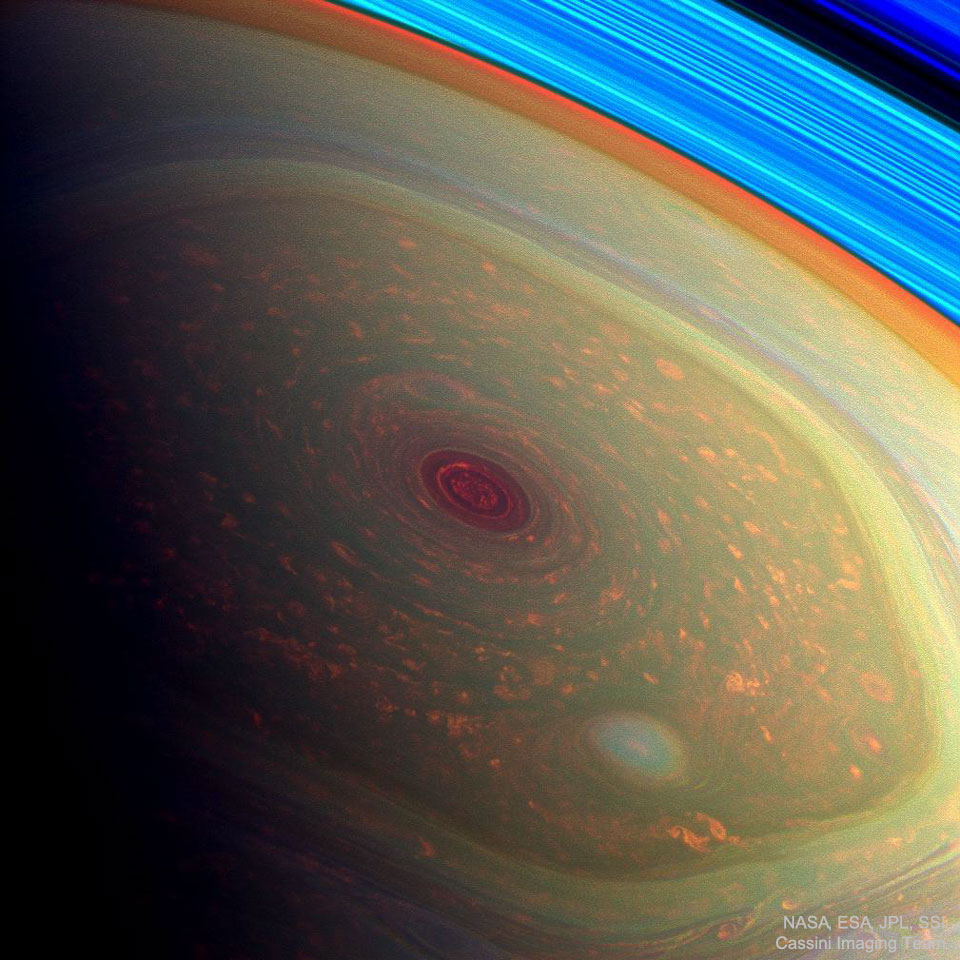
なぜ土星の雲は六角形になるのか?誰も確信を持っていません。1980年代のボイジャー探査機による土星フライバイで初めて発見されましたが、太陽系の他の場所でこれに似たものを見た人は誰もいません。2012年後半に土星の北極の太陽光を初めて捉えたカッシーニ探査機の広角カメラは、この環を持つ惑星の北極のこの見事な擬似カラー画像を記録しました。近赤外線画像データの合成により、低い雲は赤、高い雲は緑になり、土星の雲の風景が鮮やかに見えます。この画像や同様の画像は、ボイジャーから20年以上経っても六角形の安定性を示しています。土星の北極の動画は、回転しながら雲の構造が六角形構造を維持していることを示しています。地球上の個々の雲が六角形のように見えるのとは異なり、土星の雲のパターンは、ほぼ同じ長さの6つの明確な辺を持っているように見えます。六角形の中には地球が4つ収まります。右上の雲頂の向こうには、惑星の目を引く環の弧が鮮やかな青色に染まっている。
原文(English)
Why would clouds form a hexagon on Saturn? Nobody is sure. Originally discovered during the Voyager flybys of Saturn in the 1980s, nobody has ever seen anything like it anywhere else in the Solar System. Acquiring its first sunlit views of far northern Saturn in late 2012, the Cassini spacecraft's wide-angle camera recorded this stunning, false-color image of the ringed planet's north pole. The composite of near-infrared image data results in red hues for low clouds and green for high ones, giving the Saturnian cloudscape a vivid appearance. This and similar images show the stability of the hexagon even 20+ years after Voyager. Movies of Saturn's North Pole show the cloud structure maintaining its hexagonal structure while rotating. Unlike individual clouds appearing like a hexagon on Earth, the Saturn cloud pattern appears to have six well defined sides of nearly equal length. Four Earths could fit inside the hexagon. Beyond the cloud tops at the upper right, arcs of the planet's eye-catching rings are tinted bright blue.
\ この感動を宇宙仲間にシェア /
宇宙をXでシェア
© NASA,
ESA,
JPL,
SSI,
Cassini Imaging Team / APOD