
🚀 宇宙の記憶・カレンダー検索
🚀 象徴的な写真:
APOD第1回
🚀 創造の柱
🚀 スピリット火星着陸
🚀 ハッブル超深宇宙
🚀 地球へようこそ|ブルー・マーブル
🚀 エンケラドス
🚀 ベテルギウス
🚀 火星着陸
🚀 青い夕焼け
🚀 冥王星のハート
🚀 皆既日食
🚀 アースライズ再構築
🚀 ブラックホール
🚀 ウェッブ初画像
🚀 アポロ11着陸
APOD30周年(2025年6月16日)
みなみの冠座に広がる星と塵
Stars and Dust across Corona Australis
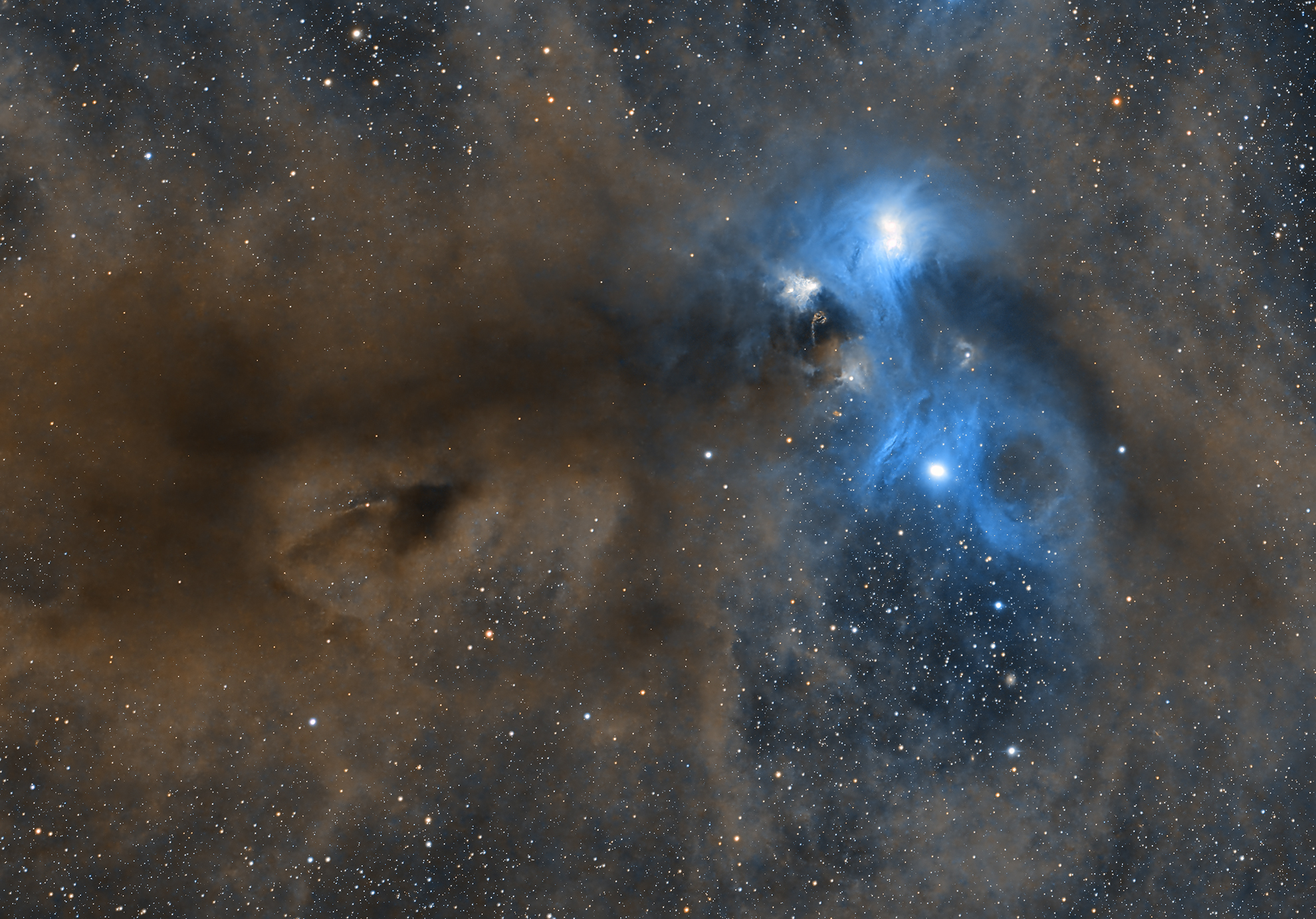
南冠座の北端付近にあるこの望遠鏡の眺めでは、宇宙塵の雲が星々の豊かな領域を横切っています。広大な分子雲複合体の一部であるこの星形成領域は、わずか500光年しか離れていません。これは、より有名なオリオン星雲として知られる星形成領域の約3分の1の距離です。2度幅のフレームは、雲の推定距離で15光年をカバーします。明るい星雲と混ざり合った塵の雲は、天の川のより遠い背景の星からの光を効果的に遮断し、まだ形成過程にある埋め込まれた星を視界から隠しています。左側には大きな暗黒星雲Bernes 157があります。その右側には、NGC 6726、6727、6729、IC 4812としてカタログ化されている美しい反射星雲のグループがあります。これらの特徴的な青色は、高温の星からの光が宇宙塵によって反射されることによって生じます。よりコンパクトなNGC 6729は、若い変光星Rコロナエ・アウストラリスを取り囲んでいる。そのすぐ下には、エネルギーの高い生まれたばかりの星に関連するハービッグ・ハロー天体として識別される、フィラメント状の弧とループが見られる。実際、この領域の中心には、最も近く、最も活発な星形成領域の一つであるコロナエ星団が存在する。
原文(English)
Cosmic dust clouds cross a rich field of stars in this telescopic vista near the northern boundary of Corona Australis, the Southern Crown. Part of a sprawling molecular cloud complex this star forming region is a mere 500 light-years away. That's about one third the distance of the more famous stellar nursery known as the Orion Nebula. The 2 degree wide frame would span 15 light-years at the clouds' estimated distance. Mixed with bright nebulosities the dust clouds effectively block light from more distant background stars in the Milky Way and obscure from view embedded stars still in the process of formation. Large dark nebula Bernes 157 is on the left. To its right are a group of pretty reflection nebulae cataloged as NGC 6726, 6727, 6729, and IC 4812. Their characteristic blue color is produced as light from hot stars is reflected by the cosmic dust. The more compact NGC 6729 surrounds young variable star R Coronae Australis. Just below it, filamentary arcs and loops are identified as Herbig Haro objects associated with energetic newborn stars. In fact, at the heart of this area lies the Coronet Cluster, one of the nearest and most active star forming regions.
\ この感動を宇宙仲間にシェア /
宇宙をXでシェア
© Alessandro Cipolat Bares / APOD