
🚀 宇宙の記憶・カレンダー検索
🚀 象徴的な写真:
APOD第1回
🚀 創造の柱
🚀 スピリット火星着陸
🚀 ハッブル超深宇宙
🚀 地球へようこそ|ブルー・マーブル
🚀 エンケラドス
🚀 ベテルギウス
🚀 火星着陸
🚀 青い夕焼け
🚀 冥王星のハート
🚀 皆既日食
🚀 アースライズ再構築
🚀 ブラックホール
🚀 ウェッブ初画像
🚀 アポロ11着陸
APOD30周年(2025年6月16日)
活発な太陽の黒点
Sunspots on an Active Sun
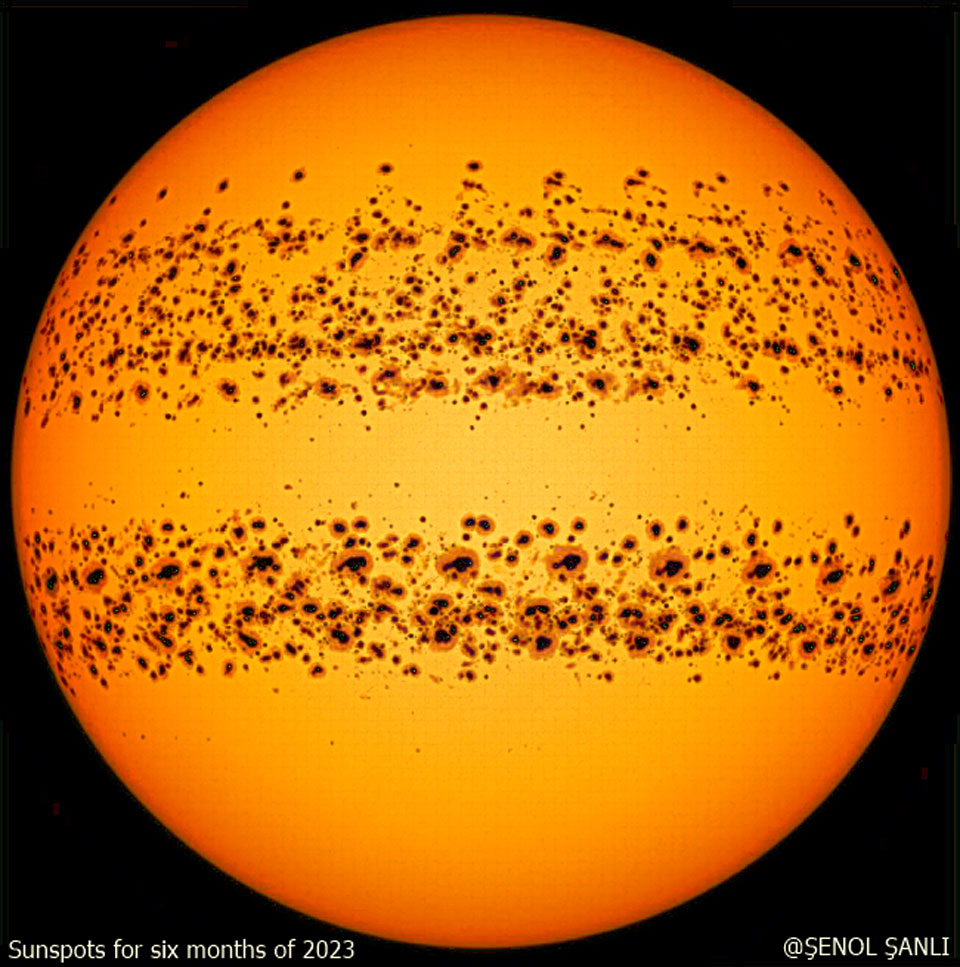
なぜ今、太陽はこんなに活発なのでしょうか?誰も確信を持っていません。太陽が2025年に極大期を迎えるため、表面活動の増加は予想されていました。しかし、先月、太陽は過去11年間の太陽活動周期全体、さらには2002年まで遡っても、どの月よりも多くの黒点を発生させました。掲載されている画像は、NASAの太陽力学観測衛星が1月から6月まで毎日撮影した画像を合成したものです。黒点が非常に多く、大きな個々の黒点が太陽の円盤を左から右へ約2週間にわたって追跡できます。太陽活動周期が続くにつれて、黒点は通常、赤道付近に現れます。黒点は、太陽が表面活動を示す方法の1つにすぎません。もう1つは、フレアやコロナ質量放出(CME)で、これらは粒子を太陽系に放出します。これらの粒子は宇宙飛行士や電子機器に影響を与える可能性があるため、表面の擾乱を追跡することは、単なる美的価値以上の意味を持ちます。逆に、太陽活動は地球の大気中でオーロラを引き起こすなど、非常に高い美的価値を持つこともある。
原文(English)
Why is our Sun so active now? No one is sure. An increase in surface activity was expected because our Sun is approaching solar maximum in 2025. However, last month our Sun sprouted more sunspots than in any month during the entire previous 11-year solar cycle -- and even dating back to 2002. The featured picture is a composite of images taken every day from January to June by NASA's Solar Dynamic Observatory. Showing a high abundance of sunspots, large individual spots can be tracked across the Sun's disk, left to right, over about two weeks. As a solar cycle continues, sunspots typically appear closer to the equator. Sunspots are just one way that our Sun displays surface activity -- another is flares and coronal mass ejections (CMEs) that expel particles out into the Solar System. Since these particles can affect astronauts and electronics, tracking surface disturbances is of more than aesthetic value. Conversely, solar activity can have very high aesthetic value -- in the Earth's atmosphere when they trigger aurora.
\ この感動を宇宙仲間にシェア /
宇宙をXでシェア
© NASA / APOD