
🚀 宇宙の記憶・カレンダー検索
🚀 象徴的な写真:
APOD第1回
🚀 創造の柱
🚀 スピリット火星着陸
🚀 ハッブル超深宇宙
🚀 地球へようこそ|ブルー・マーブル
🚀 エンケラドス
🚀 ベテルギウス
🚀 火星着陸
🚀 青い夕焼け
🚀 冥王星のハート
🚀 皆既日食
🚀 アースライズ再構築
🚀 ブラックホール
🚀 ウェッブ初画像
🚀 アポロ11着陸
APOD30周年(2025年6月16日)
スターCWレオニス周辺のシェルとアーク
Shells and Arcs around Star CW Leonis
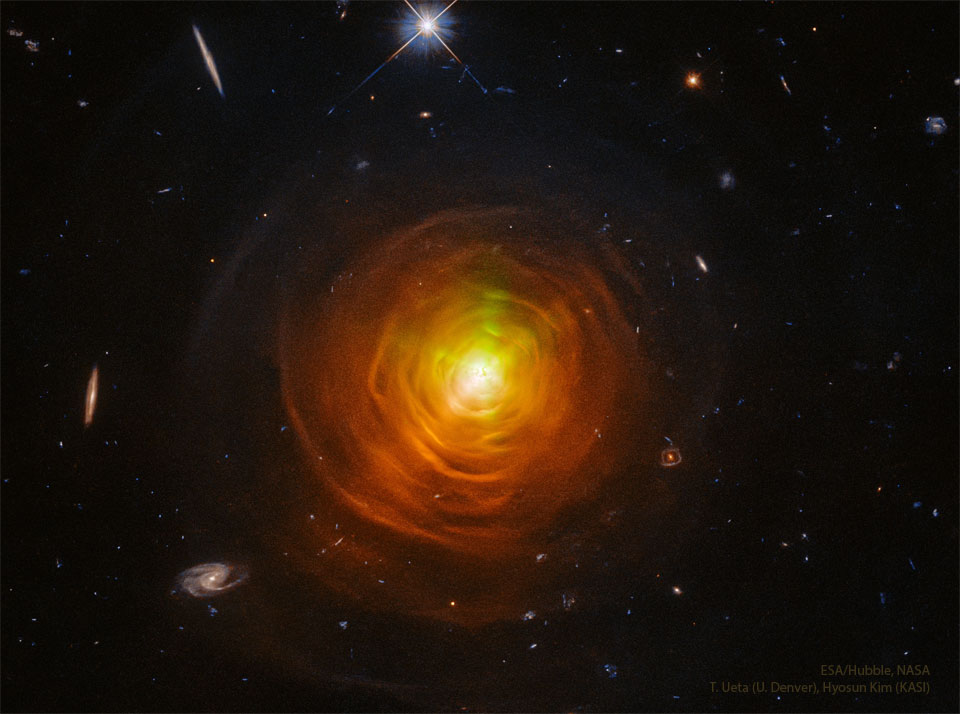
この星の周りでは何が起こっているのでしょうか?誰も確信していません。CW Leonisは最も近い炭素星で、内部の核融合によって大気中の炭素が放出されるためオレンジ色に見えます。しかし、CW Leonisはガス状の炭素に富む星雲に包まれているようにも見えます。星雲の複雑さの原因は不明ですが、その殻状や弧状の幾何学的構造は確かに興味深いものです。ハッブル宇宙望遠鏡による特集画像は、この複雑さを詳細に示しています。炭素星の表面重力が低いため、炭素や炭素化合物を宇宙空間に放出する能力が高まります。この炭素の一部は、若い星形成領域の星雲や銀河の円盤でよく見られる暗い塵を形成します。人間や地球上のすべての生命は炭素を基盤としており、私たちの炭素の少なくとも一部は、かつて炭素星のような死にかけの星の大気中を循環していたと考えられます。
原文(English)
What's happening around this star? No one is sure. CW Leonis is the closest carbon star, a star that appears orange because of atmospheric carbon dispersed from interior nuclear fusion. But CW Leonis also appears engulfed in a gaseous carbon-rich nebula. What causes the nebula's complexity is unknown, but its geometry of shells and arcs are surely intriguing. The featured image by the Hubble Space Telescope details this complexity. The low surface gravity of carbon stars enhances their ability to expel carbon and carbon compounds into space. Some of this carbon ends up forming dark dust that is commonly seen in the nebulas of young star-forming regions and the disks of galaxies. Humans and all Earth-based life are carbon-based, and at least some of our carbon was likely once circulating in the atmospheres of near-death stars like carbon stars.
\ この感動を宇宙仲間にシェア /
宇宙をXでシェア
© NASA / APOD