
🚀 宇宙の記憶・カレンダー検索
🚀 象徴的な写真:
APOD第1回
🚀 創造の柱
🚀 スピリット火星着陸
🚀 ハッブル超深宇宙
🚀 地球へようこそ|ブルー・マーブル
🚀 エンケラドス
🚀 ベテルギウス
🚀 火星着陸
🚀 青い夕焼け
🚀 冥王星のハート
🚀 皆既日食
🚀 アースライズ再構築
🚀 ブラックホール
🚀 ウェッブ初画像
🚀 アポロ11着陸
APOD30周年(2025年6月16日)
流星群:ペルセウス座流星群
Meteor Shower: Perseids from Perseus
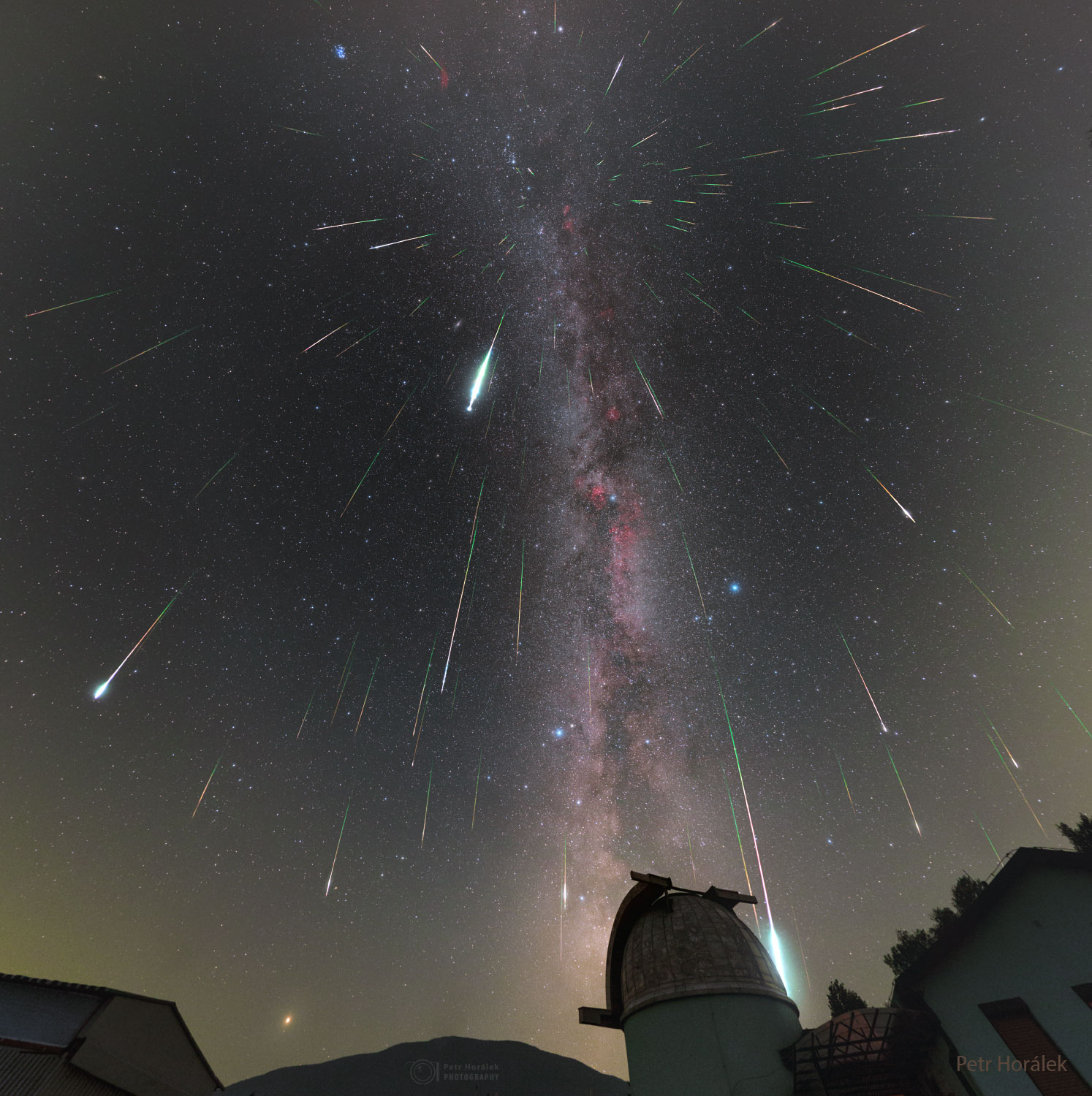
今週は流星を見るのに絶好の週です。彗星の塵が地球に降り注ぎ、毎年恒例のペルセウス座流星群のピーク時には暗い夜空を横切るでしょう。掲載されている合成画像は、2018年のペルセウス座流星群の際にスロバキアのポロニニ・ダークスカイパークで撮影されたものです。手前に写っている天文台のドームは、コロニツァ天文台の敷地内にあります。彗星の塵の粒子は互いに平行に進みますが、結果として生じる流星群は、ペルセウス座の星座の空の一点から放射状に広がっているように見えます。この放射状の効果は遠近法によるもので、平行な軌道が遠くで列車の線路のように収束しているように見えるためです。ペルセウス座流星群は土曜日の深夜過ぎにピークを迎えると予想されています。その夜は三日月がかなり遅く昇るため、雲のない空は通常よりも暗くなり、今年は多くの淡い流星が見られる可能性があります。
原文(English)
This is a good week to see meteors. Comet dust will rain down on planet Earth, streaking through dark skies during peak nights of the annual Perseid Meteor Shower. The featured composite image was taken during the 2018 Perseids from the Poloniny Dark Sky Park in Slovakia. The dome of the observatory in the foreground is on the grounds of Kolonica Observatory. Although the comet dust particles travel parallel to each other, the resulting shower meteors clearly seem to radiate from a single point on the sky in the eponymous constellation Perseus. The radiant effect is due to perspective, as the parallel tracks appear to converge at a distance, like train tracks. The Perseid Meteor Shower is expected to reach its highest peak on Saturday after midnight. Since a crescent Moon will rise only very late that night, cloudless skies will be darker than usual, making a high number of faint meteors potentially visible this year.
\ この感動を宇宙仲間にシェア /
宇宙をXでシェア
© Petr Horálek /
Institute of Physics in Opava / APOD