
🚀 宇宙の記憶・カレンダー検索
🚀 象徴的な写真:
APOD第1回
🚀 創造の柱
🚀 スピリット火星着陸
🚀 ハッブル超深宇宙
🚀 地球へようこそ|ブルー・マーブル
🚀 エンケラドス
🚀 ベテルギウス
🚀 火星着陸
🚀 青い夕焼け
🚀 冥王星のハート
🚀 皆既日食
🚀 アースライズ再構築
🚀 ブラックホール
🚀 ウェッブ初画像
🚀 アポロ11着陸
APOD30周年(2025年6月16日)
翻訳エラー: Exception: 1 日にサービス translate を実行した回数が多すぎます。
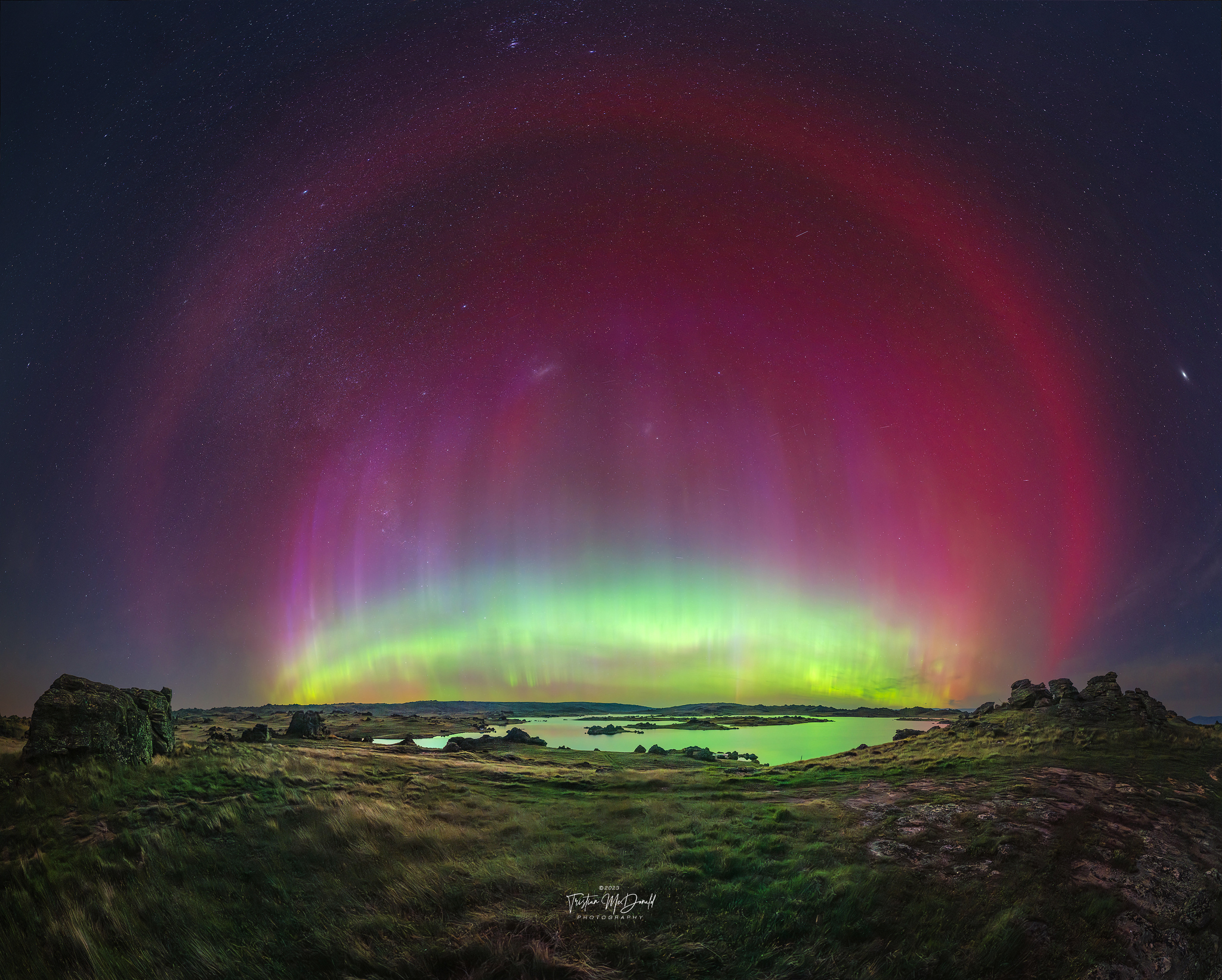
A SAR Arc from New Zealand
翻訳エラー: Exception: 1 日にサービス translate を実行した回数が多すぎます。
原文(English)
What is that unusual red halo surrounding this aurora? It is a Stable Auroral Red (SAR) arc. SAR arcs are rare and have only been acknowledged and studied since 1954. The featured wide-angle photograph, capturing nearly an entire SAR arc surrounding more common green and red aurora, was taken earlier this month from Poolburn, New Zealand, during an especially energetic geomagnetic storm. Why SAR arcs form remains a topic of research, but is likely related to Earth's protective magnetic field, a field created by molten iron flowing deep inside the Earth. This magnetic field usually redirects incoming charged particles from the Sun's wind toward the Earth's poles. However, it also traps a ring of ions closer to the equator, where they can gain energy from the magnetosphere during high solar activity. The energetic electrons in this ion ring can collide with and excite oxygen higher in Earth's ionosphere than typical auroras, causing the oxygen to glow red. Ongoing research has uncovered evidence that a red SAR arc can even transform into a purple and green STEVE.
\ この感動を宇宙仲間にシェア /
宇宙をXでシェア
©
Tristian McDonald;
Text: Tiffany Lewis
(Michigan Tech U.)
/ APOD