
🚀 宇宙の記憶・カレンダー検索
🚀 象徴的な写真:
APOD第1回
🚀 創造の柱
🚀 スピリット火星着陸
🚀 ハッブル超深宇宙
🚀 地球へようこそ|ブルー・マーブル
🚀 エンケラドス
🚀 ベテルギウス
🚀 火星着陸
🚀 青い夕焼け
🚀 冥王星のハート
🚀 皆既日食
🚀 アースライズ再構築
🚀 ブラックホール
🚀 ウェッブ初画像
🚀 アポロ11着陸
APOD30周年(2025年6月16日)
翻訳エラー: Exception: 1 日にサービス translate を実行した回数が多すぎます。
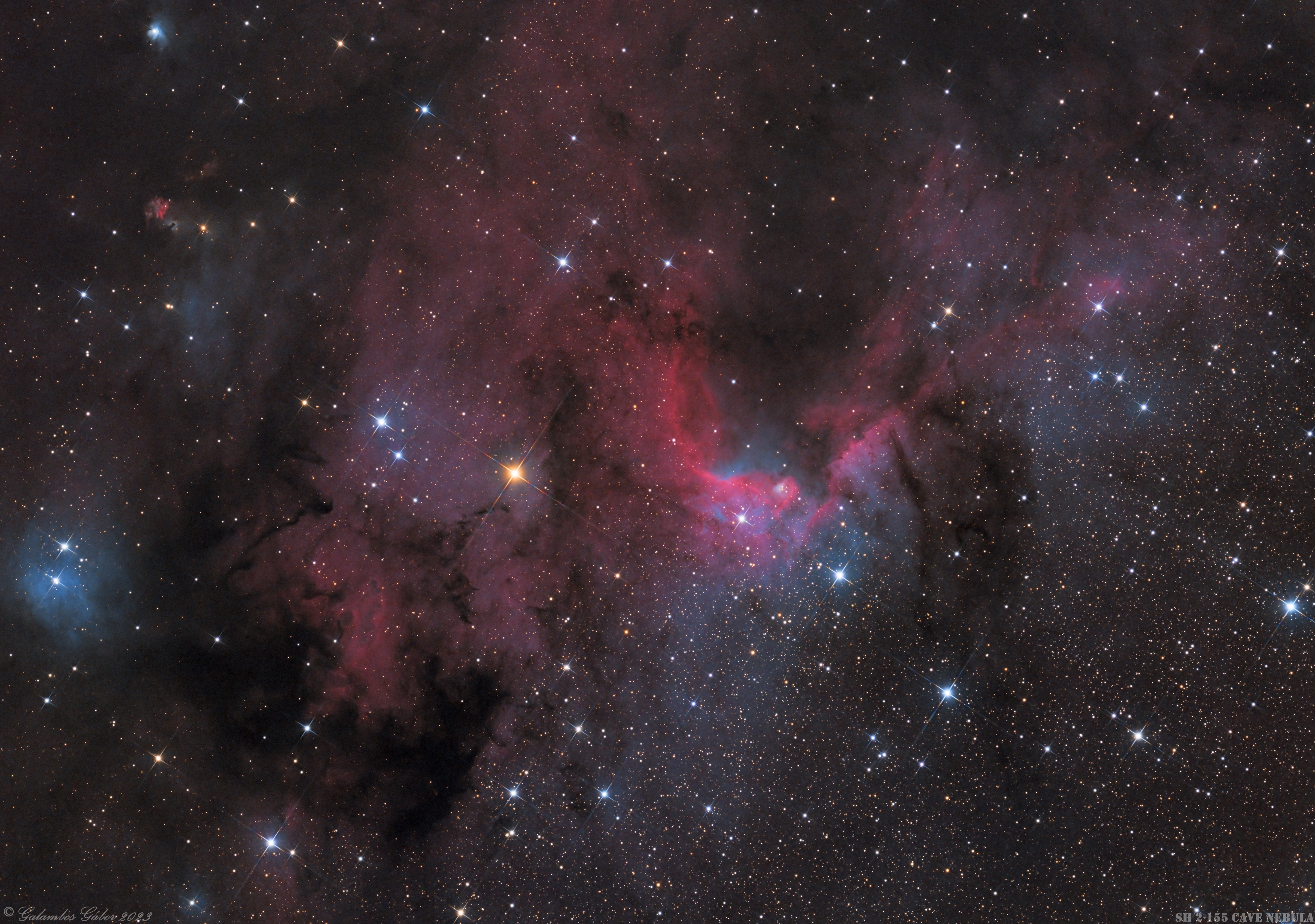
The Light, the Dark, and the Dusty
翻訳エラー: Exception: 1 日にサービス translate を実行した回数が多すぎます。
原文(English)
This colorful skyscape spans about three full moons across nebula rich starfields along the plane of our Milky Way Galaxy toward the royal northern constellation Cepheus. Near the edge of the region's massive molecular cloud some 2,400 light-years away, bright reddish emission region Sharpless (Sh)2-155 is at the center of the frame, also known as the Cave Nebula. About 10 light-years across the cosmic cave's bright walls of gas are ionized by ultraviolet light from the hot young stars around it. Dusty bluish reflection nebulae, like vdB 155 at the left, and dense obscuring clouds of dust also abound on the interstellar canvas. Astronomical explorations have revealed other dramatic signs of star formation, including the bright reddish fleck of Herbig-Haro (HH) 168. At the upper left in the frame, the Herbig-Haro object emission is generated by energetic jets from a newborn star.
\ この感動を宇宙仲間にシェア /
宇宙をXでシェア
© Gábor Galambos / APOD