
🚀 宇宙の記憶・カレンダー検索
🚀 象徴的な写真:
APOD第1回
🚀 創造の柱
🚀 スピリット火星着陸
🚀 ハッブル超深宇宙
🚀 地球へようこそ|ブルー・マーブル
🚀 エンケラドス
🚀 ベテルギウス
🚀 火星着陸
🚀 青い夕焼け
🚀 冥王星のハート
🚀 皆既日食
🚀 アースライズ再構築
🚀 ブラックホール
🚀 ウェッブ初画像
🚀 アポロ11着陸
APOD30周年(2025年6月16日)
翻訳エラー: Exception: 1 日にサービス translate を実行した回数が多すぎます。
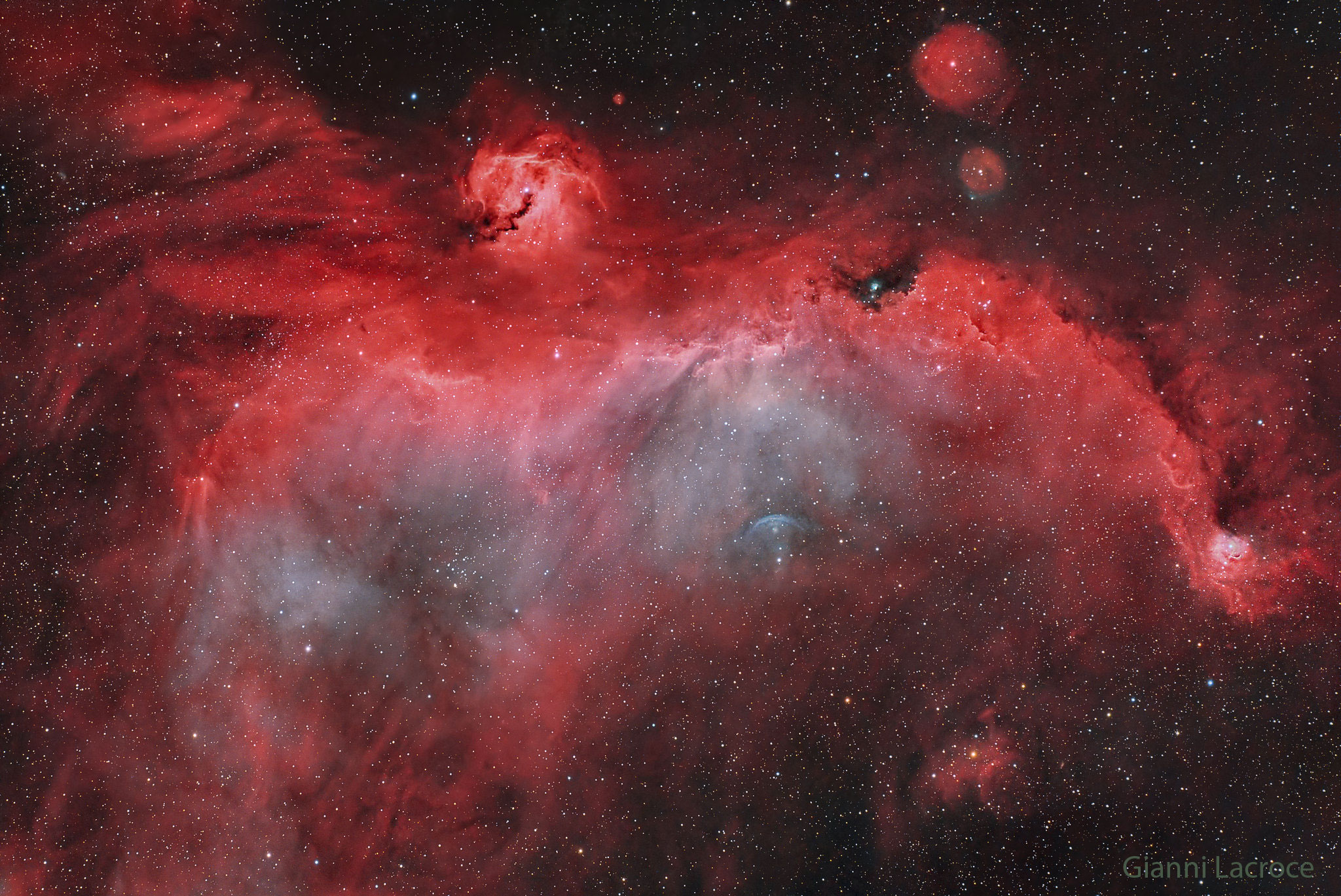
The Seagull Nebula
翻訳エラー: Exception: 1 日にサービス translate を実行した回数が多すぎます。
原文(English)
A broad expanse of glowing gas and dust presents a bird-like visage to astronomers from planet Earth, suggesting its popular moniker: the Seagull Nebula. This portrait of the cosmic bird covers a 2.5-degree wide swath across the plane of the Milky Way, near the direction of Sirius, alpha star of the constellation of the Big Dog (Canis Major). Of course, the region includes objects with other catalog designations: notably NGC 2327, a compact, dusty emission and reflection nebula with an embedded massive star that forms the bird's head. Likely part of a larger shell structure swept up by successive supernova explosions, the broad Seagull Nebula is cataloged as Sh2-296 and IC 2177. The prominent bluish arc below and right of center is a bow shock from runaway star FN Canis Majoris. Dominated by the reddish glow of atomic hydrogen, this complex of gas and dust clouds with other stars of the Canis Majoris OB1 association spans over 200 light-years at the Seagull Nebula's estimated 3,800 light-year distance. Almost Hyperspace: Random APOD Generator
\ この感動を宇宙仲間にシェア /
宇宙をXでシェア
©
Gianni Lacroce
/ APOD