
🚀 宇宙の記憶・カレンダー検索
🚀 象徴的な写真:
APOD第1回
🚀 創造の柱
🚀 スピリット火星着陸
🚀 ハッブル超深宇宙
🚀 地球へようこそ|ブルー・マーブル
🚀 エンケラドス
🚀 ベテルギウス
🚀 火星着陸
🚀 青い夕焼け
🚀 冥王星のハート
🚀 皆既日食
🚀 アースライズ再構築
🚀 ブラックホール
🚀 ウェッブ初画像
🚀 アポロ11着陸
APOD30周年(2025年6月16日)
太陽系外惑星WASP-43bの温度
Temperatures on Exoplanet WASP-43b
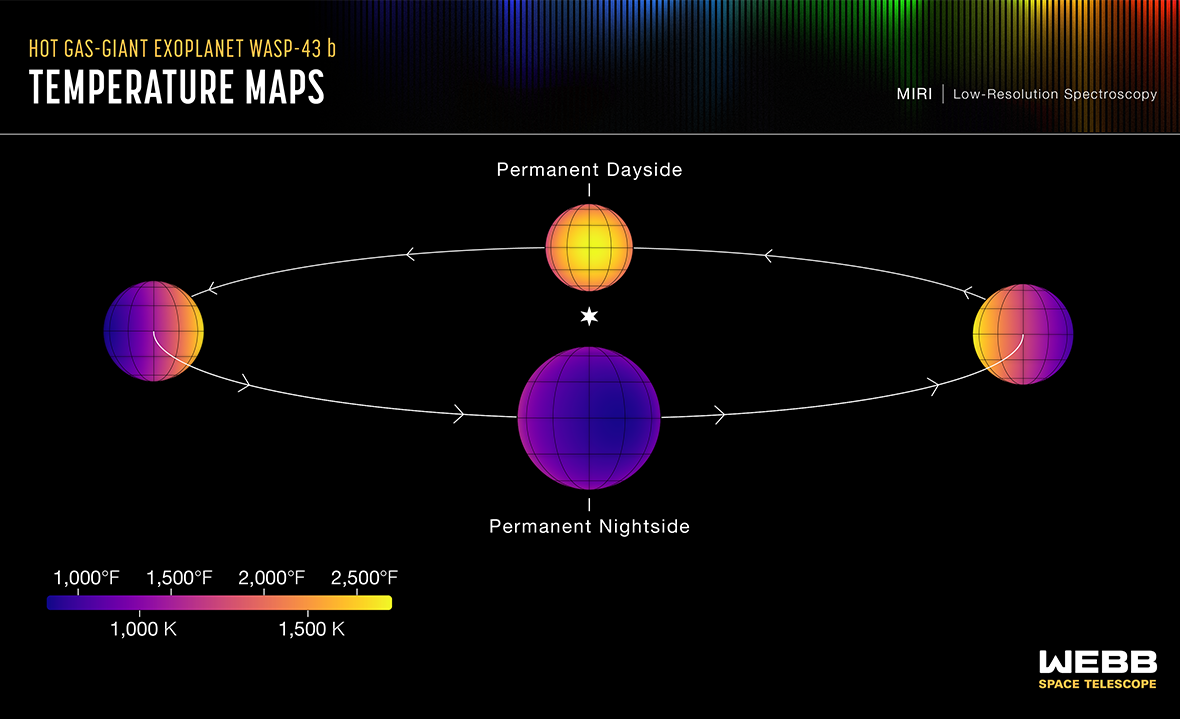
地球からわずか280光年離れた、潮汐固定された木星サイズの太陽系外惑星WASP-43bは、0.8地球日の周期で親星の周りを公転しています。これは、小さく冷たい太陽から約200万キロメートル(水星の軌道距離の25分の1未満)離れたことになります。それでも、常に親星に面している昼側の温度は、ジェイムズ・ウェッブ宇宙望遠鏡に搭載されたMIRI装置によって赤外線波長で測定された2,500度Fに達する猛烈な温度です。この高温の太陽系外惑星の軌道の図では、ウェッブの測定により夜側の温度が1,000度Fを超えていることも示されています。これは、昼側の大気ガスが完全に冷える前に、強い赤道風がそれを夜側に循環させていることを示唆しています。太陽系外惑星WASP-43bは現在正式にアストロラボスとして知られており、そのK型の親星はグノモンと名付けられました。ウェッブの赤外線スペクトルは、惑星の昼側だけでなく夜側にも水蒸気が存在することを示しており、アストロラボスの雲量に関する情報を提供しています。
原文(English)
A mere 280 light-years from Earth, tidally locked, Jupiter-sized exoplanet WASP-43b orbits its parent star once every 0.8 Earth days. That puts it about 2 million kilometers (less than 1/25th the orbital distance of Mercury) from a small, cool sun. Still, on a dayside always facing its parent star, temperatures approach a torrid 2,500 degrees F as measured at infrared wavelengths by the MIRI instrument on board the James Webb Space Telescope. In this illustration of the hot exoplanet's orbit, Webb measurements also show nightside temperatures remain above 1,000 degrees F. That suggests that strong equatorial winds circulate the dayside atmospheric gases to the nightside before they can completely cool off. Exoplanet WASP-43b is now formally known as Astrolábos, and its K-type parent star has been christened Gnomon. Webb's infrared spectra indicate water vapor is present on the nightside as well as the dayside of the planet, providing information about cloud cover on Astrolábos.
\ この感動を宇宙仲間にシェア /
宇宙をXでシェア
© NASA / APOD