
🚀 宇宙の記憶・カレンダー検索
🚀 象徴的な写真:
APOD第1回
🚀 創造の柱
🚀 スピリット火星着陸
🚀 ハッブル超深宇宙
🚀 地球へようこそ|ブルー・マーブル
🚀 エンケラドス
🚀 ベテルギウス
🚀 火星着陸
🚀 青い夕焼け
🚀 冥王星のハート
🚀 皆既日食
🚀 アースライズ再構築
🚀 ブラックホール
🚀 ウェッブ初画像
🚀 アポロ11着陸
APOD30周年(2025年6月16日)
球状星団 NGC 6752
Globular Star Cluster NGC 6752
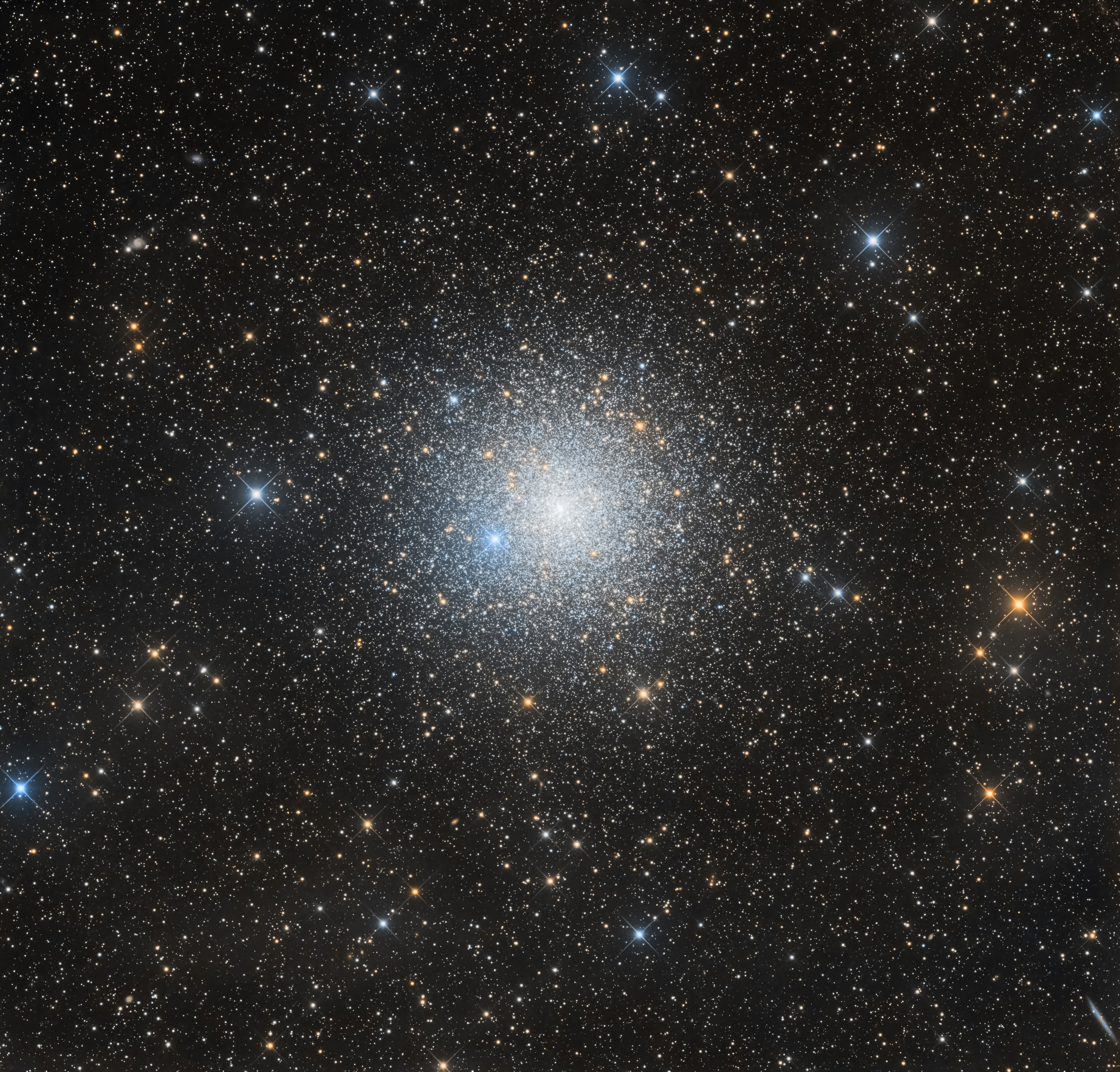
南天の星座であるパヴォ座の方向、約13,000光年離れたところに、球状星団NGC 6752が天の川銀河のハローを漂っています。100億年以上前に誕生したNGC 6752は、オメガ・ケンタウリ、47トゥカーナエ、メシエ22に次いで、地球の夜空で4番目に明るい球状星団です。直径約100光年の球状領域に10万個以上の星が集まっています。NGC 6752の望遠鏡による観測では、星団の中心付近の星のかなりの割合が多重星系であることが判明しました。また、ブルーストラグラーと呼ばれる星の存在も明らかになりました。ブルーストラグラーとは、星団の星々がすべて太陽の少なくとも2倍の年齢であると予想される中で、この星団に存在するには若すぎ、質量も大きすぎる星のことです。ブルーストラグラーは、星団の中心にある高密度の恒星環境における星の合体や衝突によって形成されたと考えられています。この鮮明なカラー合成画像には、星団の古代の赤色巨星が黄色がかった色合いで写し出されている。(注:星団の中心から8時方向にある明るく尖った青い星は、NGC 6752への視線上にある前景の星である。)
原文(English)
Some 13,000 light-years away toward the southern constellation Pavo, the globular star cluster NGC 6752 roams the halo of our Milky Way galaxy. Over 10 billion years old, NGC 6752 follows clusters Omega Centauri, 47 Tucanae, and Messier 22 as the fourth brightest globular in planet Earth's night sky. It holds over 100 thousand stars in a sphere about 100 light-years in diameter. Telescopic explorations of NGC 6752 have found that a remarkable fraction of the stars near the cluster's core are multiple star systems. They also reveal the presence of blue straggle stars, stars which appear to be too young and massive to exist in a cluster whose stars are all expected to be at least twice as old as the Sun. The blue stragglers are thought to be formed by star mergers and collisions in the dense stellar environment at the cluster's core. This sharp color composite also features the cluster's ancient red giant stars in yellowish hues. (Note: The bright, spiky blue star about 8 o'clock from the cluster center is a foreground star along the line-of-sight to NGC 6752)
\ この感動を宇宙仲間にシェア /
宇宙をXでシェア
© Massimo Di Fusco / APOD