
🚀 宇宙の記憶・カレンダー検索
🚀 象徴的な写真:
APOD第1回
🚀 創造の柱
🚀 スピリット火星着陸
🚀 ハッブル超深宇宙
🚀 地球へようこそ|ブルー・マーブル
🚀 エンケラドス
🚀 ベテルギウス
🚀 火星着陸
🚀 青い夕焼け
🚀 冥王星のハート
🚀 皆既日食
🚀 アースライズ再構築
🚀 ブラックホール
🚀 ウェッブ初画像
🚀 アポロ11着陸
APOD30周年(2025年6月16日)
地元のくだらない話
The Local Fluff
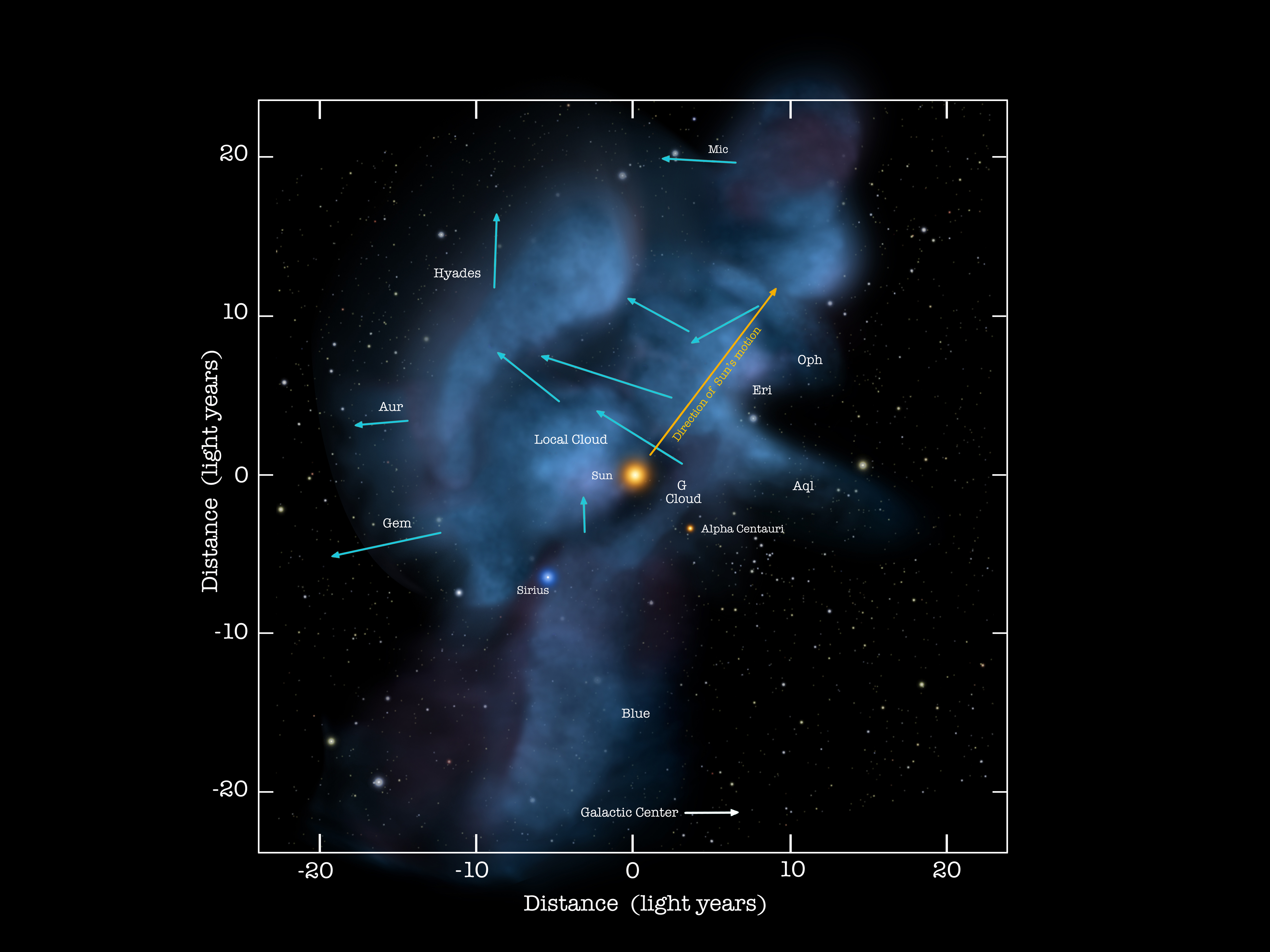
星は孤独ではありません。私たちの銀河の円盤では、可視物質の約10パーセントが星間物質(ISM)と呼ばれるガス状物質です。ISMは均一ではなく、太陽の近くでも斑点状になっています。ISMは非常に希薄で、光をほとんど発しないため、局所的なISMを検出するのは非常に困難です。しかし、この主に水素からなるガスは、最も近い星の光で検出できる特定の色を吸収します。地球周回軌道上の星間境界探査衛星(IBEX)による継続的な観測と粒子検出に基づいた、20光年以内の局所的なISMの作業マップがここに示されています。これらの観測は、私たちの太陽が局所的な星間雲の中を移動していることを示しており、この雲はさそり座・ケンタウルス座アソシエーションの星形成領域から外側に向かって流れています。私たちの太陽は、局所的な雲、または局所的なフラッフと呼ばれる雲から、今後1万年以内に抜け出す可能性があります。局所的な星間物質については、その分布、起源、太陽や地球への影響など、多くのことがまだ解明されていません。驚くべきことに、IBEX探査機の観測結果は、中性星間粒子が太陽系を通過する方向が変化していることを示しています。APOD年間レビュー:2024年ナイトスカイネットワークプレゼンテーション
原文(English)
The stars are not alone. In the disk of our Milky Way Galaxy, about 10 percent of visible matter is in the form of gas called the interstellar medium (ISM). The ISM is not uniform and shows patchiness even near our Sun. It can be quite difficult to detect the local ISM because it is so tenuous and emits so little light. This mostly hydrogen gas, however, absorbs some very specific colors that can be detected in the light of the nearest stars. A working map of the local ISM within 20 light-years, based on ongoing observations and particle detections from the Earth-orbiting Interstellar Boundary Explorer satellite (IBEX), is shown here. These observations indicate that our Sun is moving through a Local Interstellar Cloud as this cloud flows outwards from the Scorpius-Centaurus Association star forming region. Our Sun may exit the Local Cloud, also called the Local Fluff, during the next 10,000 years. Much remains unknown about the local ISM, including details of its distribution, its origin, and how it affects the Sun and the Earth. Unexpectedly, IBEX spacecraft measurements indicate that the direction from which neutral interstellar particles flow through our Solar System is changing. APOD Year in Review: Night Sky Network Presentation for 2024
\ この感動を宇宙仲間にシェア /
宇宙をXでシェア
© NASA / APOD