
🚀 宇宙の記憶・カレンダー検索
🚀 象徴的な写真:
APOD第1回
🚀 創造の柱
🚀 スピリット火星着陸
🚀 ハッブル超深宇宙
🚀 地球へようこそ|ブルー・マーブル
🚀 エンケラドス
🚀 ベテルギウス
🚀 火星着陸
🚀 青い夕焼け
🚀 冥王星のハート
🚀 皆既日食
🚀 アースライズ再構築
🚀 ブラックホール
🚀 ウェッブ初画像
🚀 アポロ11着陸
APOD30周年(2025年6月16日)
M27:ダンベル星雲
M27: The Dumbbell Nebula
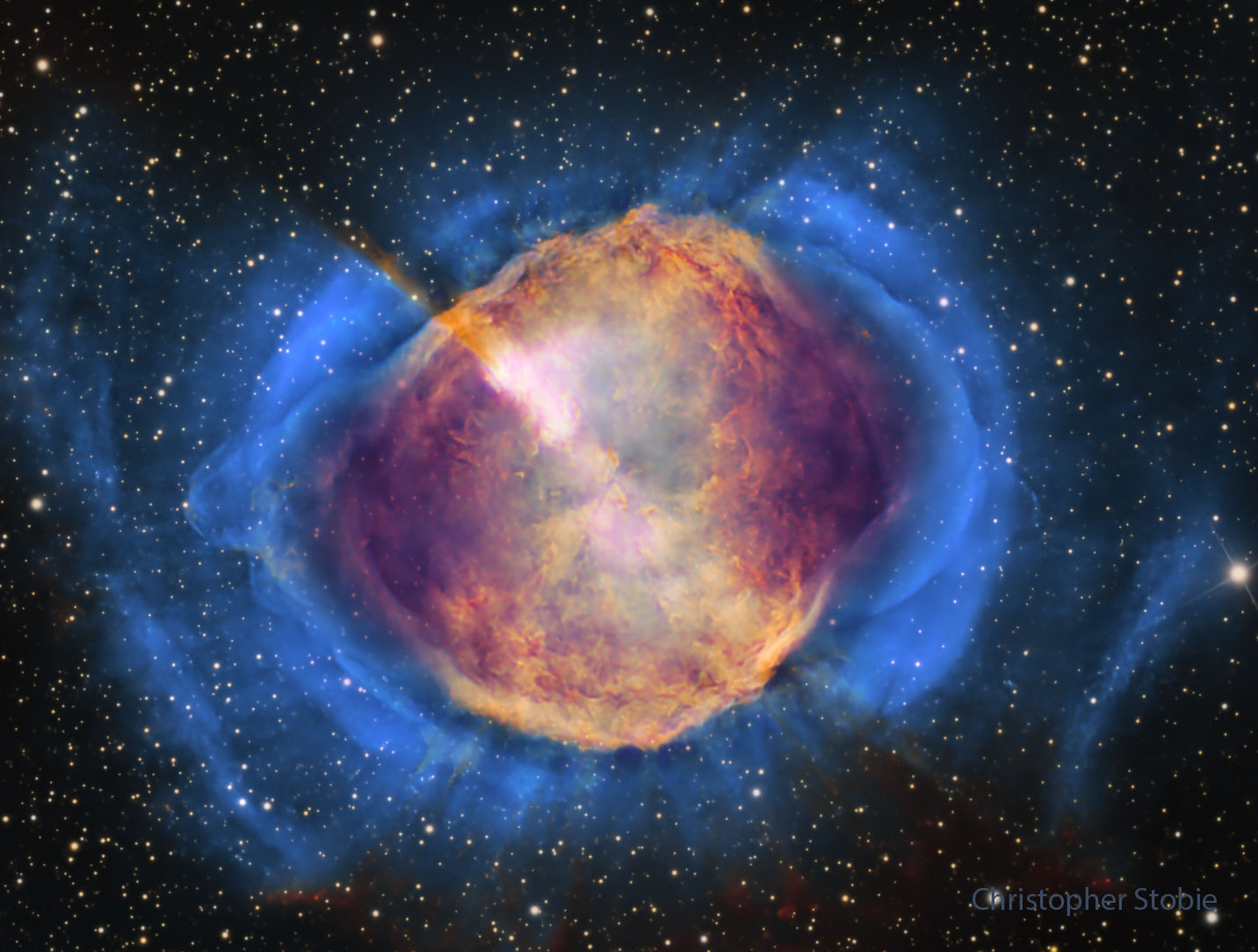
これが私たちの太陽の未来なのでしょうか? 十分にあり得る話です。太陽の未来を予見させる最初の兆候は、1764年に偶然発見されました。当時、シャルル・メシエは彗星と混同されないように、拡散天体のリストを作成していました。メシエのリストの27番目の天体は、現在M27またはダンベル星雲として知られており、惑星状星雲です。これは空で最も明るい惑星状星雲の1つで、双眼鏡で狐座(こぎつね座)の方向に見ることができます。M27から地球に光が届くまでには約1000年かかります。ここでは、硫黄(赤)、水素(緑)、酸素(青)が発する色で示されています。現在では、約60億年後には、太陽は外側のガスをM27のような惑星状星雲に放出し、残った中心部はX線を発する高温の白色矮星になることが分かっています。しかし、M27の物理学と意義を理解することは、18世紀の科学をはるかに超えていました。今日でも、惑星状星雲については、その複雑な形状がどのように形成されるかなど、多くのことが謎に包まれたままです。APOD年間レビュー:2024年ナイトスカイネットワークプレゼンテーション
原文(English)
Is this what will become of our Sun? Quite possibly. The first hint of our Sun's future was discovered inadvertently in 1764. At that time, Charles Messier was compiling a list of diffuse objects not to be confused with comets. The 27th object on Messier's list, now known as M27 or the Dumbbell Nebula, is a planetary nebula, one of the brightest planetary nebulas on the sky and visible with binoculars toward the constellation of the Fox (Vulpecula). It takes light about 1000 years to reach us from M27, featured here in colors emitted by sulfur (red), hydrogen (green) and oxygen (blue). We now know that in about 6 billion years, our Sun will shed its outer gases into a planetary nebula like M27, while its remaining center will become an X-ray hot white dwarf star. Understanding the physics and significance of M27 was well beyond 18th century science, though. Even today, many things remain mysterious about planetary nebulas, including how their intricate shapes are created. APOD Year in Review: Night Sky Network Presentation for 2024
\ この感動を宇宙仲間にシェア /
宇宙をXでシェア
© Christopher Stobie / APOD