
🚀 宇宙の記憶・カレンダー検索
🚀 象徴的な写真:
APOD第1回
🚀 創造の柱
🚀 スピリット火星着陸
🚀 ハッブル超深宇宙
🚀 地球へようこそ|ブルー・マーブル
🚀 エンケラドス
🚀 ベテルギウス
🚀 火星着陸
🚀 青い夕焼け
🚀 冥王星のハート
🚀 皆既日食
🚀 アースライズ再構築
🚀 ブラックホール
🚀 ウェッブ初画像
🚀 アポロ11着陸
APOD30周年(2025年6月16日)
マウナケア山頂の天の川
Milky Way over Maunakea
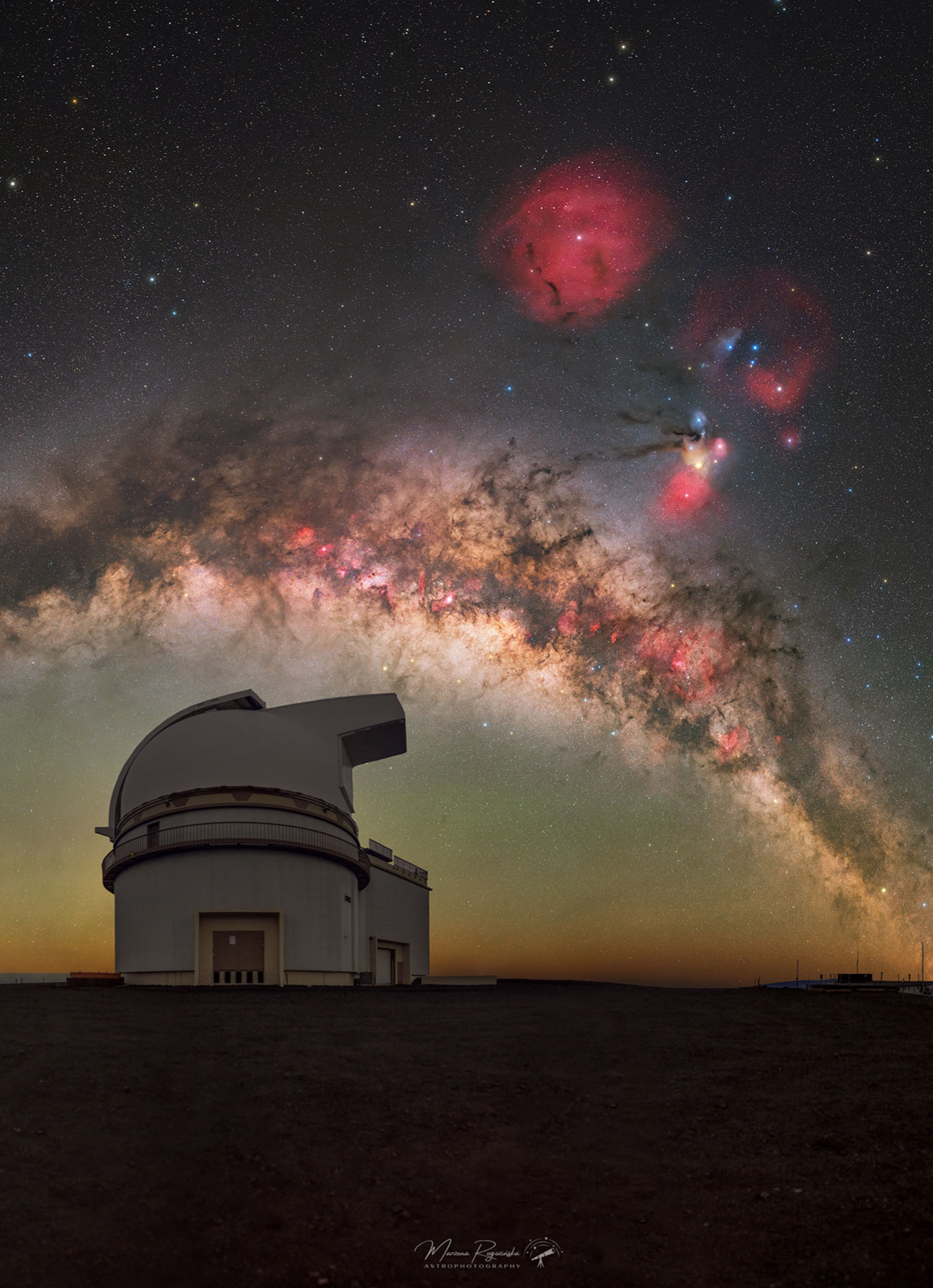
天の川銀河の帯を見たことがありますか?晴れた夜空に、暗い場所で適切な時間に観測すると、かすかな光の帯が空を横切って見えるようになります。目が暗順応するとすぐに、初めてその帯に気づくかもしれません。そして、次第にはっきりと見え、壮観な光景となるでしょう。驚きが増す理由の一つは、このぼんやりとした帯、天の川銀河に何十億もの星が含まれているという事実に気づくからかもしれません。掲載画像では、夜空高くに天の川銀河の帯が弧を描いています。右側には、色鮮やかなへびつかい座ρ星雲、中央上部付近には、赤く円形のへびつかい座ζ星雲も見えます。この画像は、2月下旬にアメリカ合衆国ハワイ州マウナケアで撮影されたもので、手前の望遠鏡はハワイ大学の2.2メートル望遠鏡です。幸いなことに、天の川を見るためにハワイの火山の頂上付近に行く必要はありません。すべてをまとめてみましょう:今日の天文学パズル
原文(English)
Have you ever seen the band of our Milky Way Galaxy? In a clear sky from a dark location at the right time, a faint band of light becomes visible across the sky. Soon after your eyes become dark adapted, you might spot the band for the first time. It may then become obvious. Then spectacular. One reason for your growing astonishment might be the realization that this fuzzy swath, the Milky Way, contains billions of stars. Visible in the featured image, high above in the night sky, the band of the Milky Way Galaxy arcs. Also visible are the colorful clouds of Rho Ophiuchi on the right, and the red and circular Zeta Ophiuchi nebula near the top center. Taken in late February from Maunakea, Hawaii, USA, the foreground telescope is the University of Hawaii's 2.2-Meter Telescope. Fortunately, you don’t need to be near the top of a Hawaiian volcano to see the Milky Way. Put it All Together: Astronomy Puzzle of the Day
\ この感動を宇宙仲間にシェア /
宇宙をXでシェア
© Marzena Rogozinska / APOD