
🚀 宇宙の記憶・カレンダー検索
🚀 象徴的な写真:
APOD第1回
🚀 創造の柱
🚀 スピリット火星着陸
🚀 ハッブル超深宇宙
🚀 地球へようこそ|ブルー・マーブル
🚀 エンケラドス
🚀 ベテルギウス
🚀 火星着陸
🚀 青い夕焼け
🚀 冥王星のハート
🚀 皆既日食
🚀 アースライズ再構築
🚀 ブラックホール
🚀 ウェッブ初画像
🚀 アポロ11着陸
APOD30周年(2025年6月16日)
ナノセイル-D2
NanoSail-D2
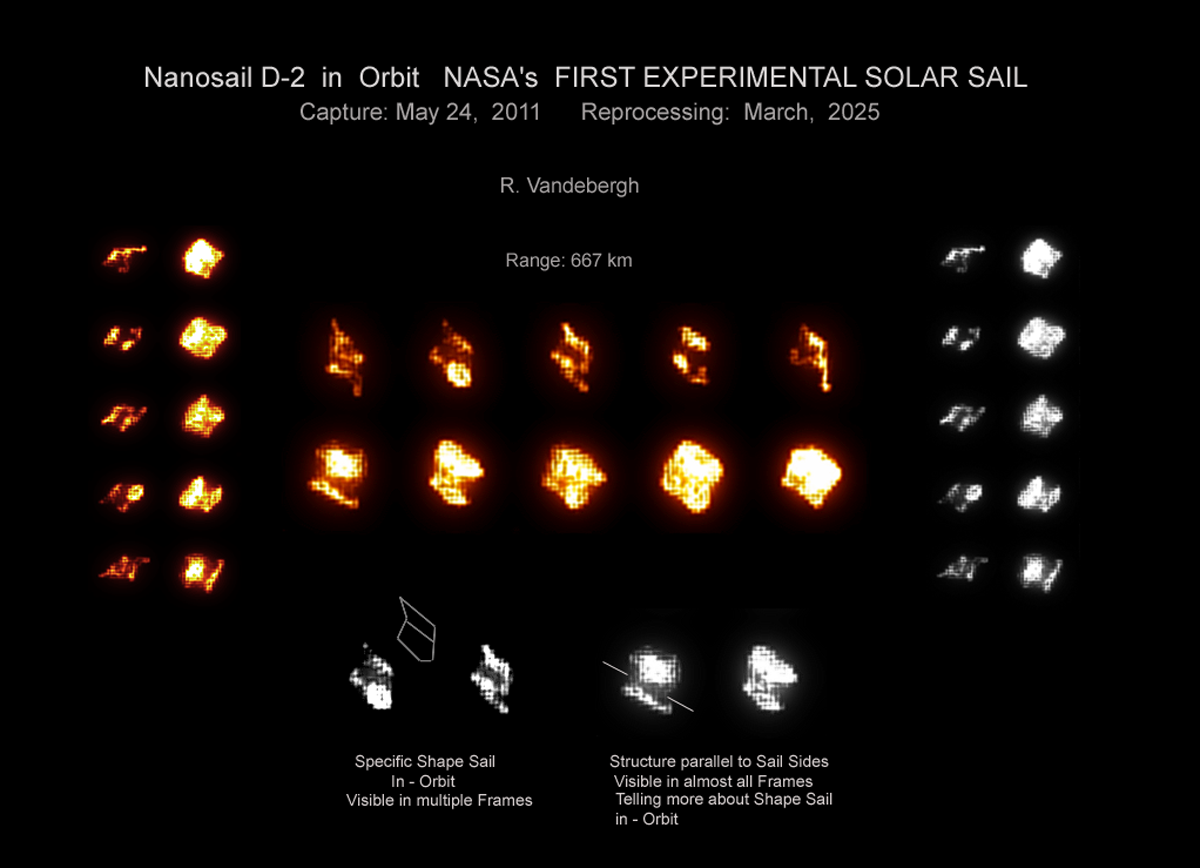
2011年1月20日、NASAのNanoSail-D2は、非常に薄く反射率の高い10平方メートルの帆を展開し、地球低軌道を周回する初のソーラーセイル宇宙船となった。宇宙を航行するという発想は、しばしばSFの世界の話とされてきたが、400年前に太陽風によって吹き飛ばされた彗星の尾を観測した天文学者ヨハネス・ケプラーによって提唱された。しかし、NanoSail-D2、日本の惑星間探査機IKAROS、惑星協会のLightsail Aといった現代のソーラーセイル宇宙船の設計は、推力として太陽光そのものからの小さくても継続的な圧力に依存している。地球を周回するNanoSail-D2のソーラーセイルは、太陽光にきらめき、周期的に明るく肉眼で見えるようになった。これらの驚くほど詳細な画像は、小型望遠鏡で軌道上のソーラーセイル宇宙船を手動で追跡することによって撮影された。
原文(English)
In 2011, on January 20, NASA's NanoSail-D2 unfurled a very thin and very reflective 10 square meter sail becoming the first solar sail spacecraft in low Earth orbit. Often considered the stuff of science fiction, sailing through space was suggested 400 years ago by astronomer Johannes Kepler, who had observed comet tails blown by the solar wind. But modern solar sail spacecraft designs, like NanoSail-D2, Japan's interplanetary spacecraft IKAROS, or the Planetary Society's Lightsail A, rely on the small but continuous pressure from sunlight itself for thrust. Glinting in the sunlight as it circled planet Earth, NanoSail-D2's solar sail was periodically bright and visible to the eye. These remarkably detailed images were captured by manually tracking the orbiting solar sail spacecraft with a small telescope.
\ この感動を宇宙仲間にシェア /
宇宙をXでシェア
© Ralf Vandebergh / APOD