
🚀 宇宙の記憶・カレンダー検索
🚀 象徴的な写真:
APOD第1回
🚀 創造の柱
🚀 スピリット火星着陸
🚀 ハッブル超深宇宙
🚀 地球へようこそ|ブルー・マーブル
🚀 エンケラドス
🚀 ベテルギウス
🚀 火星着陸
🚀 青い夕焼け
🚀 冥王星のハート
🚀 皆既日食
🚀 アースライズ再構築
🚀 ブラックホール
🚀 ウェッブ初画像
🚀 アポロ11着陸
APOD30周年(2025年6月16日)
M78:赤の海に映る青
M78: Reflecting Blue in a Sea of Red
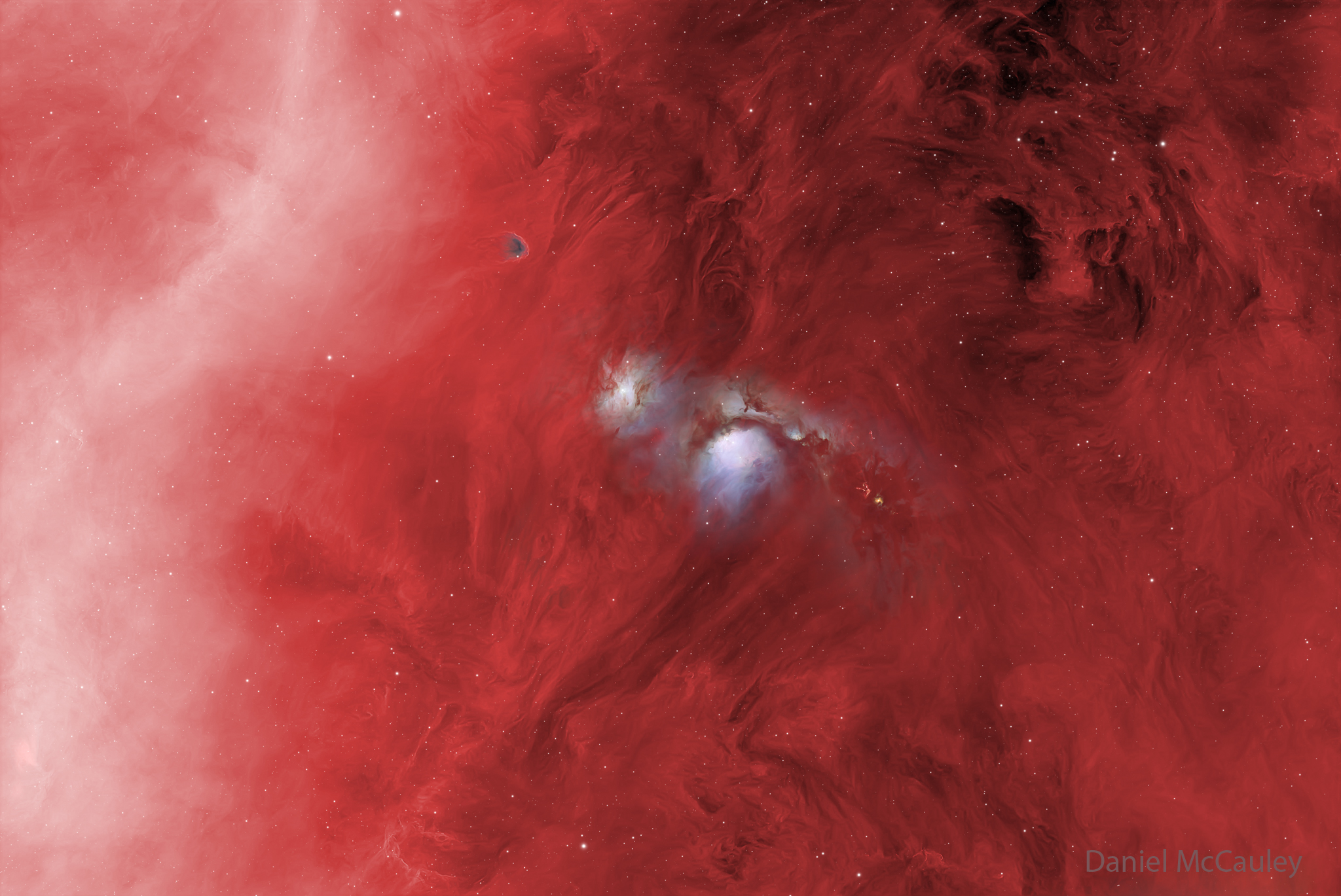
広大なオリオン分子雲複合体には、いくつかの明るい青い星雲が特に目立っています。中央に写っているのは、最も目立つ反射星雲のうちの2つです。反射星雲とは、明るい星々の光を反射してできた塵の雲のことです。より有名な星雲は、画像中央にあるM78で、200年以上前にカタログ化されました。その左上には、あまり知られていないNGC 2071があります。天文学者たちは、内部の星がどのように形成されるかをよりよく理解するために、これらの反射星雲の研究を続けています。全体的に赤く光っているのは、オリオン座の大部分を覆う拡散水素ガスによるものです。オリオン座複合体はオリオン座の大部分に広がっています。約1500光年離れたこのより大きな複合体の近くには、オリオン大星雲、馬頭星雲、バーナードループがあり、バーナードループは左上の白い帯として部分的に写っています。Almost Hyperspace: Random APOD Generator
原文(English)
In the vast Orion Molecular Cloud complex, several bright blue nebulas are particularly apparent. Pictured here in the center are two of the most prominent reflection nebulas - dust clouds lit by the reflecting light of bright embedded stars. The more famous nebula is M78, in the image center, cataloged over 200 years ago. To its upper left is the lesser known NGC 2071. Astronomers continue to study these reflection nebulas to better understand how interior stars form. The overall red glow is from diffuse hydrogen gas that covers much of the Orion complex that spans much of the constellation of Orion. Nearby in the greater complex, which lies about 1,500 light years away, are the Orion Nebula, the Horsehead Nebula, and Barnard's Loop -- partially seen here as the white band on the upper left. Almost Hyperspace: Random APOD Generator
\ この感動を宇宙仲間にシェア /
宇宙をXでシェア
© Daniel McCauley / APOD