
🚀 宇宙の記憶・カレンダー検索
🚀 象徴的な写真:
APOD第1回
🚀 創造の柱
🚀 スピリット火星着陸
🚀 ハッブル超深宇宙
🚀 地球へようこそ|ブルー・マーブル
🚀 エンケラドス
🚀 ベテルギウス
🚀 火星着陸
🚀 青い夕焼け
🚀 冥王星のハート
🚀 皆既日食
🚀 アースライズ再構築
🚀 ブラックホール
🚀 ウェッブ初画像
🚀 アポロ11着陸
APOD30周年(2025年6月16日)
渦巻銀河NGC 1512:広視野画像
Spiral Galaxy NGC 1512: Wide Field
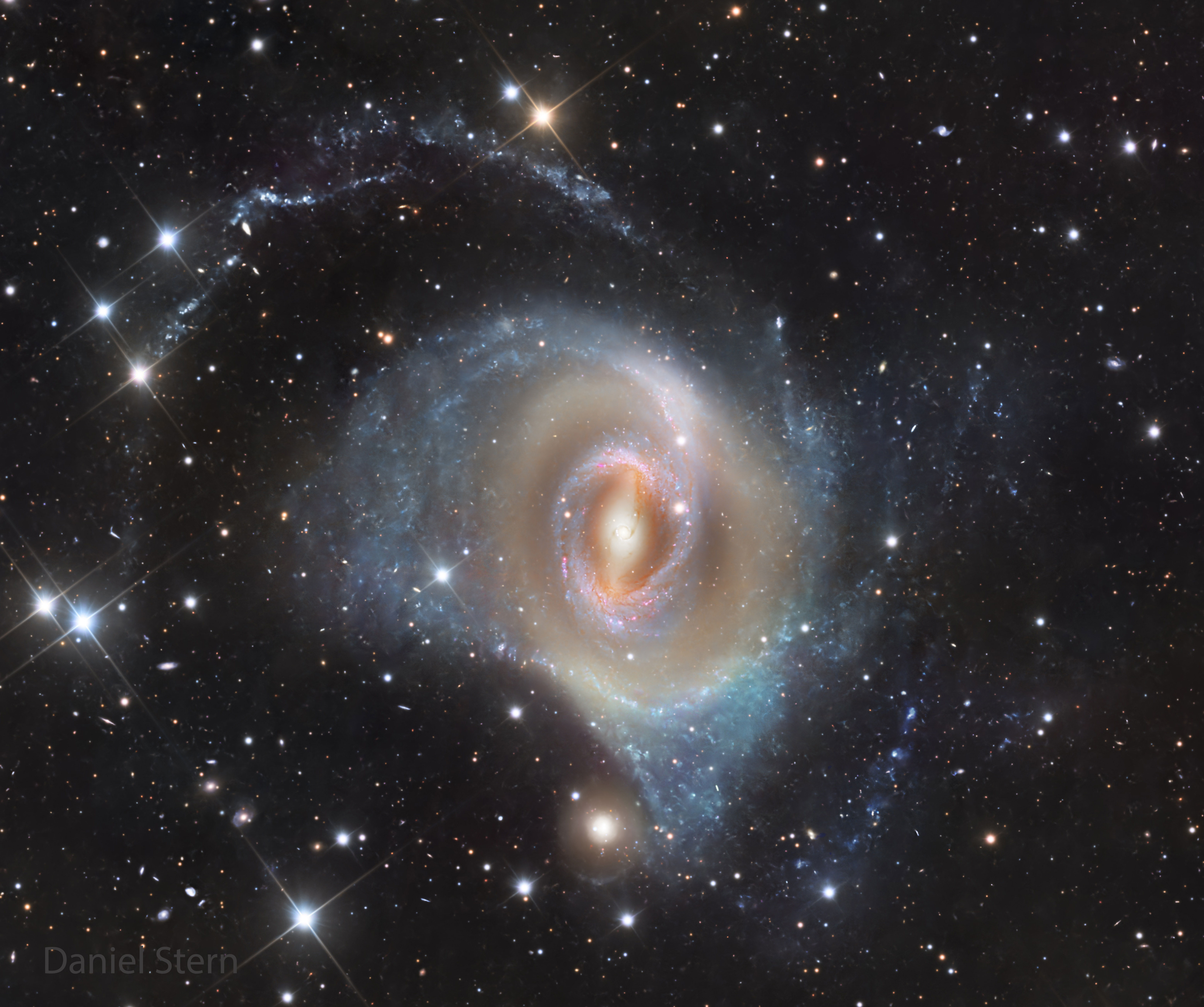
ほとんどの銀河にはリングがありませんが、なぜこの銀河には3つもあるのでしょうか?まず、NGC 1512の中心付近にあるリング(ここでは見えにくいですが)は、最近形成された星々で明るく輝く核リングです。次に、赤と青の両方に見える星と塵のリングがあり、直感に反してインナーリングと呼ばれています。このインナーリングは、銀河を水平に横切る拡散した中心棒の両端をつないでいます。この広視野画像で最も外側にあるのは、アウターリングと考えられるギザギザした構造です。このアウターリングは螺旋状に見え、明るい青い星の集団が点在しています。これらのリング構造はすべて、NGC 1512自身の重力非対称性によって、長期にわたる進化と呼ばれるプロセスを経て形成されたと考えられています。この画像は先月、チリのディープスカイチリにある望遠鏡で撮影されました。
原文(English)
Most galaxies don't have any rings -- why does this galaxy have three? To begin, a ring that's near NGC 1512's center -- and so hard to see here -- is the nuclear ring which glows brightly with recently formed stars. Next out is a ring of stars and dust appearing both red and blue, called, counter-intuitively, the inner ring. This inner ring connects ends of a diffuse central bar of stars that runs horizontally across the galaxy. Farthest out in this wide field image is a ragged structure that might be considered an outer ring. This outer ring appears spiral-like and is dotted with clusters of bright blue stars. All these ring structures are thought to be affected by NGC 1512's own gravitational asymmetries in a drawn-out process called secular evolution. The featured image was captured last month from a telescope at Deep Sky Chile in Chile.
\ この感動を宇宙仲間にシェア /
宇宙をXでシェア
© Daniel Stern / APOD