
🚀 宇宙の記憶・カレンダー検索
🚀 象徴的な写真:
APOD第1回
🚀 創造の柱
🚀 スピリット火星着陸
🚀 ハッブル超深宇宙
🚀 地球へようこそ|ブルー・マーブル
🚀 エンケラドス
🚀 ベテルギウス
🚀 火星着陸
🚀 青い夕焼け
🚀 冥王星のハート
🚀 皆既日食
🚀 アースライズ再構築
🚀 ブラックホール
🚀 ウェッブ初画像
🚀 アポロ11着陸
APOD30周年(2025年6月16日)
ヴィエルチョシュ彗星の尾
Tails of Comet Wierzchoś
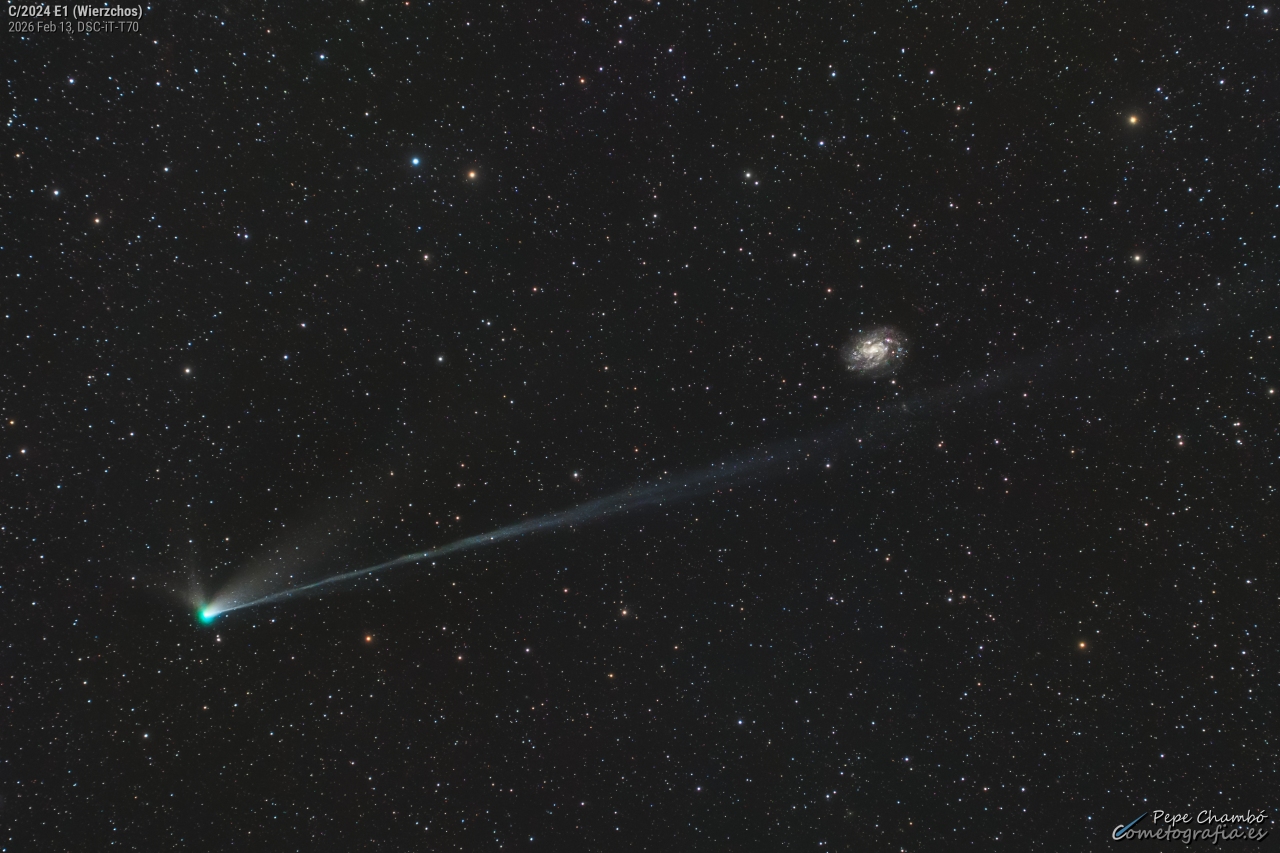
彗星の中には、太陽系に定期的に訪れるものもあれば、一度だけ訪れて二度と戻ってこないものもあります。現在、太陽系の内側を通過している彗星 C/2024 E1 (Wierzchoś) をもう一度見る機会はありません。この彗星の双曲線軌道は、おそらく恒星間を旅する彗星になることを示しています。Wierzchoś 彗星は今日、地球に最も接近しており、地球から太陽までの距離とほぼ同じ距離を通過しています。特集されている 30 分露光の画像は先週チリで撮影されたもので、5 度の長さのイオンの尾と 3 つの短い塵の尾が写っています。コマの緑色は、太陽光による二炭素分子の分解によるものですが、そのプロセスは尾を染めるほど長くは続きません。右端には、はるか遠くに渦巻銀河 NGC 300 があります。
原文(English)
Some comets are regular guests of our solar neighborhood; others come by only once, never to return. We won’t have another chance to see Comet C/2024 E1 (Wierzchoś), which is currently making its way through the inner Solar System. The hyperbolic orbit of this comet indicates that it will likely become an interstellar traveler. Comet Wierzchoś is today near its closest approach to the Earth, passing roughly the same distance from the Earth as is the Sun. The featured 30-minute exposure was taken last week in Chile and shows a 5-degree long ion tail as well as three shorter dust tails. The green hue of the coma comes from the breakdown of dicarbon molecules by sunlight, but that process does not last long enough to also tinge the tails. On the far right lies a spiral galaxy far in the distance: NGC 300.
\ この感動を宇宙仲間にシェア /
宇宙をXでシェア
© José J. Chambó;
Text:
Cecilia Chirenti
(NASA
GSFC,
UMCP,
CRESST II) / APOD