
🚀 宇宙の記憶・カレンダー検索
🚀 象徴的な写真:
APOD第1回
🚀 創造の柱
🚀 スピリット火星着陸
🚀 ハッブル超深宇宙
🚀 地球へようこそ|ブルー・マーブル
🚀 エンケラドス
🚀 ベテルギウス
🚀 火星着陸
🚀 青い夕焼け
🚀 冥王星のハート
🚀 皆既日食
🚀 アースライズ再構築
🚀 ブラックホール
🚀 ウェッブ初画像
🚀 アポロ11着陸
APOD30周年(2025年6月16日)
HD 61005の天球
The Astrosphere of HD 61005
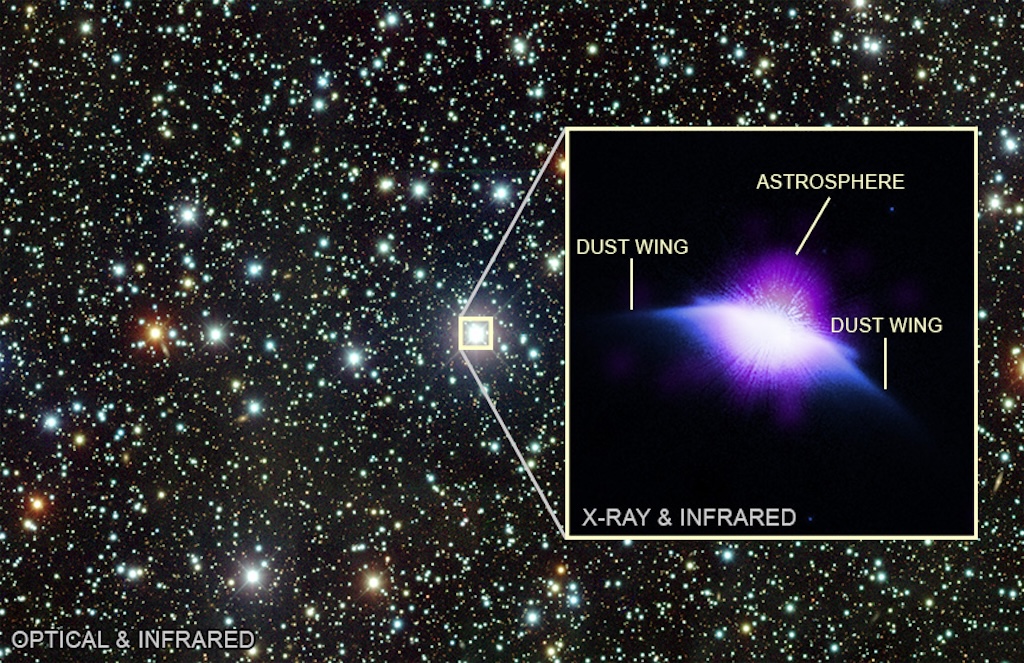
若い星は泡を吹くのでしょうか?拡大図は、チリのセロ・トロロ汎米天文台で観測された星野を示しており、挿入図は、わずか120光年離れた太陽のような星、HD 61005を強調しています。太陽よりはるかに若く、約1億歳であるこの星は、周囲の低温の塵やガスを押し出す高速で密度の高い恒星風を吹き出し、アストロスフィアと呼ばれる泡を形成しています。この星が吹き出した泡は、チャンドラX線観測衛星で検出され、その直径は地球と太陽の距離の約200倍です。私たちの太陽にも、惑星を宇宙放射線から守るヘリオスフィアと呼ばれる泡があります。挿入図には、ハッブル宇宙望遠鏡で観測された、星形成後に残された残骸も示されています。この残骸は翼のように見えるため、この星は蛾という愛称で呼ばれています。
原文(English)
Do young stars blow bubbles? The larger view shows a stellar field observed with the Cerro Tololo Inter-American Observatory in Chile, and the inset highlights HD 61005, a star like our Sun, only 120 light-years away. Much younger than the Sun, at just about 100 million years old, it blows a fast and dense stellar wind that pushes out the cooler dust and gas that surrounds it, forming a bubble called an astrosphere. The star-blown bubble was detected with the Chandra X-ray Observatory, and it has a diameter roughly 200 times the Earth-Sun distance. Our Sun has a bubble too, called the heliosphere, which protects the planets from cosmic radiation. Also shown in the inset is debris left behind from star formation, observed by Hubble. The debris appears as wings, giving the star its nickname: the Moth.
\ この感動を宇宙仲間にシェア /
宇宙をXでシェア
© NASA / APOD