
🚀 宇宙の記憶・カレンダー検索
🚀 象徴的な写真:
APOD第1回
🚀 創造の柱
🚀 スピリット火星着陸
🚀 ハッブル超深宇宙
🚀 地球へようこそ|ブルー・マーブル
🚀 エンケラドス
🚀 ベテルギウス
🚀 火星着陸
🚀 青い夕焼け
🚀 冥王星のハート
🚀 皆既日食
🚀 アースライズ再構築
🚀 ブラックホール
🚀 ウェッブ初画像
🚀 アポロ11着陸
APOD30周年(2025年6月16日)
テイデ天文台での春分の日
Spring Equinox at Teide Observatory
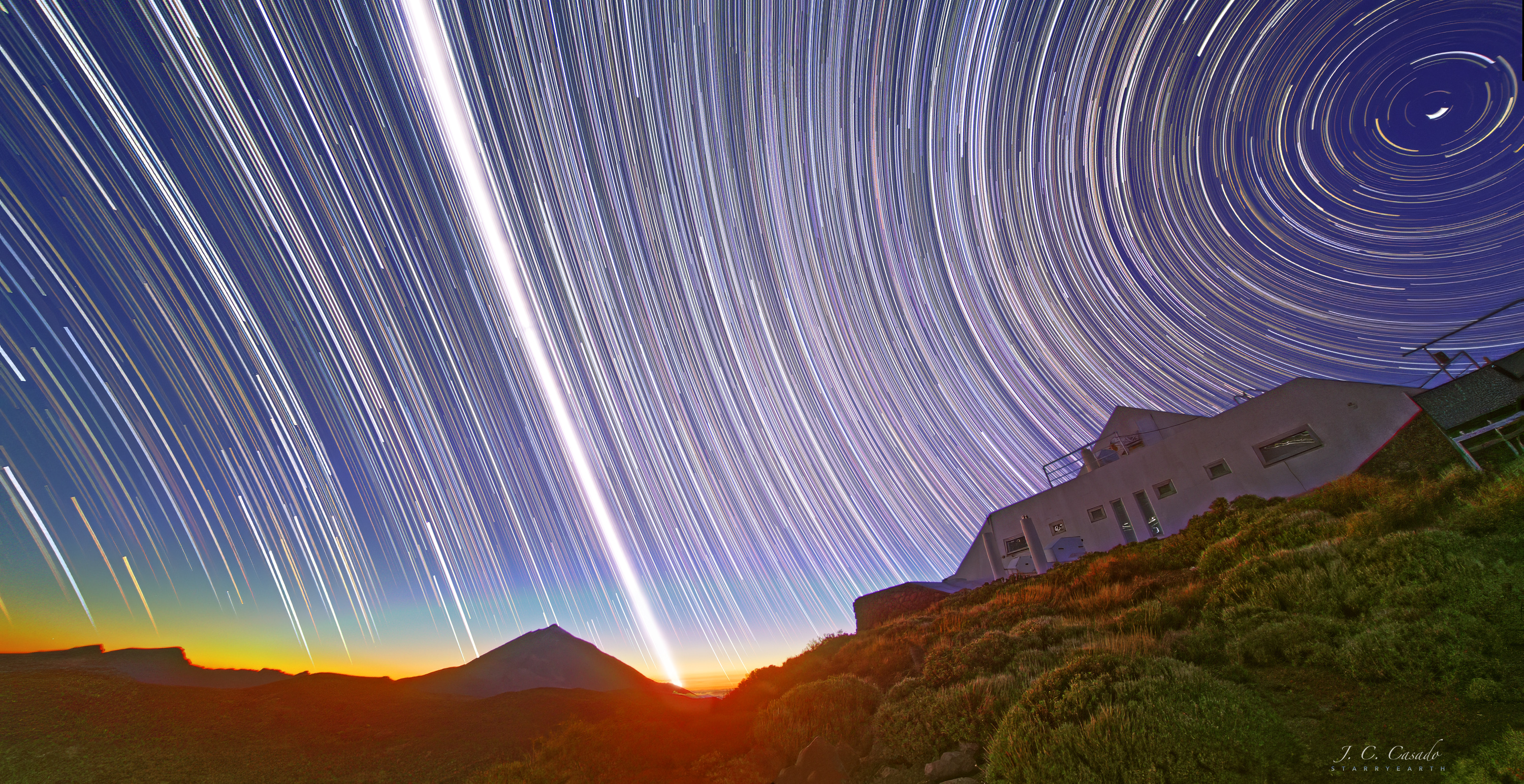
今日の春分の決定的な天文学的瞬間は、協定世界時 (UTC) 14:46 (3 月 20 日) です。このとき、太陽は天の赤道を横切り、地球の空を北に向かって一年かけて移動し、北半球では春の始まり、南半球では秋の始まりを告げます。このとき、地球全体で昼と夜の長さがほぼ等しくなります。実際、この合成された空の風景には、スペイン、カナリア諸島、テネリフェ島のテイデ天文台で春分の日に撮影された昼と夜の両方の露出が使用されています。1,000 枚以上の画像が魚眼レンズで撮影され、この野心的な春分のプロジェクトで合成されました。春分の日に天の赤道に沿って沈む太陽の見かけの動きは、6 時間にわたって撮影された一連の昼間の露出から得られる明るい直線状の斜めの軌跡に従います。日没後、夜間に撮影された写真には星の軌跡が写し出されており、天の赤道は直線状の軌跡として、また右上の北極星付近の北天極と左下端(テイデ山の地平線の下)の南天極を囲む同心円状の弧が描かれている。前景には遠くに見えるテイデ山の山頂と、天文台のピラミッド型の太陽観測実験棟が写っている。
原文(English)
The defining astronomical moment of the equinox today is at 14:46 UTC (March 20). That's when the Sun crosses the celestial equator moving north in its yearly journey through planet Earth's sky, marking the beginning of spring for our fair planet in the northern hemisphere and fall in the southern hemisphere. Then, day and night are nearly equal around the globe. In fact, both day and nighttime exposures from a spring equinox at the Observatorio del Teide in Tenerife, Canary Islands, Spain, are used in this composited skyscape. Over 1,000 images were taken with a fisheye lens and merged in the ambitious equinox project. The apparent motion of the Sun setting along the celestial equator on the equinox date follows the bright linear, diagonal track from the sequence of daytime exposures taken over 6 hours. After sunset, nighttime exposures recorded startrails, with the celestial equator as a linear track and concentric arcs circling the north celestial pole near Polaris at upper right and the south celestial pole beyond the lower left edge (and below the Teide horizon). The foreground includes the distant Teide volcano peak and the observatory's pyramid-shaped solar laboratory building.
\ この感動を宇宙仲間にシェア /
宇宙をXでシェア
© Juan Carlos Casado / APOD