
🚀 宇宙の記憶・カレンダー検索
🚀 象徴的な写真:
APOD第1回
🚀 創造の柱
🚀 スピリット火星着陸
🚀 ハッブル超深宇宙
🚀 地球へようこそ|ブルー・マーブル
🚀 エンケラドス
🚀 ベテルギウス
🚀 火星着陸
🚀 青い夕焼け
🚀 冥王星のハート
🚀 皆既日食
🚀 アースライズ再構築
🚀 ブラックホール
🚀 ウェッブ初画像
🚀 アポロ11着陸
APOD30周年(2025年6月16日)
R3彗星の長く細い尾(PanSTARRS)
The Long Wispy Tail of Comet R3 (PanSTARRS)
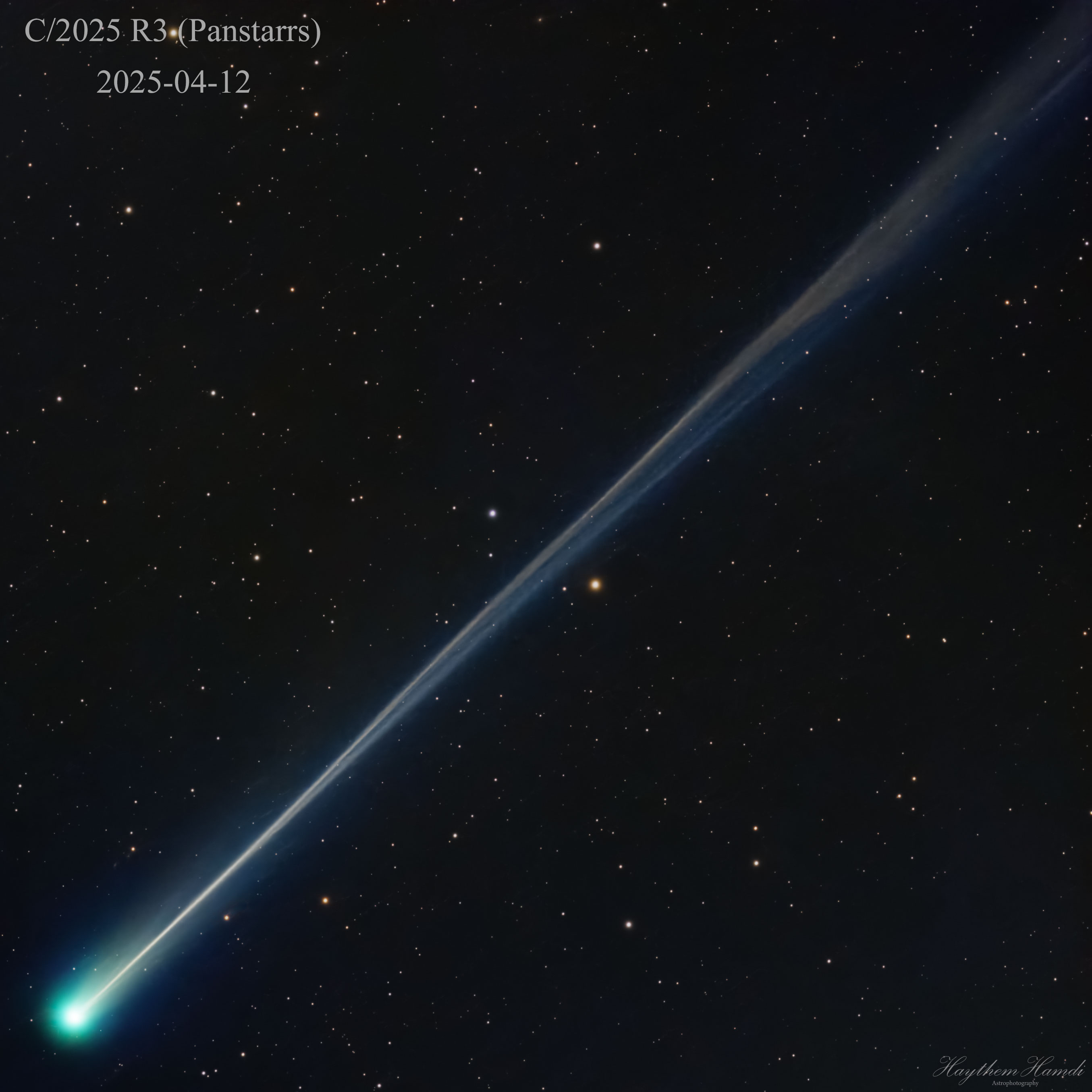
なぜ彗星R3(PanSTARRS)は細い尾を持っているのでしょうか?太陽系内で最も明るい最新の彗星、彗星C/2025 R3(PanSTARRS)は、すでに印象的な輝くガスの流れを伸ばしています。この尾は、おそらく直径数キロメートルの汚れた氷でできた目に見えない中心核から始まります。核は太陽によって温められ、中性ガスの雲を放出し、淡緑色に輝くコマを形成します。高エネルギーの太陽光によって電離された核ガスは、太陽風によって太陽から押し出され、淡青色に輝くイオンの尾になります。イオンの尾が細いのは、太陽風の構造が常に変化しているためです。2日前に米国ロードアイランド州から撮影された写真では、彗星R3(PanSTARRS)が何度にも及ぶイオンの尾を見せています。彗星R3(PanSTARRS)は、今後10日間は北の空で夜明け前に最もよく見え、その後は南の空で最もよく見えるようになります。拡大中のギャラリー:2026年のR3彗星
原文(English)
Why does Comet R3 (PanSTARRS) have a wispy tail? The newest bright member of the inner Solar System, Comet C/2025 R3 (PanSTARRS) is already extending an impressive stream of glowing gas. This tail starts from an unseen central nucleus of dirty ice that is likely a few kilometers across. The nucleus is warmed by the Sun and emits a cloud of neutral gas into a coma that glows light green. Nuclear gas ionized by energetic sunlight is pushed away from the Sun by the solar wind into an ion tail that glows light blue. The wispy nature of the ion tail is caused by the constantly changing structure of the solar wind. Pictured from Rhode Island, USA two days ago, Comet R3 (PanSTARRS) shows off a many-degree ion tail. Comet R3 (PanSTARRS) is best seen before dawn from northern skies for another 10 days, after which it will be best visible from southern skies. Growing Gallery: Comet R3 in 2026
\ この感動を宇宙仲間にシェア /
宇宙をXでシェア
© Haythem Hamdi / APOD