
🚀 宇宙の記憶・カレンダー検索
🚀 象徴的な写真:
APOD第1回
🚀 創造の柱
🚀 スピリット火星着陸
🚀 ハッブル超深宇宙
🚀 地球へようこそ|ブルー・マーブル
🚀 エンケラドス
🚀 ベテルギウス
🚀 火星着陸
🚀 青い夕焼け
🚀 冥王星のハート
🚀 皆既日食
🚀 アースライズ再構築
🚀 ブラックホール
🚀 ウェッブ初画像
🚀 アポロ11着陸
APOD30周年(2025年6月16日)
タイタンを見る
Seeing Titan
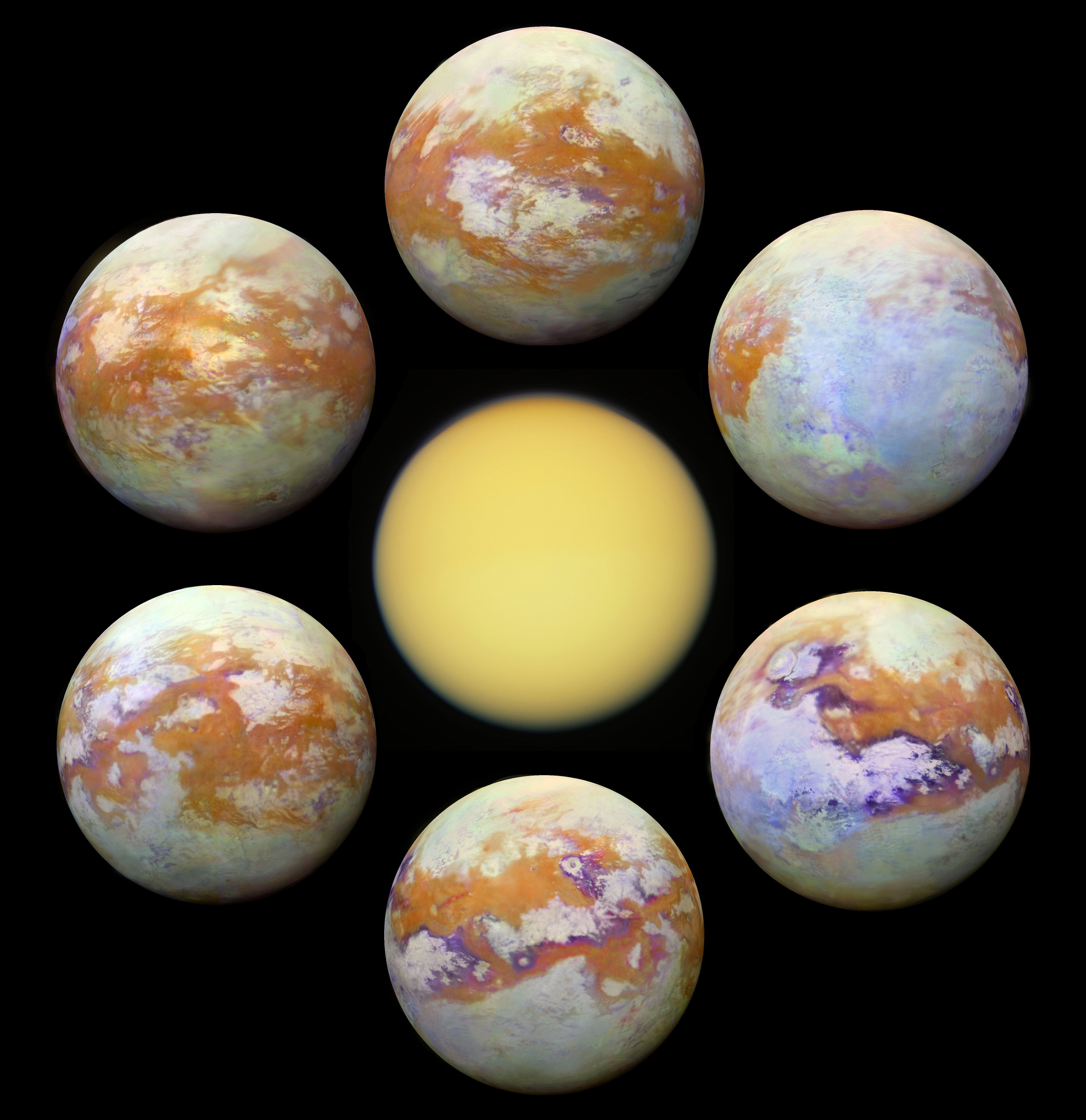
厚い大気に覆われた土星最大の衛星タイタンの表面は、実際に見るのは非常に困難です。タイタンの上層大気に浮遊する微粒子が、ほとんど透過不可能な霞を作り出し、可視光線を強く散乱させ、表面の特徴を観測者の目から隠しています。しかし、タイタンの表面は、散乱が弱く大気吸収が少ない赤外線波長ではより鮮明に画像化できます。このタイタンの可視光画像(中央)の周囲には、この魅惑的な衛星のこれまでで最も鮮明な全球赤外線画像がいくつか配置されています。擬似カラーで表示された6枚のパネルは、2004年から2017年まで土星を周回したカッシーニ探査機に搭載された可視赤外線マッピング分光計(VIMS)による13年間の赤外線画像データを一貫して処理したものです。これらは、カッシーニの可視光画像との驚くべき比較を提供します。NASAの革新的なロータークラフトによるタイタン表面探査ミッションは、2028年7月以降に打ち上げられる予定です。
原文(English)
Shrouded in a thick atmosphere, the surface of Saturn's largest moon, Titan, is really hard to see. Small particles suspended in Titan's upper atmosphere cause an almost impenetrable haze, strongly scattering light at visible wavelengths and hiding surface features from prying eyes. Still, Titan's surface is better imaged at infrared wavelengths, where scattering is weaker and atmospheric absorption is reduced. Arrayed around this visible light image (center) of Titan are some of the clearest global infrared views of the tantalizing moon so far. In false color, the six panels present a consistent processing of 13 years of infrared image data from the Visual and Infrared Mapping Spectrometer (VIMS) on board the Cassini spacecraft orbiting Saturn from 2004 to 2017. They offer a stunning comparison with Cassini's visible light view. NASA's revolutionary rotorcraft mission to Titan's surface is due to launch no earlier than July, 2028.
\ この感動を宇宙仲間にシェア /
宇宙をXでシェア
© NASA / APOD