
🚀 宇宙の記憶・カレンダー検索
🚀 象徴的な写真:
APOD第1回
🚀 創造の柱
🚀 スピリット火星着陸
🚀 ハッブル超深宇宙
🚀 地球へようこそ|ブルー・マーブル
🚀 エンケラドス
🚀 ベテルギウス
🚀 火星着陸
🚀 青い夕焼け
🚀 冥王星のハート
🚀 皆既日食
🚀 アースライズ再構築
🚀 ブラックホール
🚀 ウェッブ初画像
🚀 アポロ11着陸
APOD30周年(2025年6月16日)
マゼランの小さな雲
The Small Cloud of Magellan
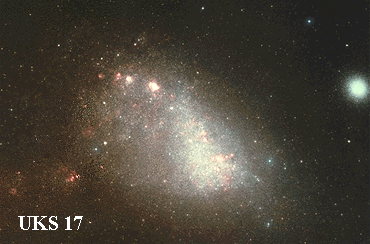
北半球の一般の観測者にはほとんど知られていないが、南の空にはマゼラン雲と呼ばれる2つの拡散した天体が存在する。マゼラン雲は、私たちの銀河系である天の川銀河の周りを公転する小さな不規則銀河である。ここに写っている小マゼラン雲(SMC)は約25万光年離れており、若い高温の青い星が多数存在することから、最近星形成が活発に行われたことがわかる。SMCは実際には2つの銀河が重なり合って1つの銀河のように見えるという証拠がある。画面右端付近の明るい塊は、天の川銀河の外縁部付近にある球状星団である。
原文(English)
Almost unknown to casual observers in the northern hemisphere, the southern sky contains two diffuse wonders known as the Magellanic Clouds. The Magellanic Clouds are small irregular galaxies orbiting our own larger Milky Way spiral galaxy. The Small Magellanic Cloud (SMC), pictured here, is about 250,000 light years away and contains a preponderance of young, hot, blue stars indicating it has undergone a recent period of star formation. There is evidence that the SMC is actually two galaxies superposed to appear as one. The bright blob near the right hand edge of the frame is a globular cluster near the outskirts of the Milky Way.
\ この感動を宇宙仲間にシェア /
宇宙をXでシェア
© Anglo-Australian Telescope
Board
Explanation:
Almost unknown to casual observers in the northern hemisphere,
the southern
sky contains two diffuse wonders known as the
Magellanic Clouds.
The Magellanic Clouds are small irregular
galaxies orbiting our
own larger Milky Way spiral galaxy.
The Small Magellanic Cloud
(SMC), pictured here,
is about 250,000 light years away and
contains a preponderance of young, hot, blue stars indicating it has
undergone a recent period of star formation.
There is evidence that the SMC is actually two
galaxies superposed to appear as one.
The bright blob near
the right hand edge of the frame is a
globular cluster near the
outskirts of the Milky Way.
Tomorrow's picture: GL 105C: The Coolest Star?
| Archive
| Glossary
| Education
| About APOD |
Astronomy Picture of the Day (APOD) is created and edited in 1995 by
Robert
Nemiroff (GMU) and
Jerry Bonnell (USRA). Specific rights may apply.
Correspondence about APOD should be addressed to
nemiroff@grossc.gsfc.nasa.gov or bonnell@grossc.gsfc.nasa.gov.
A service of the
Laboratory for High Energy Astrophysics (LHEA) at
NASA/
GSFC
Technical Rep:
Sherri Calvo,
301-286-5668, sherri.calvo@gsfc.nasa.gov
Questions/Comments/Feedback to: feedback@athena.gsfc.nasa.gov
General astronomy pointers are available. / APOD