
🚀 宇宙の記憶・カレンダー検索
🚀 象徴的な写真:
APOD第1回
🚀 創造の柱
🚀 スピリット火星着陸
🚀 ハッブル超深宇宙
🚀 地球へようこそ|ブルー・マーブル
🚀 エンケラドス
🚀 ベテルギウス
🚀 火星着陸
🚀 青い夕焼け
🚀 冥王星のハート
🚀 皆既日食
🚀 アースライズ再構築
🚀 ブラックホール
🚀 ウェッブ初画像
🚀 アポロ11着陸
APOD30周年(2025年6月16日)
M1:爆発するかに星雲
M1: The Exploding Crab Nebula
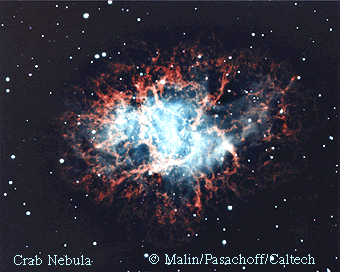
かに星雲は、恒星の爆発、すなわち超新星爆発によって形成されました。恒星の外層は激しく宇宙空間に放出され、内核は崩壊して中性子星を形成しました。この中性子星は、現在ではパルサーとして観測されています。パルサーとは、星雲の中心にある回転する恒星で、可視光を発します。かに星雲パルサーは、1秒間に約30回点滅します。かに星雲を形成した恒星爆発は900年以上前に観測されましたが、星雲自体は今もなお膨張し、輝き続けています。星雲がどのようにして輝くためのエネルギーを得ているのかは謎でしたが、最終的に、このエネルギーはパルサーの回転速度の低下によって放出されることが明らかになり、解明されました。
原文(English)
The Crab Nebula resulted from a star that exploded - a supernova. The outer layers of the star were thrown violently into space, while the inner core collapsed to form a neutron star. This neutron star is visible to us today as a pulsar - a rotating star at the center of the nebula that emits visible flashes of light. The Crab Pulsar flashes about 30 times every second. Although the stellar explosion that caused the Crab Nebula was seen over 900 years ago, the nebula itself still expands and shines. How the nebula obtains the energy needed to shine was a mystery eventually solved by noting that this energy could be released by the slowing of the pulsar's rotation.
\ この感動を宇宙仲間にシェア /
宇宙をXでシェア
© AATB,
Caltech, David Malin, Jay
Pasachoff / APOD