
🚀 宇宙の記憶・カレンダー検索
🚀 象徴的な写真:
APOD第1回
🚀 創造の柱
🚀 スピリット火星着陸
🚀 ハッブル超深宇宙
🚀 地球へようこそ|ブルー・マーブル
🚀 エンケラドス
🚀 ベテルギウス
🚀 火星着陸
🚀 青い夕焼け
🚀 冥王星のハート
🚀 皆既日食
🚀 アースライズ再構築
🚀 ブラックホール
🚀 ウェッブ初画像
🚀 アポロ11着陸
APOD30周年(2025年6月16日)
ノヴァ・シグニ 1992
Nova Cygni 1992
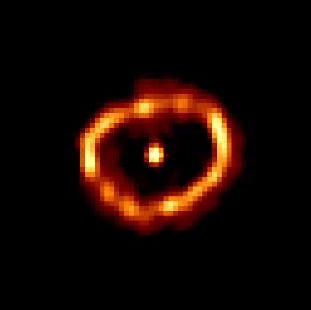
1992年、はくちょう座で巨大な爆発が起こりました。新星は「はくちょう座1992」と名付けられ、おそらく降着円盤連星系で発生したと考えられています。天文学者たちは、この連星系の白色矮星の表面に大量のガスが降り注ぎ、核融合反応が起こりやすい状態になったと推測しています。その結果生じた熱核爆発によって、周囲のガスの大部分が吹き飛ばされ、膨張する殻が形成されました。ハッブル宇宙望遠鏡は1994年にこの膨張する殻を撮影しました。新星は近年で最も明るい新星であり、最も明るい時は望遠鏡を使わなくても見ることができました。電磁スペクトルのあらゆる領域で観測されました。
原文(English)
In 1992 a tremendous explosion occurred in the constellation of Cygnus. Dubbed Nova Cygni 1992, this event most probably occurred in an accretion disk binary system. Astronomers hypothesize that this system's white dwarf had so much gas dumped onto it's surface that conditions became ripe for nuclear fusion. The resulting thermonuclear detonation blasted much of the surrounding gas into an expanding shell. The Hubble Space Telescope photographed this expanding shell in 1994. Nova Cygni 1992 was the brightest nova in recent history - at its brightest it could be seen without a telescope. It was observed in every part of the electromagnetic spectrum.
\ この感動を宇宙仲間にシェア /
宇宙をXでシェア
© NASA / APOD