
🚀 宇宙の記憶・カレンダー検索
🚀 象徴的な写真:
APOD第1回
🚀 創造の柱
🚀 スピリット火星着陸
🚀 ハッブル超深宇宙
🚀 地球へようこそ|ブルー・マーブル
🚀 エンケラドス
🚀 ベテルギウス
🚀 火星着陸
🚀 青い夕焼け
🚀 冥王星のハート
🚀 皆既日食
🚀 アースライズ再構築
🚀 ブラックホール
🚀 ウェッブ初画像
🚀 アポロ11着陸
APOD30周年(2025年6月16日)
ASCA X線観測所
ASCA X-Ray Observatory
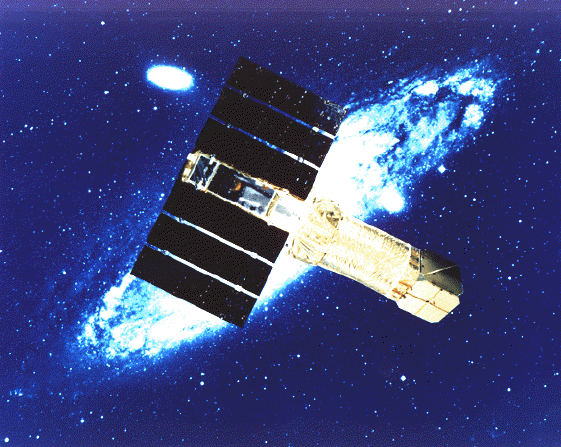
本日、宇宙論・天体物理学探査衛星(ASCA、打ち上げ時にAstro Dから改名)の打ち上げ3周年を迎えます。銀河M31に重ねて表示されているASCAは、NASAが科学機器の一部を提供した日本の衛星です。ASCAには4つの大型X線望遠鏡が搭載されています。そのうち2つの望遠鏡の焦点にはガス撮像分光計(GIS)が、残りの2つの焦点には固体撮像分光計(SIS)が設置されています。ASCAは最近、高エネルギー宇宙線が超新星爆発の膨張ガス中で生成されるという証拠を提供しました。ASCAは3年間の運用期間中に、クエーサー、超新星残骸、矮新星、パルサー、銀河団、そしてあらゆる方向からやってくるように見える謎のX線背景放射に関する貴重なデータも提供してきました。
原文(English)
Today marks the third anniversary of the launch of the Advanced Satellite for Cosmology and Astrophysics (ASCA; renamed from Astro D when launched). ASCA, seen here superposed on galaxy M31, is a Japanese satellite for which NASA has provided some scientific equipment. ASCA carries four large-area X-ray telescopes. At the focus of two of the telescopes is a Gas Imaging Spectrometer (GIS), while a Solid-state Imaging Spectrometer (SIS) is at the focus of the other two. ASCA has provided recent evidence that high energy cosmic rays are formed in the expanding gas from a supernova. During ASCA's three years of operation, it has also yielded valuable data on quasars, supernova remnants, dwarf novae, pulsars, clusters of galaxies, and the mysterious X-ray background radiation that appears to come from all directions.
\ この感動を宇宙仲間にシェア /
宇宙をXでシェア
© NASA / APOD