
🚀 宇宙の記憶・カレンダー検索
🚀 象徴的な写真:
APOD第1回
🚀 創造の柱
🚀 スピリット火星着陸
🚀 ハッブル超深宇宙
🚀 地球へようこそ|ブルー・マーブル
🚀 エンケラドス
🚀 ベテルギウス
🚀 火星着陸
🚀 青い夕焼け
🚀 冥王星のハート
🚀 皆既日食
🚀 アースライズ再構築
🚀 ブラックホール
🚀 ウェッブ初画像
🚀 アポロ11着陸
APOD30周年(2025年6月16日)
周期彗星スウィフト・タットル
Periodic Comet Swift-Tuttle
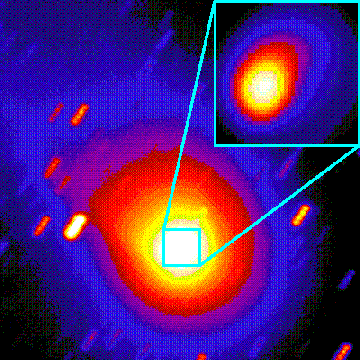
上に示した擬似カラーのスウィフト・タットル彗星は、地球に繰り返し接近することが知られている最大の天体です。また、2千年にわたって観測されている最も古い周期彗星の1つでもあります。1862年に最後に観測され、1992年に再出現しましたが、壮観ではありませんでした。しかし、彗星は双眼鏡で多くの場所から見えるほど明るくなりました。この合成望遠鏡画像を作成するために、彗星の動きを補正するために4つの異なる露光を組み合わせています。その結果、星がわずかに尾を引いて見えます。挿入図は、中心のコマの詳細を示しています。見えない核自体は、基本的に直径約10キロメートルの汚れた氷の塊です。彗星は通常、太陽系の遠いオールトの雲(冥王星のはるか彼方)で発生し、ほとんどは太陽系の内側には入りません。近くの星の重力などによって摂動を受けると、彗星は太陽に向かって落下することがあります。彗星が太陽に近づくと、岩石、氷の塊、ガス、塵などが蒸発し、時に印象的な尾を形成します。実際、スウィフト・タットル彗星の残骸は、毎年7月と8月に見られるペルセウス座流星群の原因となっています。スウィフト・タットル彗星は2126年に地球に接近すると予想されており、今年の百武彗星や来年のヘール・ボップ彗星に匹敵するほどの壮大な光景が見られるかもしれません。
原文(English)
Comet Swift-Tuttle, shown above in false color, is the largest object known to make repeated passes near the Earth. It is also one of the oldest known periodic comets with sightings spanning two millennia. Last seen in 1862, its reappearance in 1992 was not spectacular, but the comet did become bright enough to see from many locations with binoculars. To create this composite telescopic image, four separate exposures have been combined, compensating for the motion of the comet. As a result, the stars appear slightly trailed. The inset shows details of the central coma. The unseen nucleus itself is essentially a chunk of dirty ice about ten kilometers in diameter. Comets usually originate in the Oort cloud in the distant Solar System - well past Pluto, most never venturing into the inner Solar System. When perturbed - perhaps by the gravity of a nearby star - a comet may fall toward the Sun. As a comet approaches the Sun, rocks, ice-chunks, gas, and dust boil away, sometimes creating impressive looking tails. In fact, debris from Comet Swift-Tuttle is responsible for the Perseids meteor shower visible every July and August. Comet Swift-Tuttle is expected to make an impressive pass near the earth in the year 2126, possibly similar to Comet Hyakutake this year or Comet Hale-Bopp next year.
\ この感動を宇宙仲間にシェア /
宇宙をXでシェア
© NASA / APOD