
🚀 宇宙の記憶・カレンダー検索
🚀 象徴的な写真:
APOD第1回
🚀 創造の柱
🚀 スピリット火星着陸
🚀 ハッブル超深宇宙
🚀 地球へようこそ|ブルー・マーブル
🚀 エンケラドス
🚀 ベテルギウス
🚀 火星着陸
🚀 青い夕焼け
🚀 冥王星のハート
🚀 皆既日食
🚀 アースライズ再構築
🚀 ブラックホール
🚀 ウェッブ初画像
🚀 アポロ11着陸
APOD30周年(2025年6月16日)
翻訳エラー: Exception: 1 日にサービス translate を実行した回数が多すぎます。
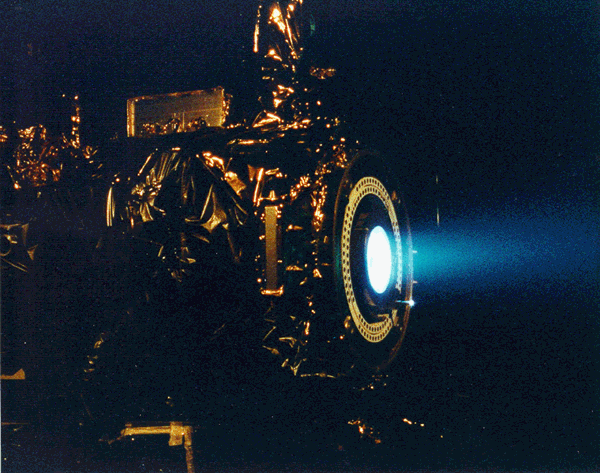
An Ion Drive for Deep Space 1
翻訳エラー: Exception: 1 日にサービス translate を実行した回数が多すぎます。
原文(English)
Space travel entered the age of the ion drive in 1998 with the launch of Deep Space 1, a NASA mission designed primarily to test new technologies. Although the ion drive on Deep Space 1 provided acceleration much smaller than we feel toward Earth, it gradually gave the spacecraft the speed it needed to travel across our Solar System. The propulsion drive worked by ionizing xenon atoms with power provided by large panels that collect sunlight. As these ions were expelled by a strong electric field out the back, the spacecraft slowly gained speed. Pictured above, hot blue ions emerge from a prototype drive that was successfully tested at JPL in 1997. Deep Space 1 successfully zoomed past asteroid 9969 Braille in July 1999 and then Comet Borrelly in September 2001, then obtaining the most detailed photograph ever taken of a comet nucleus. The spacecraft was retired in December 2001
\ この感動を宇宙仲間にシェア /
宇宙をXでシェア
© NASA / APOD