
🚀 宇宙の記憶・カレンダー検索
🚀 象徴的な写真:
APOD第1回
🚀 創造の柱
🚀 スピリット火星着陸
🚀 ハッブル超深宇宙
🚀 地球へようこそ|ブルー・マーブル
🚀 エンケラドス
🚀 ベテルギウス
🚀 火星着陸
🚀 青い夕焼け
🚀 冥王星のハート
🚀 皆既日食
🚀 アースライズ再構築
🚀 ブラックホール
🚀 ウェッブ初画像
🚀 アポロ11着陸
APOD30周年(2025年6月16日)
翻訳エラー: Exception: 1 日にサービス translate を実行した回数が多すぎます。
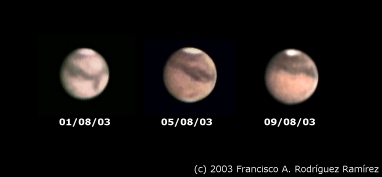
Mars Through a Small Telescope
翻訳エラー: Exception: 1 日にサービス translate を実行した回数が多すぎます。
原文(English)
How does Mars appear through a small telescope? Viewed with the unaided eye or through a small telescope, possibly the most striking part of Mars' appearance is its red color. The color derives from rust, iron oxide, which composes perhaps 10% of the Martian soil. The oxygen that rusts the surface iron on Mars originates predominantly from carbon dioxide gas, which composes 95% of the Martian atmosphere. Mars nears its closest approach with Earth in nearly 60 millennia on August 27, the red planet continues to appear larger, brighter, and a good target for sky enthusiasts. Pictured above, Mars was captured from the Canary Islands of Spain during three days in three different orientations earlier this month. Visible through the small telescope are white polar caps of water and carbon-dioxide ice, light red areas rich in lightly colored craters, and dark red areas dominated by relatively smooth lowlands.
\ この感動を宇宙仲間にシェア /
宇宙をXでシェア
©
Francisco A. Rodriguez Ramirez
(AstroEduca)
/ APOD