
🚀 宇宙の記憶・カレンダー検索
🚀 象徴的な写真:
APOD第1回
🚀 創造の柱
🚀 スピリット火星着陸
🚀 ハッブル超深宇宙
🚀 地球へようこそ|ブルー・マーブル
🚀 エンケラドス
🚀 ベテルギウス
🚀 火星着陸
🚀 青い夕焼け
🚀 冥王星のハート
🚀 皆既日食
🚀 アースライズ再構築
🚀 ブラックホール
🚀 ウェッブ初画像
🚀 アポロ11着陸
APOD30周年(2025年6月16日)
ジャイプール天文台の日時計
Jaipur Observatory Sundial
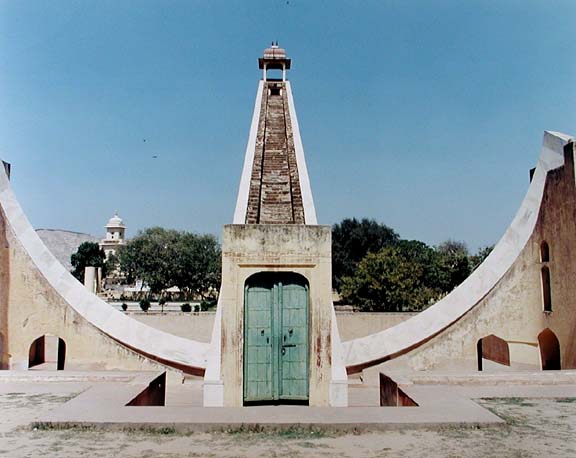
この扉をくぐり、階段を上ると、インドのジャイプールから北天の極へと向かう一筋の旅が始まります。このような宇宙の配置は、建築そのものが天文測定を可能にしている素晴らしいインドの天文台に数多く見られます。これらの建造物は、18世紀にマハラジャのジャイ・シング2世(1686~1743年)によってジャイプールなどの都市に建てられました。約90フィートの高さのこの階段は、実際には影を落とす装置、つまりグノモン(日時計の目盛り)を形成しており、おそらく現在でも地球上で最大の日時計の一部となっています。ジャイ・シング2世の天文学への情熱を物語る、彼の天文台の構造物の設計と大規模さは、今でも驚くほど正確な影の測定と天体の角度の観測を可能にしています。
原文(English)
Walk through these doors and up the stairs to begin your journey along a line from Jaipur, India toward the North Celestial Pole. Such cosmic alignments abound in marvelous Indian observatories where the architecture itself allows astronomical measurements. The structures were built in Jaipur and other cities in the eighteenth century by the Maharaja Jai Singh II (1686-1743). Rising about 90 feet high, this stairway actually forms a shadow caster or gnomon, part of what is still perhaps the largest sundial on planet Earth. Testaments to Jai Singh II's passion for astronomy, the design and large scale of his observatories' structures still provide impressively accurate measurements of shadows and sightings of celestial angles.
\ この感動を宇宙仲間にシェア /
宇宙をXでシェア
©
Tim Feresten
/ APOD