
🚀 宇宙の記憶・カレンダー検索
🚀 象徴的な写真:
APOD第1回
🚀 創造の柱
🚀 スピリット火星着陸
🚀 ハッブル超深宇宙
🚀 地球へようこそ|ブルー・マーブル
🚀 エンケラドス
🚀 ベテルギウス
🚀 火星着陸
🚀 青い夕焼け
🚀 冥王星のハート
🚀 皆既日食
🚀 アースライズ再構築
🚀 ブラックホール
🚀 ウェッブ初画像
🚀 アポロ11着陸
APOD30周年(2025年6月16日)
象の鼻の中
Inside the Elephant's Trunk
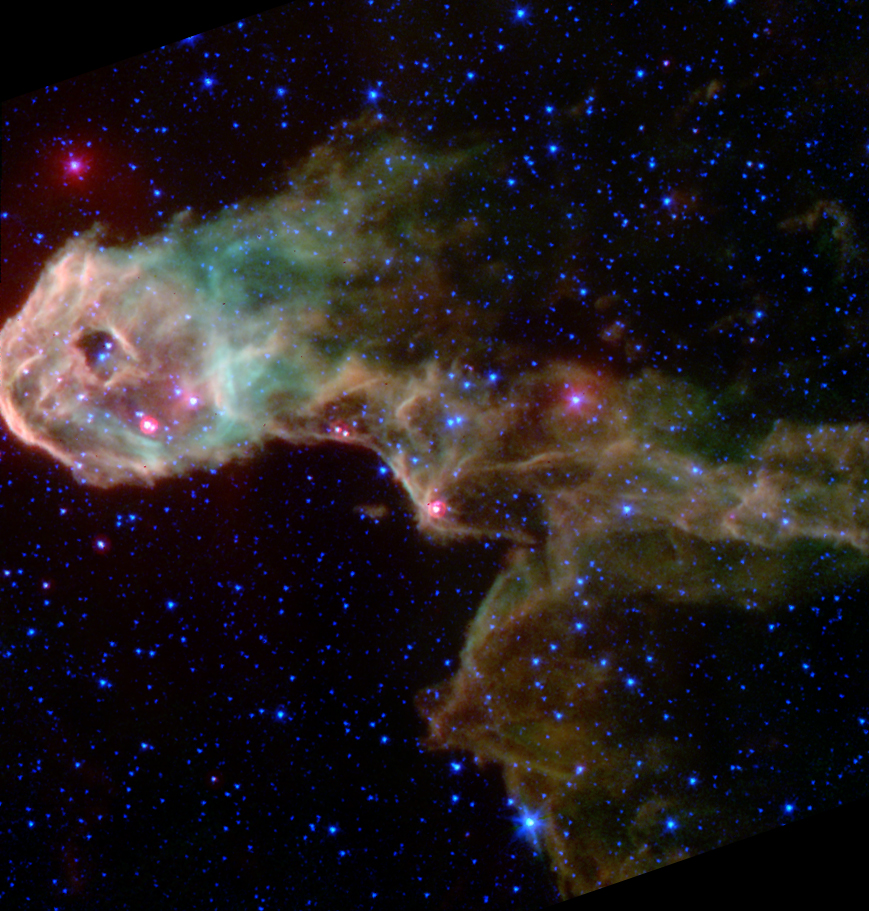
新たに命名されたスピッツァー宇宙望遠鏡による最初の素晴らしい画像には、象の鼻星雲として知られる不透明な暗黒球状天体の内部を捉えたこの画像が含まれています。スピッツァーの機器で記録された赤外線画像データの合成画像では、この興味深い領域は、ケフェウス座の方向へ2,450光年離れた輝く輝線星雲IC 1396の中に埋め込まれています。これまで発見されていなかった原始星は、可視光波長では塵に隠されていましたが、球状天体内部では明るい赤みがかった天体として現れています。擬似カラーで示されているように、赤外線放射の曲がりくねったフィラメントは約12光年に及び、塵、分子状水素ガス、および多環芳香族炭化水素(PAH)と呼ばれる複雑な分子によるものです。スピッツァー宇宙望遠鏡は以前は宇宙赤外線望遠鏡施設(SIRTF)として知られており、赤外線波長で宇宙を探査するように設計されています。スピッツァー宇宙望遠鏡は、ハッブル宇宙望遠鏡、コンプトンガンマ線観測衛星、チャンドラX線観測衛星に続く、NASAの宇宙望遠鏡群「グレート・オブザーバトリーズ・プログラム」における最後の構成要素となる。
原文(English)
Spectacular first images from the newly christened Spitzer Space Telescope include this penetrating interior view of an otherwise opaque dark globule known as the Elephant's Trunk Nebula. Seen in a composite of infrared image data recorded by Spitzer's instruments, the intriguing region is embedded within the glowing emission nebula IC 1396 at a distance of 2,450 light-years toward the constellation Cepheus. Previously undiscovered protostars hidden by dust at optical wavelengths appear as bright reddish objects within the globule. Shown in false-color, winding filaments of infrared emission span about 12 light-years and are due to dust, molecular hydrogen gas, and complex molecules called polycyclic aromatic hydrocarbons or PAHs. The Spitzer Space Telescope was formerly known as the Space Infrared Telescope Facility (SIRTF) and is designed to explore the Universe at infrared wavelengths. Spitzer follows the Hubble Space Telescope, the Compton Gamma-ray Observatory, and the Chandra X-ray Observatory as the final element in NASA's space-borne Great Observatories Program.
\ この感動を宇宙仲間にシェア /
宇宙をXでシェア
© NASA / APOD