
🚀 宇宙の記憶・カレンダー検索
🚀 象徴的な写真:
APOD第1回
🚀 創造の柱
🚀 スピリット火星着陸
🚀 ハッブル超深宇宙
🚀 地球へようこそ|ブルー・マーブル
🚀 エンケラドス
🚀 ベテルギウス
🚀 火星着陸
🚀 青い夕焼け
🚀 冥王星のハート
🚀 皆既日食
🚀 アースライズ再構築
🚀 ブラックホール
🚀 ウェッブ初画像
🚀 アポロ11着陸
APOD30周年(2025年6月16日)
ウォルフ・ライエ連星BAT99-49を取り巻く星雲
Nebulas Surrounding Wolf-Rayet Binary BAT99-49
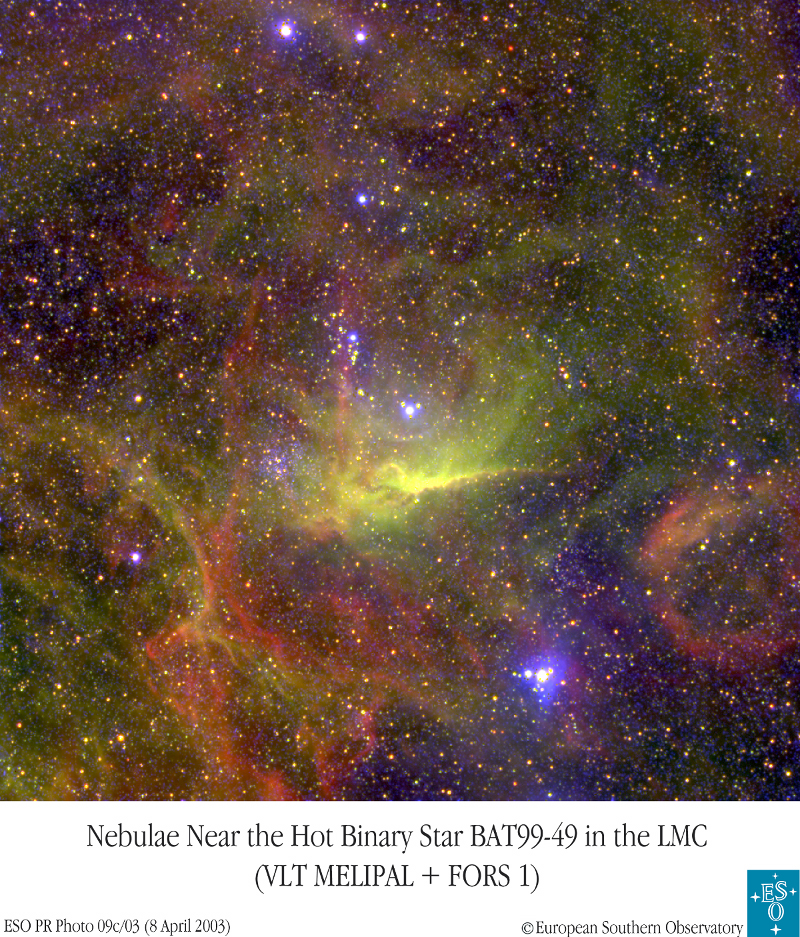
2 つの若い星が、これらの色鮮やかな星間ガス雲にエネルギーを供給できるのはなぜでしょうか? 厚い塵に隠れていますが、星は強力なイオンと高エネルギーの放射線を放出し、それが雲を分裂させて輝かせます。ヨーロッパ南天天文台のメリパル VLT 望遠鏡による上記の合成カラー画像は、BAT99-49 として知られる星雲複合体の詳細を解像しており、青色はヘリウム原子、緑色は酸素原子、赤色は水素原子からの放射を示しています。私たちの天の川銀河の最大の伴銀河である大マゼラン雲 (LMC) に位置する中央の連星のうち、1 つの星は謎めいたウォルフ・ライエ星で、もう 1 つは巨大な O 型星です。ウォルフ・ライエ星は宇宙で最も高温の表面を持つ星の 1 つであり、O 型星は通常の主系列星の中で最も質量が大きくエネルギーの高い星です。
原文(English)
How could two young stars power these colorful interstellar gas clouds? Although hidden by thick dust, the stars spew forceful ions and energetic radiation that cause the clouds to fragment and light up. The above composite color image from the European Southern Observatory's Melipal VLT telescope resolves details in the nebula complex known as BAT99-49, with emission from helium atoms in blue hues, oxygen atoms in green, and hydrogen atoms in red. Located in the Large Magellanic Cloud (LMC), the largest satellite galaxy to our own Milky Way Galaxy, one of the stars in the central binary is an enigmatic Wolf-Rayet star while the other is a massive O star. Wolf-Rayet stars have some of the hottest surfaces in the universe, while O stars are the most massive and energetic of normal main sequence stars.
\ この感動を宇宙仲間にシェア /
宇宙をXでシェア
© Y. Naze, G. Rauw, J. Manfroid, J. Vreux
(Univ. Liege),
Y. Chu (Univ. Illinois),
ESO / APOD