
🚀 宇宙の記憶・カレンダー検索
🚀 象徴的な写真:
APOD第1回
🚀 創造の柱
🚀 スピリット火星着陸
🚀 ハッブル超深宇宙
🚀 地球へようこそ|ブルー・マーブル
🚀 エンケラドス
🚀 ベテルギウス
🚀 火星着陸
🚀 青い夕焼け
🚀 冥王星のハート
🚀 皆既日食
🚀 アースライズ再構築
🚀 ブラックホール
🚀 ウェッブ初画像
🚀 アポロ11着陸
APOD30周年(2025年6月16日)
ティコ超新星残骸からのX線画像
X-Rays From Tycho's Supernova Remnant
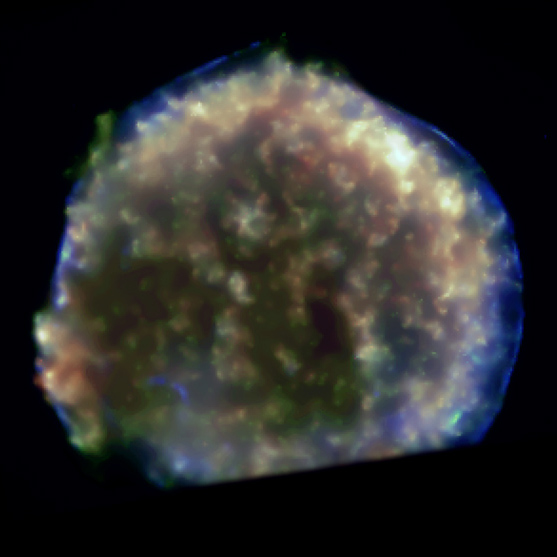
1572年、デンマークの天文学者ティコ・ブラーエは、カシオペヤ座に明るい新星が突然出現したことを記録しました。この新星は数ヶ月かけて徐々に姿を消し、天の川銀河で最後に観測された恒星爆発の一つである超新星であったと考えられています。現在ではティコの超新星残骸として知られるこの膨張する残骸雲は、軌道上のチャンドラX線観測衛星による詳細な擬似カラーX線画像に示されています。青色で示されているのは、超新星残骸の外縁に沿った衝撃波を受けた領域からの最高エネルギーのX線で、摂氏2000万度のガスに相当します。残骸の内部では、より低温のガス(摂氏約1000万度!)からのX線が支配的です。他の超新星残骸とは異なり、高温の中心点源は見つかっておらず、この恒星爆発は最終的に白色矮星を破壊した暴走核爆発が起源であるという説を裏付けている。約7,500光年の距離にあるティコ超新星残骸は、直径が約20光年あるように見える。このX線画像の視野は、ほぼ球形である雲の下部をわずかに切り取っている。
原文(English)
In 1572, Danish astronomer Tycho Brahe recorded the sudden appearance of a bright new star in the constellation Cassiopeia. The new star faded from view over a period of months and is believed to have been a supernova, one of the last stellar explosions seen in our Milky Way galaxy. Now known as Tycho's Supernova Remnant, the expanding debris cloud is shown in this detailed false-color x-ray image from the orbiting Chandra Observatory. Represented in blue, the highest energy x-rays come from shocked regions along the outer edges of the supernova remnant, corresponding to gas at temperatures of 20 million degrees Celsius. X-rays from cooler gas (only 10 million degrees or so!) dominate the remnant's interior. Unlike some other supernova remnants, no hot central point source can be found, supporting the theory that the origin of this stellar explosion was a runaway nuclear detonation that ultimately destroyed a white dwarf star. At a distance of about 7,500 light-years, Tycho's Supernova Remnant appears to be nearly 20 light-years across. This x-ray picture's field of view slightly cuts off the bottom of the generally spherical cloud.
\ この感動を宇宙仲間にシェア /
宇宙をXでシェア
© NASA / APOD