
🚀 宇宙の記憶・カレンダー検索
🚀 象徴的な写真:
APOD第1回
🚀 創造の柱
🚀 スピリット火星着陸
🚀 ハッブル超深宇宙
🚀 地球へようこそ|ブルー・マーブル
🚀 エンケラドス
🚀 ベテルギウス
🚀 火星着陸
🚀 青い夕焼け
🚀 冥王星のハート
🚀 皆既日食
🚀 アースライズ再構築
🚀 ブラックホール
🚀 ウェッブ初画像
🚀 アポロ11着陸
APOD30周年(2025年6月16日)
タイタン上空の二重の霞
The Double Haze above Titan
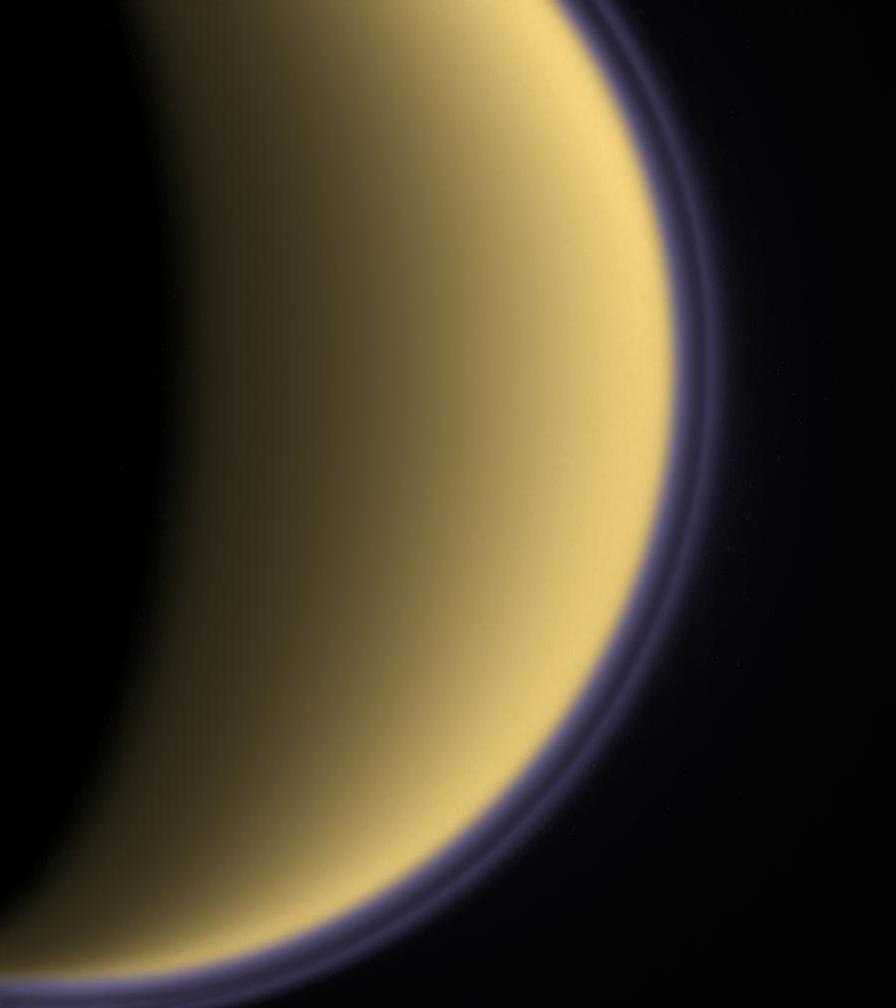
ほとんどの衛星にはもや層がまったくないのに、なぜタイタンには2つもあるのでしょうか? 先月土星の周回軌道に入ったカッシーニ探査機からの画像により、太陽系で最も謎めいた衛星タイタンは、厚い大気だけでなく、2つの異なるもやの球体にも囲まれていることが確認されました。これらの層は、上記の擬似カラー紫外線画像では紫色で表示されています。タイタンの不透明な大気は、主に窒素で構成されているという点で地球の大気と似ています。高エネルギーの太陽光が大気中の高濃度の窒素とメタンに当たると、エタンや二酸化炭素などの微量の有機化合物が生成されるようです。これらの有機化合物やその他の複雑な有機分子が、分離したもや層に存在していると考えられます。2004年12月、カッシーニはタイタンに着陸するためのホイヘンス探査機を打ち上げます。
原文(English)
Most moons have no haze layer at all - why does Titan have two? Images from the Cassini spacecraft that slipped into orbit around Saturn last month confirm that the Solar System's most mysterious moon is surrounded not only by a thick atmosphere but also by two distinct spheres of haze. These layers are visible as purple in the above false-color ultraviolet image. Titan's opaque atmosphere is similar to Earth's atmosphere in that it is composed mostly of nitrogen. As energetic sunlight strikes high level atmospheric nitrogen and methane, trace amounts of organic compounds such as ethane and carbon dioxide appear to form. These and other complex organic molecules likely populate the detached haze layer. In December 2004, Cassini will launch the Huygens probe to land on Titan.
\ この感動を宇宙仲間にシェア /
宇宙をXでシェア
© NASA / APOD