
🚀 宇宙の記憶・カレンダー検索
🚀 象徴的な写真:
APOD第1回
🚀 創造の柱
🚀 スピリット火星着陸
🚀 ハッブル超深宇宙
🚀 地球へようこそ|ブルー・マーブル
🚀 エンケラドス
🚀 ベテルギウス
🚀 火星着陸
🚀 青い夕焼け
🚀 冥王星のハート
🚀 皆既日食
🚀 アースライズ再構築
🚀 ブラックホール
🚀 ウェッブ初画像
🚀 アポロ11着陸
APOD30周年(2025年6月16日)
ソーラーセイル
Solar Sail
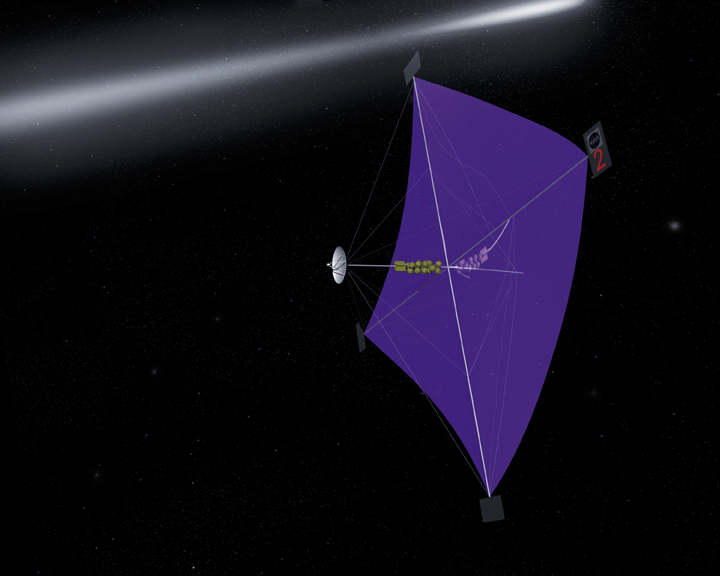
ソーラーセイルは将来のオリンピック競技になるだろうか? 約400年前、天文学者のヨハネス・ケプラーは太陽風によって吹く彗星の尾を観測し、適切な帆を使えば宇宙船も同様に宇宙を航行できるのではないかと示唆した。太陽光が実際に彗星の尾を動かす力を生み出していることは広く認識されており、大型の反射帆は宇宙船を推進する実用的な手段となり得る。実際、上の図は、極薄の帆から反射された太陽光によって推進される恒星間探査機のNASAが検討したコンセプトを表している。幅約500メートルの繊細なソーラーセイルは宇宙空間で展開される。太陽光からの継続的な圧力によって、探査機は最終的に従来のロケットで可能な速度の約5倍まで加速される。オリンピックに間に合うかどうかはまだ分からないが、NASAは最近、地球上でソーラーセイル技術の試験を実施し、日本の宇宙航空研究開発機構(JAXA)宇宙空間宇宙科学研究所(ISAS)は宇宙空間でソーラーセイル材料を展開した。惑星協会は、モスクワの宇宙研究所(IKI)およびパートナーと協力して、ソーラーセイル推進宇宙船コスモス1号の打ち上げ準備を進めている。
原文(English)
Could solar sailing become a future Olympic sport? Nearly 400 years ago astronomer Johannes Kepler observed comet tails blown by a solar breeze and suggested that vessels might likewise navigate through space using appropriately fashioned sails. It is now widely recognized that sunlight does indeed produce a force which moves comet tails and a large, reflective sail could be a practical means of propelling a spacecraft. In fact, the illustration above represents a concept explored by NASA for an interstellar probe pushed along by sunlight reflected from an ultrathin sail. Nearly half a kilometer wide, the delicate solar sail would be unfurled in space. Continuous pressure from sunlight would ultimately accelerate the craft to speeds about five times higher than possible with conventional rockets. While not quite ready for the Olympics, NASA has recently tested solar sail technologies on earth and the Japanese Space Agency ISAS has deployed solar sail material in space. The Planetary Society in collaboration with the Space Research Institute (IKI) in Moscow and partners is preparing to launch Cosmos 1, a solar sail powered spacecraft.
\ この感動を宇宙仲間にシェア /
宇宙をXでシェア
© NASA / APOD