
🚀 宇宙の記憶・カレンダー検索
🚀 象徴的な写真:
APOD第1回
🚀 創造の柱
🚀 スピリット火星着陸
🚀 ハッブル超深宇宙
🚀 地球へようこそ|ブルー・マーブル
🚀 エンケラドス
🚀 ベテルギウス
🚀 火星着陸
🚀 青い夕焼け
🚀 冥王星のハート
🚀 皆既日食
🚀 アースライズ再構築
🚀 ブラックホール
🚀 ウェッブ初画像
🚀 アポロ11着陸
APOD30周年(2025年6月16日)
UKIRT: アロハ・オリオン
UKIRT: Aloha Orion
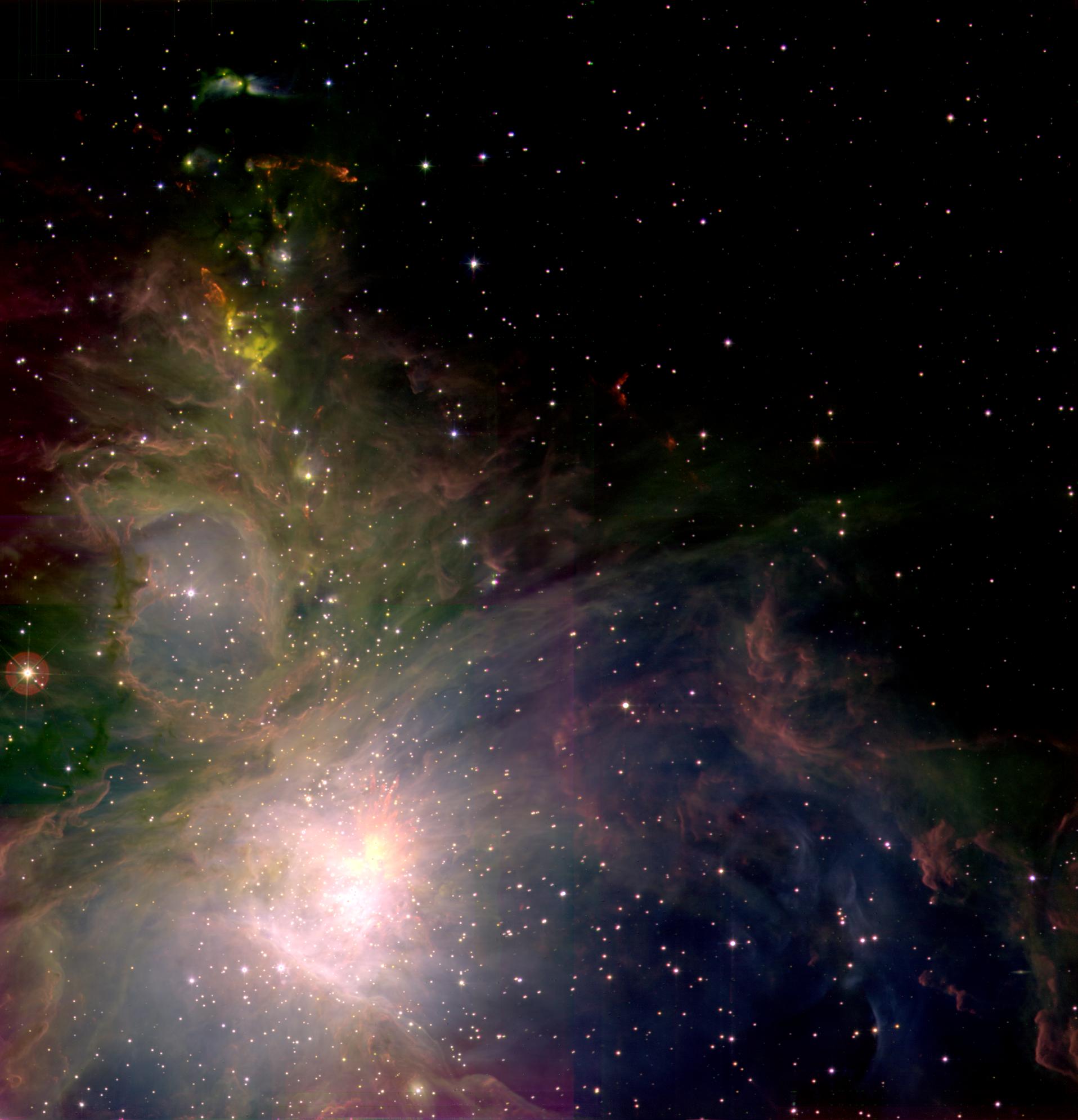
濃密な分子雲の端には、ガスのフィラメント、宇宙塵、そして無数の若い星々が、オリオン星雲のこの鮮明な画像に映し出されています。有名な星形成領域の魅力的な構造が、ハワイの新しい目であるWFCAM(マウナケアにある英国赤外線望遠鏡(UKIRT)に設置された強力な広視野カメラ)によって赤外線で明らかにされています。WFCAMの全視野のほんの一部であるこの画像は、星雲までの距離1,500光年で約11光年をカバーしています。この画像では、通常は見えない赤外線が可視光の色にマッピングされています。赤は波長2.12マイクロメートルの水素分子からの狭帯域赤外線放射、緑は2.2マイクロメートルの放射、青は1.25マイクロメートルの放射を表しています。可視光の波長は約0.5マイクロメートルです。
原文(English)
At the edge of a dense molecular cloud, filaments of gas, cosmic dust, and a multitude of young stars beckon in this penetrating image of the Orion Nebula. Alluring structures in the well-known star forming region are revealed here in infrared light as viewed by a new Hawaiian eye - WFCAM - a powerful wide field camera commissioned at the United Kingdom Infrared Telescope (UKIRT) on Mauna Kea. Only a fraction of WFCAM's full field, this picture covers about 11 light-years at the 1,500 light-year distance of the nebula. In the image, otherwise invisible infrared light has been mapped into visible colors. Red represents narrow-band infrared emission from hydrogen molecules at a wavelength of 2.12 microns, green is emission at 2.2 microns, and blue is emission at 1.25 microns. Visible light has a wavelength of about 0.5 microns (micrometers).
\ この感動を宇宙仲間にシェア /
宇宙をXでシェア
© NASA / APOD