
🚀 宇宙の記憶・カレンダー検索
🚀 象徴的な写真:
APOD第1回
🚀 創造の柱
🚀 スピリット火星着陸
🚀 ハッブル超深宇宙
🚀 地球へようこそ|ブルー・マーブル
🚀 エンケラドス
🚀 ベテルギウス
🚀 火星着陸
🚀 青い夕焼け
🚀 冥王星のハート
🚀 皆既日食
🚀 アースライズ再構築
🚀 ブラックホール
🚀 ウェッブ初画像
🚀 アポロ11着陸
APOD30周年(2025年6月16日)
スウォーム
The Swarm
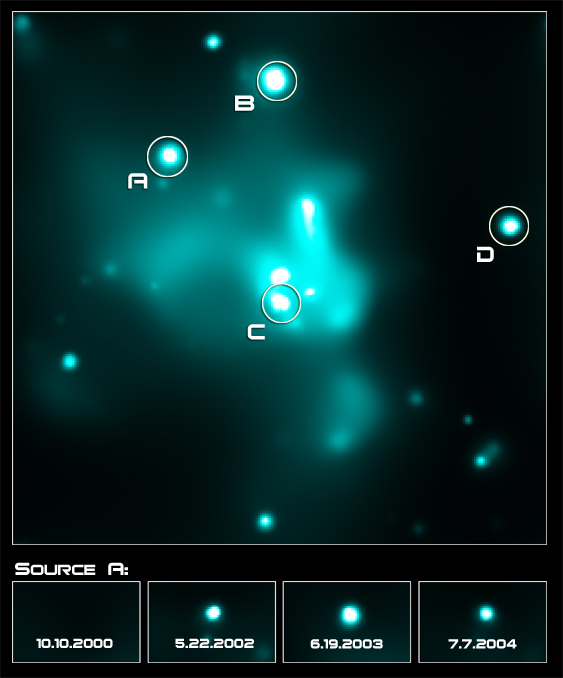
ブラックホールの集まりを何と呼ぶでしょうか…群れ、連なり、群集?天文学者たちは、銀河の中心付近の領域を監視し、銀河の中心にある超大質量ブラックホールの周囲に群がる、驚くほど多くの変動するX線源(おそらくブラックホールか連星系の中性子星)の証拠を発見しました。チャンドラ観測所の監視プログラムによるX線画像データをまとめたものが上に示されており、4つの変動源が丸で囲まれ、A~Dとラベル付けされています。4つの源では群集とは言えないかもしれませんが、これらはすべて、Sgr A*(Cのすぐ上にある明るい源)として知られる中心の超大質量ブラックホールからわずか3光年以内に位置しています。これらの検出は、はるかに多くのブラックホール系が存在することを示唆しています。他の星との重力相互作用が繰り返されることで、ブラックホール系は銀河中心領域に向かって螺旋状に内側に落ちていくと考えられています。
原文(English)
What do you call a group of black holes ... a flock, a brace, a swarm? Monitoring a region around the center of our Galaxy, astronomers have indeed found evidence for a surprisingly large number of variable x-ray sources - likely black holes or neutron stars in binary star systems - swarming around the Milky Way's own central supermassive black hole. Chandra Observatory combined x-ray image data from their monitoring program is shown above, with four variable sources circled and labeled A-D. While four sources may not make a swarm, these all lie within only three light-years of the central supermassive black hole known as Sgr A* (the bright source just above C). Their detection implies that a much larger concentration of black hole systems is present. Repeated gravitational interactions with other stars are thought to cause the black hole systems to spiral inward toward the Galactic Center region.
\ この感動を宇宙仲間にシェア /
宇宙をXでシェア
© NASA / APOD