
🚀 宇宙の記憶・カレンダー検索
🚀 象徴的な写真:
APOD第1回
🚀 創造の柱
🚀 スピリット火星着陸
🚀 ハッブル超深宇宙
🚀 地球へようこそ|ブルー・マーブル
🚀 エンケラドス
🚀 ベテルギウス
🚀 火星着陸
🚀 青い夕焼け
🚀 冥王星のハート
🚀 皆既日食
🚀 アースライズ再構築
🚀 ブラックホール
🚀 ウェッブ初画像
🚀 アポロ11着陸
APOD30周年(2025年6月16日)
赤外線で見るオリオン座
Orion in Infrared
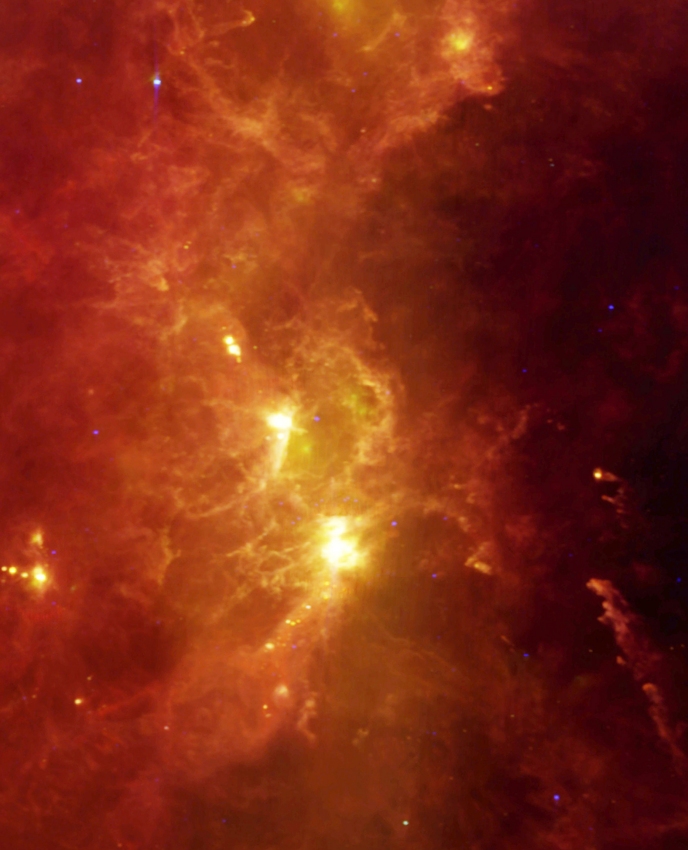
オリオン座をご存知ですか?この印象的でありながら見慣れないオリオン座の領域の画像は、現在は運用を終了した赤外線天文衛星(IRAS)の観測データを使用して作成されました。上の画像は、3つの異なる不可視赤外線波長で記録された情報を組み合わせ、空の約30×24度の範囲をカバーしています。オリオン座の視覚的に印象的な星のほとんどは目立ちませんが、明るいベテルギウスは左下に小さな明るい紫色の点として現れています。右側の明るい領域にはオリオン大星雲があり、画像下部のすぐ上の明るい領域はバラ星雲です。これらの領域を取り囲むのは、何百万年にもわたって形成と爆発を繰り返してきた星々から放出された、混沌とした輝くガスと暗い塵の塊です。
原文(English)
Do you recognize the constellation Orion? This striking but unfamiliar looking picture of the familiar Orion region of the sky was produced using survey data from the now-defunct InfraRed Astronomical Satellite (IRAS). The above image combines information recorded at three different invisible infrared wavelengths and covers about 30x24 degrees on the sky. Most of Orion's visually impressive stars don't stand out, but bright Betelgeuse does appear as a small bright purplish dot on the lower left. The bright region on the right contains the Great Nebula in Orion, while the bright region just above the image bottom is the Rosette Nebula. Surrounding these regions are a jumble of chaotic glowing gas and dark dust jettisoned by stars forming and exploding over millions of years.
\ この感動を宇宙仲間にシェア /
宇宙をXでシェア
© NASA / APOD