
🚀 宇宙の記憶・カレンダー検索
🚀 象徴的な写真:
APOD第1回
🚀 創造の柱
🚀 スピリット火星着陸
🚀 ハッブル超深宇宙
🚀 地球へようこそ|ブルー・マーブル
🚀 エンケラドス
🚀 ベテルギウス
🚀 火星着陸
🚀 青い夕焼け
🚀 冥王星のハート
🚀 皆既日食
🚀 アースライズ再構築
🚀 ブラックホール
🚀 ウェッブ初画像
🚀 アポロ11着陸
APOD30周年(2025年6月16日)
バーナードのオリオン座周回ループ
Barnard's Loop Around Orion
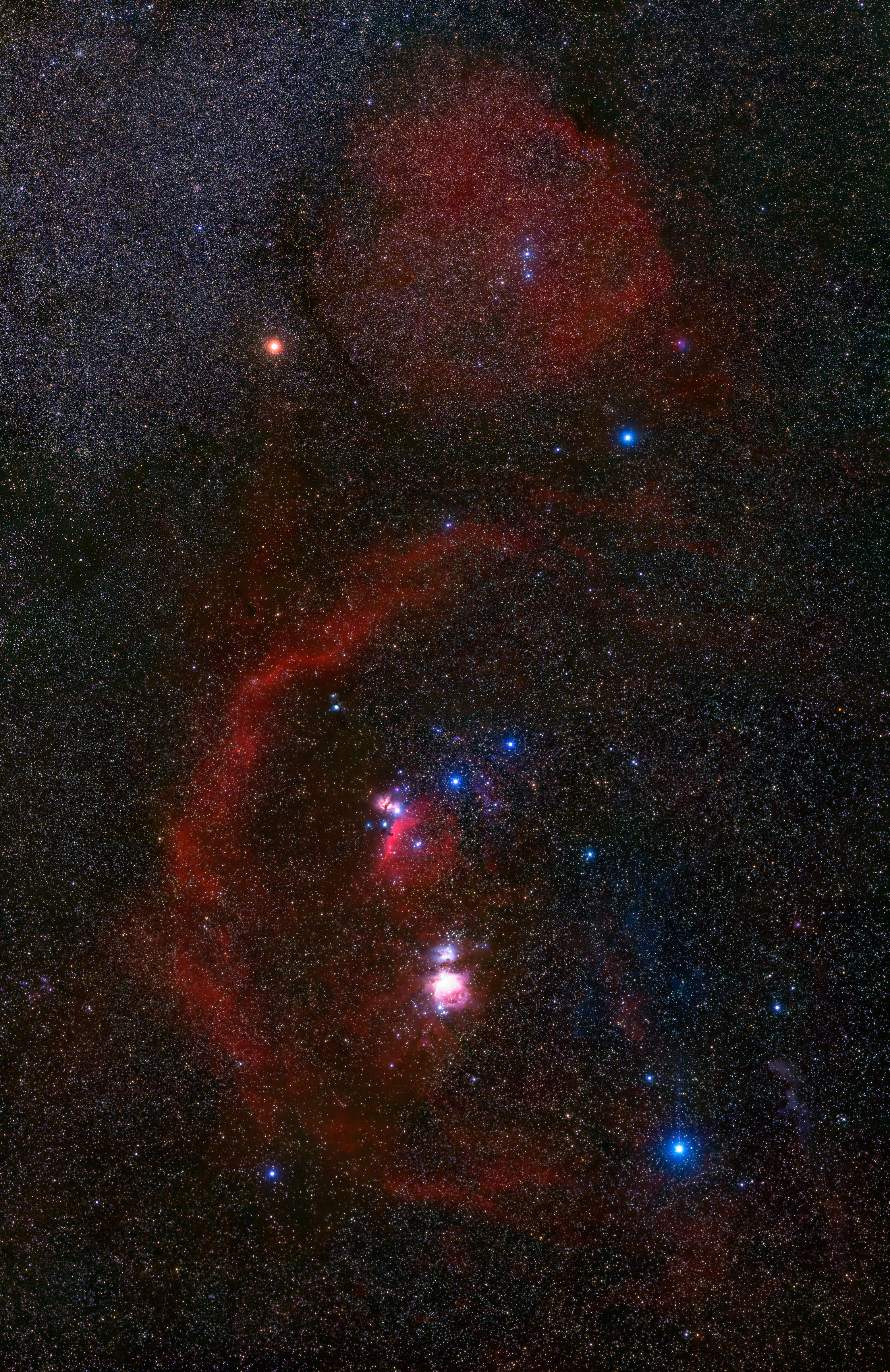
なぜオリオン座の三つ星は泡に囲まれているのでしょうか? 発光星雲のように輝いていますが、バーナードループとして知られるこの泡の起源は現在不明です。起源の仮説としては、明るいオリオン座の星からの恒星風や、はるか昔に消滅した星の超新星爆発などが挙げられます。バーナードループは肉眼では識別できないほど暗いです。この星雲は、1895年にE. E. バーナードが長時間露光フィルムで発見しました。オリオン座の三つ星は画像の中央を横切る3つの明るい星として見え、上の2つは明らかに青く見えます。オリオン座の三つ星の一番下の星のすぐ右には、発光星雲のわずかな窪みがあり、これを高倍率で見ると馬頭星雲に分解できます。三つ星の右には、明るく有名で写真映えするオリオン大星雲があります。
原文(English)
Why is the belt of Orion surrounded by a bubble? Although glowing like an emission nebula, the origin of the bubble, known as Barnard's Loop, is currently unknown. Progenitor hypotheses include the winds from bright Orion stars and the supernovas of stars long gone. Barnard's Loop is too faint to be identified with the unaided eye. The nebula was discovered only in 1895 by E. E. Barnard on long duration film exposures. Orion's belt is seen as the three bright stars across the center of the image, the upper two noticeably blue. Just to the right of the lowest star in Orion's belt is a slight indentation in an emission nebula that, when seen at higher magnification, resolves into the Horsehead Nebula. To the right of the belt stars is the bright, famous, and photogenic Orion Nebula.
\ この感動を宇宙仲間にシェア /
宇宙をXでシェア
© W. H. Wang / APOD