
🚀 宇宙の記憶・カレンダー検索
🚀 象徴的な写真:
APOD第1回
🚀 創造の柱
🚀 スピリット火星着陸
🚀 ハッブル超深宇宙
🚀 地球へようこそ|ブルー・マーブル
🚀 エンケラドス
🚀 ベテルギウス
🚀 火星着陸
🚀 青い夕焼け
🚀 冥王星のハート
🚀 皆既日食
🚀 アースライズ再構築
🚀 ブラックホール
🚀 ウェッブ初画像
🚀 アポロ11着陸
APOD30周年(2025年6月16日)
超新星残骸N132Dの可視光およびX線画像
Supernova Remnant N132D in Optical and X Rays
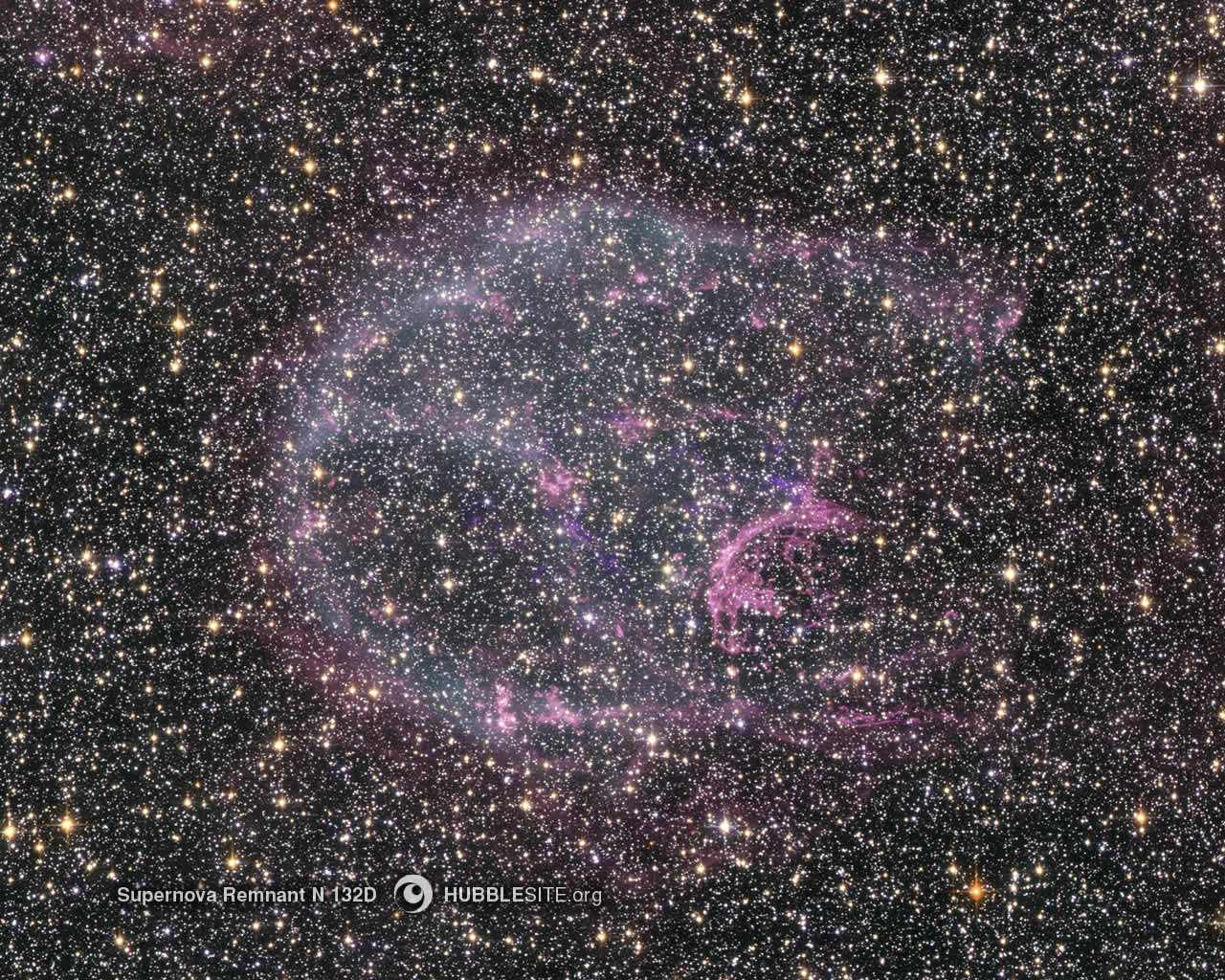
星が爆発してから数千年経っても、その膨張する残骸はスペクトル全体にわたって明るく輝いている。これは、隣接する大マゼラン雲(LMC)銀河にある超新星残骸N132Dの場合も同様である。この爆発によって膨張した残骸は現在80光年に及び、太陽の約600倍の質量を掃き集めている。N132Dは最近、ハッブル宇宙望遠鏡によって可視光で詳細に撮影された。ハッブルの画像は、チャンドラX線観測衛星によって位置が一致するX線で撮影された詳細な画像と合成された。代表的な色で上に示した合成画像は、水素ガスからのピンク色の放射と酸素ガスからの紫色の放射によって強調された、ほぼ球状に膨張する衝撃波を示している。LMC由来の無関係な星々が密集した領域が画像に広がっている。この画像を研究することで、かつて星の内部深くに隠されていた物質を研究する機会が得られる。 N132Dは直径約150光年で、地球から約16万光年離れた、かじき座の方向に位置しています。
原文(English)
Thousands of years after a star exploded, its expanding remnant still glows brightly across the spectrum. Such is the case with N132D, a supernova remnant located in the neighboring Large Magellanic Cloud (LMC) galaxy. The expanding shell from this explosion now spans 80 light-years and has swept up about 600 Suns worth of mass. N132D was imaged recently in optical light and in great detail with the Hubble Space Telescope. The Hubble image was then combined with a position coincident detailed image in X-ray light taken by the Chandra X-ray Observatory. The combination, shown above in representative colors, shows a nearly spherical expanding shockwave highlighted by pink emission from hydrogen gas and purple emission from oxygen gas. A dense field of unrelated stars also from the LMC populates the image. Studying the image gives an opportunity to study material once hidden deep inside a star. N132D spans about 150 light years and lies about 160,000 light years away toward the constellation of Dorado.
\ この感動を宇宙仲間にシェア /
宇宙をXでシェア
© NASA / APOD