
🚀 宇宙の記憶・カレンダー検索
🚀 象徴的な写真:
APOD第1回
🚀 創造の柱
🚀 スピリット火星着陸
🚀 ハッブル超深宇宙
🚀 地球へようこそ|ブルー・マーブル
🚀 エンケラドス
🚀 ベテルギウス
🚀 火星着陸
🚀 青い夕焼け
🚀 冥王星のハート
🚀 皆既日食
🚀 アースライズ再構築
🚀 ブラックホール
🚀 ウェッブ初画像
🚀 アポロ11着陸
APOD30周年(2025年6月16日)
横から見た活動的な太陽黒点
An Active Sunspot Viewed Sideways
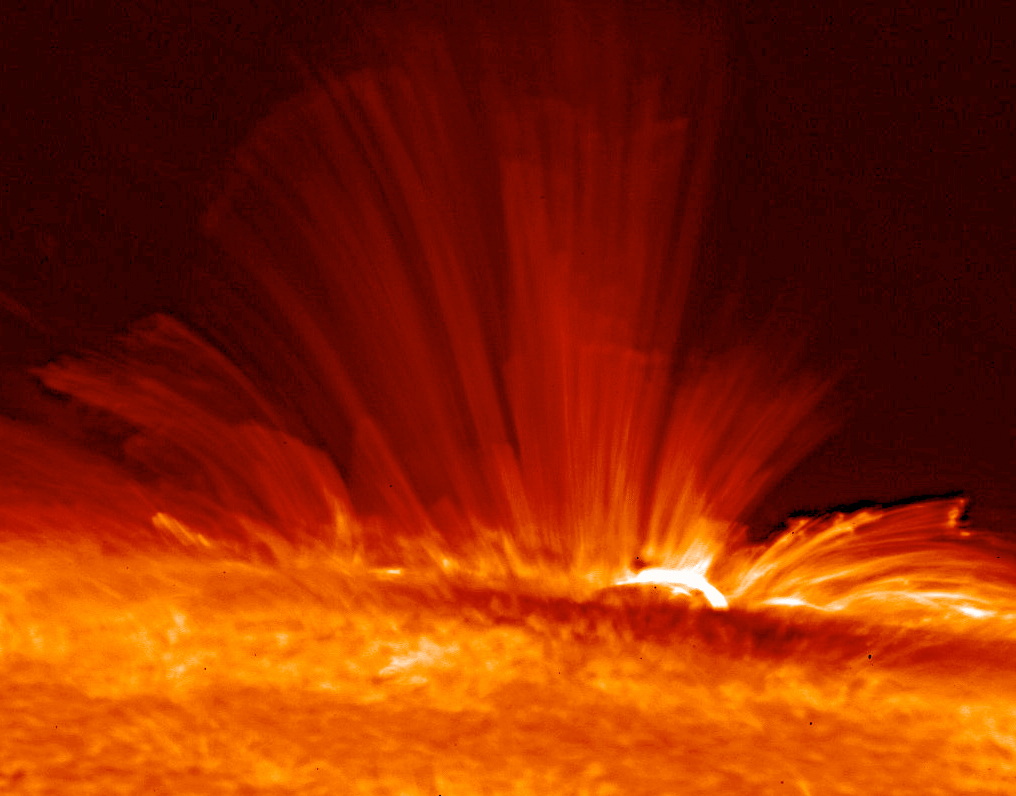
太陽に黒点があるのはなぜでしょうか?何千年も前から観測されてきた黒点は、太陽の複雑で変化する磁場によってわずかに沈下し冷却された領域であることが数十年前から知られています。しかし、日本の新しい太陽観測衛星「ひので」が撮影した上記のような高解像度画像は、現代の理解を深めるのに役立っています。上記画像の中央には黒点がありますが、通常の向きではなく横向きに写っています。特に興味深いのは、太陽の磁場が黒点の中心からまっすぐに伸び、黒点の縁で大きく湾曲している様子を示す、噴出する輝くガスです。太陽が宇宙空間に粒子を放出する仕組みをより深く理解することで、衛星、宇宙飛行士、さらには地球上の電力網に影響を与える太陽嵐の予測精度が向上する可能性があります。
原文(English)
Why are there dark spots on the sun? Although noted for thousands of years, sunspots have been known for decades to be regions of the Sun that are slightly depressed and cooled by the Sun's complex and changing magnetic field. High resolution pictures like the above image from Japan's new Sun-watching Hinode satellite, however, are helping to increase modern understanding. In the center of the above image is a sunspot, but not seen in the usual orientation --this sunspot is seen sideways. Of particular interest is erupting glowing gas that shows how the Sun's magnetic field comes right out of the spot center, but curves markedly around the spot edges. Better understanding of how the Sun ejects particles into space may result in more accurate predictions of solar storms that affect satellites, astronauts, and even power grids on Earth.
\ この感動を宇宙仲間にシェア /
宇宙をXでシェア
© Hinode / APOD