
🚀 宇宙の記憶・カレンダー検索
🚀 象徴的な写真:
APOD第1回
🚀 創造の柱
🚀 スピリット火星着陸
🚀 ハッブル超深宇宙
🚀 地球へようこそ|ブルー・マーブル
🚀 エンケラドス
🚀 ベテルギウス
🚀 火星着陸
🚀 青い夕焼け
🚀 冥王星のハート
🚀 皆既日食
🚀 アースライズ再構築
🚀 ブラックホール
🚀 ウェッブ初画像
🚀 アポロ11着陸
APOD30周年(2025年6月16日)
小惑星と銀河
Asteroid and Galaxy
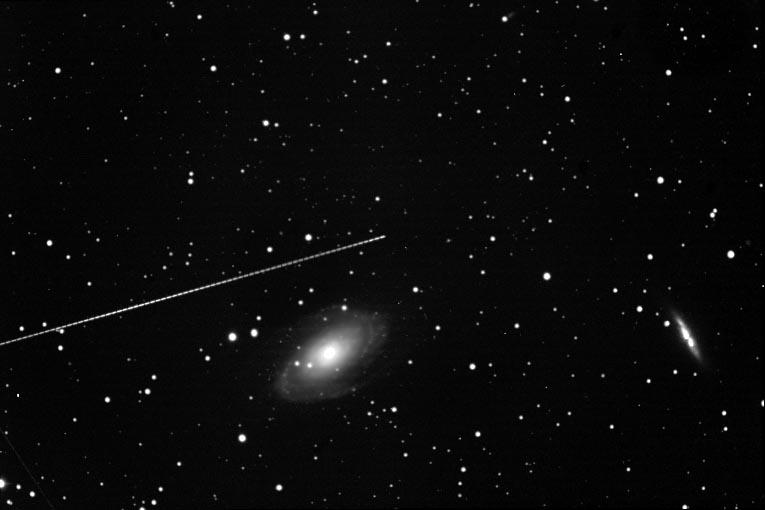
アポロ級小惑星2006 VV2は3月下旬に地球をかすめ、340万キロメートル、つまり地球と月の距離の約8.8倍まで接近しました。軌道が地球に近く、直径が1キロメートル以上と推定されるため、2006 VV2は潜在的に危険な小惑星に分類されています。大小さまざまな望遠鏡が、2036年まで同程度の大きさの既知の小惑星としては最も地球に接近するこの待望のフライバイに向けられました。この合成望遠鏡画像は、3月28日にニューメキシコ州バドで約1時間にわたって記録された一連の画像から作成されました。小惑星は視野の中心付近から始まり、左下方向に移動して、銀河M81のすぐ近くを通過したように見えます。もちろん、右側の伴銀河M82とともに、M81は実際には1200万光年離れており、小惑星の接近距離はわずか15光秒です。
原文(English)
Apollo class asteroid 2006 VV2 flashed past planet Earth in late March, approaching to within 3.4 million kilometers or about 8.8 times the Earth-Moon distance. Due to the proximity of its orbit to Earth and its estimated diameter of over 1 kilometer, 2006 VV2 is classified as a Potentially Hazardous Asteroid. Telescopes large and small were trained on the much anticipated flyby, the closest for a known asteroid of comparable size until the year 2036. This composite telescopic view is from a series of images recorded over a period of about an hour on Mar. 28 from Vado, New Mexico. The asteroid begins near the center of the field and tracks down and to the left, apparently passing very near galaxy M81. Of course, along with its companion galaxy M82 on the right, M81 is really 12 million light years away, compared to the asteroid's range of a mere 15 light seconds.
\ この感動を宇宙仲間にシェア /
宇宙をXでシェア
© NASA / APOD