
🚀 宇宙の記憶・カレンダー検索
🚀 象徴的な写真:
APOD第1回
🚀 創造の柱
🚀 スピリット火星着陸
🚀 ハッブル超深宇宙
🚀 地球へようこそ|ブルー・マーブル
🚀 エンケラドス
🚀 ベテルギウス
🚀 火星着陸
🚀 青い夕焼け
🚀 冥王星のハート
🚀 皆既日食
🚀 アースライズ再構築
🚀 ブラックホール
🚀 ウェッブ初画像
🚀 アポロ11着陸
APOD30周年(2025年6月16日)
ぼんやりとした巨人のより鮮明な眺め
A Sharper View of a Hazy Giant
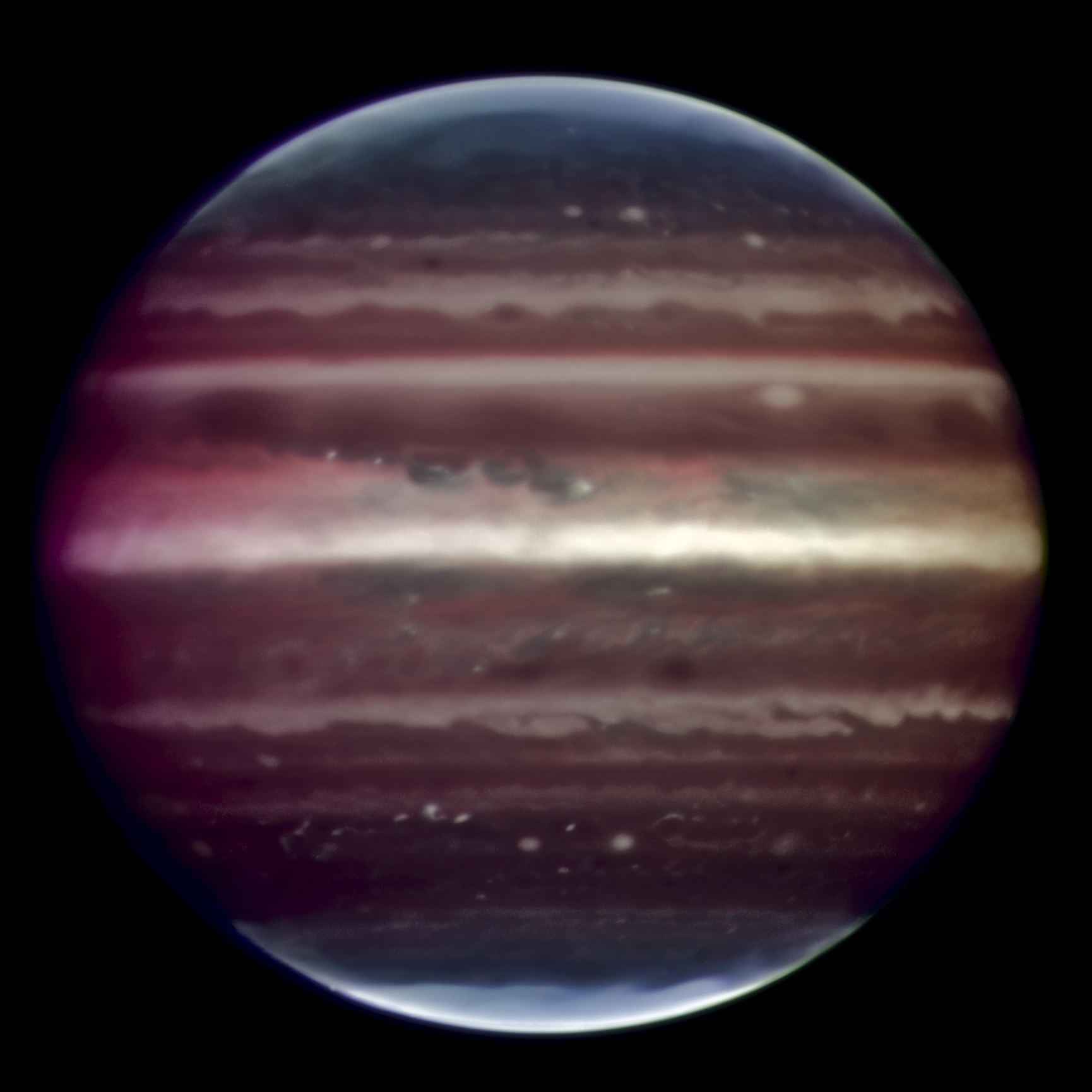
この木星の劇的な画像は、地上から撮影された巨大ガス惑星全体の最も鮮明な画像として宣伝されています。この画像は、チリにあるヨーロッパ南天天文台の直径8メートルの超大型望遠鏡ユニットの1つに搭載されたMAD(Multi-conjugate Adaptive optics Demonstrator)と呼ばれる試作装置を使用して撮影されました。赤外線波長で動作するMAD装置は、複数のガイド星と可変鏡を使用して地球大気の乱流によって生じる歪みを感知して補正することで、地上望遠鏡の悩みの種である大気によるぼやけを取り除きます。木星の厚い大気の奥深くにある水素とメタンは、赤外線波長の光を吸収します。そのため、このより鮮明な画像は、赤道付近と極付近で目立つ巨大惑星の高層ヘイズから反射された赤外線太陽光を示しています。これにより、直径300キロメートルほどの小さな特徴も明らかになります。この有望な技術は、星団や星雲などの他の広がりを持つ天体の画像化にも応用できます。美学と天文学に関する調査をご覧ください。
原文(English)
This dramatic image of Jupiter is touted as the sharpest picture of the entire gas giant ever taken from the ground. The picture was made using a prototype instrument known as MAD (Multi-conjugate Adaptive optics Demonstrator) mounted on one of the European Southern Observatory's 8-meter diameter Very Large Telescope units in Chile. Working at infrared wavelengths the MAD instrument removes atmospheric blurring, the bane of earthbound telescopes, by using multiple guide stars and deformable mirrors to sense and correct for the distortions produced by turbulence in Earth's atmosphere. Hydrogen and methane deep in Jupiter's own thick atmosphere absorb light at infrared wavelengths. So, this sharper view shows the infrared sunlight reflected from the giant planet's high level haze prominent in the equatorial regions and near the poles. It reveals features as small as 300 kilometers across. The promising technique can also be applied to imaging other extended objects like star clusters and nebulae. Take a survey on Aesthetics and Astronomy.
\ この感動を宇宙仲間にシェア /
宇宙をXでシェア
© NASA / APOD