
🚀 宇宙の記憶・カレンダー検索
🚀 象徴的な写真:
APOD第1回
🚀 創造の柱
🚀 スピリット火星着陸
🚀 ハッブル超深宇宙
🚀 地球へようこそ|ブルー・マーブル
🚀 エンケラドス
🚀 ベテルギウス
🚀 火星着陸
🚀 青い夕焼け
🚀 冥王星のハート
🚀 皆既日食
🚀 アースライズ再構築
🚀 ブラックホール
🚀 ウェッブ初画像
🚀 アポロ11着陸
APOD30周年(2025年6月16日)
SN 1006超新星残骸
SN 1006 Supernova Remnant
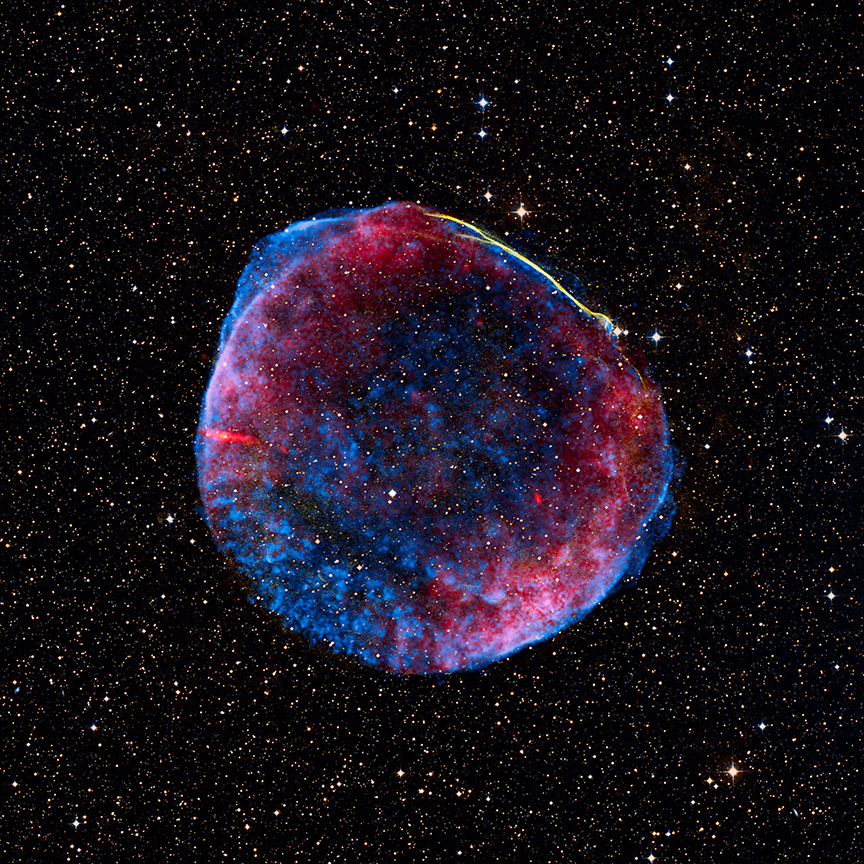
西暦1006年、人類史上最も明るい超新星と思われる新たな星が地球の空を照らしました。南天のオオカミ座にあるこの恒星爆発による膨張する残骸雲は、電磁スペクトル全体にわたって今も宇宙の光のショーを繰り広げています。実際、この合成画像には、チャンドラ天文台のX線データ(青色)、光学データ(黄色)、電波画像データ(赤色)が含まれています。現在SN 1006超新星残骸として知られるこの残骸雲は、直径約60光年で、白色矮星の残骸であると考えられています。連星系の一部であったこのコンパクトな白色矮星は、伴星から徐々に物質を取り込みました。質量の蓄積が最終的に熱核爆発を引き起こし、矮星を破壊しました。超新星残骸までの距離は約7000光年であるため、その爆発は実際には1006年に光が地球に到達する7000年前に起こったことになる。残骸内の衝撃波は粒子を極めて高いエネルギーまで加速させ、謎の宇宙線の発生源と考えられている。
原文(English)
A new star, likely the brightest supernova in recorded human history, lit up planet Earth's sky in the year 1006 AD. The expanding debris cloud from the stellar explosion, found in the southerly constellation of Lupus, still puts on a cosmic light show across the electromagnetic spectrum. In fact, this composite view includes X-ray data in blue from the Chandra Observatory, optical data in yellowish hues, and radio image data in red. Now known as the SN 1006 supernova remnant, the debris cloud appears to be about 60 light-years across and is understood to represent the remains of a white dwarf star. Part of a binary star system, the compact white dwarf gradually captured material from its companion star. The buildup in mass finally triggered a thermonuclear explosion that destroyed the dwarf star. Because the distance to the supernova remnant is about 7,000 light-years, that explosion actually happened 7,000 years before the light reached Earth in 1006. Shockwaves in the remnant accelerate particles to extreme energies and are thought to be a source of the mysterious cosmic rays.
\ この感動を宇宙仲間にシェア /
宇宙をXでシェア
© NASA / APOD