
🚀 宇宙の記憶・カレンダー検索
🚀 象徴的な写真:
APOD第1回
🚀 創造の柱
🚀 スピリット火星着陸
🚀 ハッブル超深宇宙
🚀 地球へようこそ|ブルー・マーブル
🚀 エンケラドス
🚀 ベテルギウス
🚀 火星着陸
🚀 青い夕焼け
🚀 冥王星のハート
🚀 皆既日食
🚀 アースライズ再構築
🚀 ブラックホール
🚀 ウェッブ初画像
🚀 アポロ11着陸
APOD30周年(2025年6月16日)
リング星雲ディープフィールド
Ring Nebula Deep Field
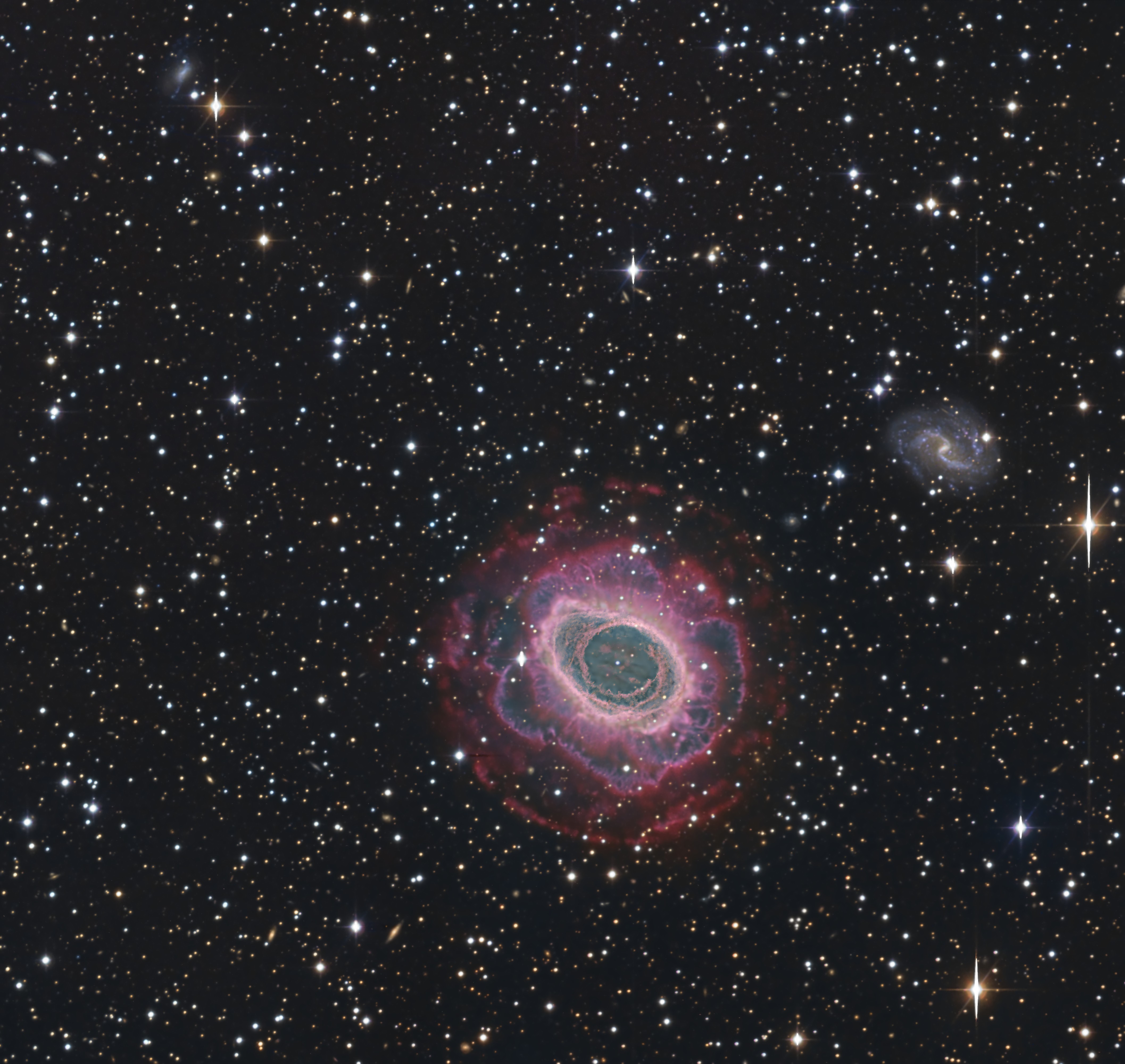
小型望遠鏡を持つ天体観測愛好家にとって馴染み深いリング星雲(M57)は、約2,000光年離れたこと座に位置しています。中心のリングは約1光年の直径ですが、3つの異なる望遠鏡のデータを組み合わせたこの非常に詳細な画像は、星雲の中心星からさらに遠くまで伸びる輝くガスのループ状のフィラメントを捉えています。もちろん、このよく研究されている惑星状星雲の例では、輝く物質は惑星から来ているわけではありません。代わりに、このガス状の覆いは、死にゆく太陽のような星から放出された外層を表しています。この素晴らしい合成画像には、リングの原子水素の可視光での放射(紫色で表示)と近赤外線波長での分子水素の放射(赤色で表示)を記録した狭帯域画像データが含まれています。さらに遠くにある渦巻銀河IC 1296も右上に見えます。
原文(English)
A familiar sight to sky enthusiasts with even a small telescope, the Ring Nebula (M57) is some 2,000 light-years away in the musical constellation Lyra. The central ring is about one light-year across, but this remarkably deep exposure - a collaborative effort combining data from three different telescopes - explores the looping filaments of glowing gas extending much farther from the nebula's central star. Of course, in this well-studied example of a planetary nebula, the glowing material does not come from planets. Instead, the gaseous shroud represents outer layers expelled from a dying, sun-like star. This remarkable composite image includes narrowband image data recording the Ring's atomic hydrogen emission (shown as violet) in visible light and molecular hydrogen emission (shown as red) at near infrared wavelengths. The much more distant spiral galaxy IC 1296 is also visible at the upper right.
\ この感動を宇宙仲間にシェア /
宇宙をXでシェア
© Vicent Peris
(DSA /
OAUV /
PixInsight),
Jack Harvey
(DSA /
SSRO),
Steve Mazlin
(DSA /
SSRO),
Jose Luis Lamadrid
(DSA /
ceFca),
Ana Guijarro
(CAHA),
RECTA,
DSA. / APOD