
🚀 宇宙の記憶・カレンダー検索
🚀 象徴的な写真:
APOD第1回
🚀 創造の柱
🚀 スピリット火星着陸
🚀 ハッブル超深宇宙
🚀 地球へようこそ|ブルー・マーブル
🚀 エンケラドス
🚀 ベテルギウス
🚀 火星着陸
🚀 青い夕焼け
🚀 冥王星のハート
🚀 皆既日食
🚀 アースライズ再構築
🚀 ブラックホール
🚀 ウェッブ初画像
🚀 アポロ11着陸
APOD30周年(2025年6月16日)
スピッツァーのM101
Spitzer's M101
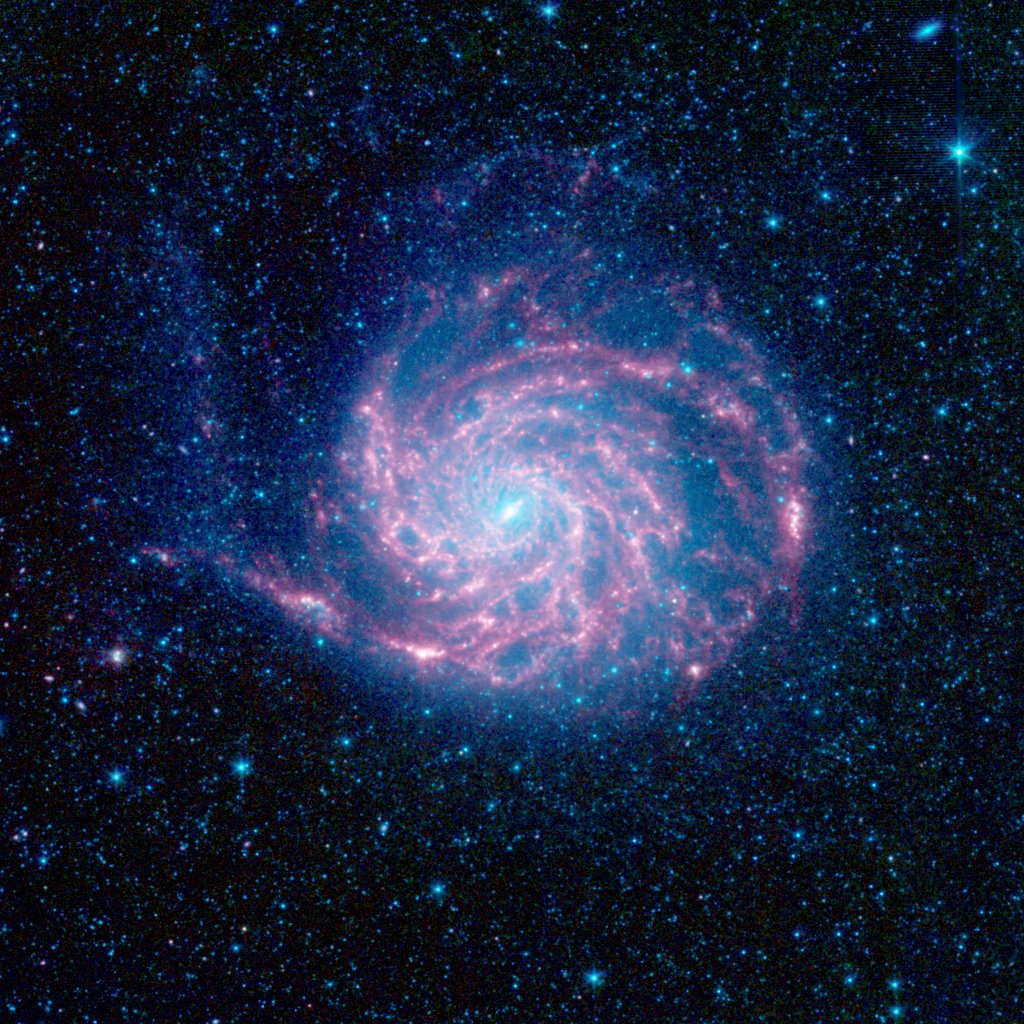
巨大で美しい渦巻銀河M101は、シャルル・メシエの有名なカタログの最後の方の項目の一つですが、決して重要度の低いものではありません。直径約17万光年のこの銀河は巨大で、私たちの天の川銀河のほぼ2倍の大きさです。M101は、19世紀のロス卿の大型望遠鏡「パーソンタウンのレヴィアサン」によって最初に観測された渦巻星雲の一つでもあります。スピッツァー宇宙望遠鏡によって赤外線波長で記録されたこの21世紀の画像は、星の光が青みがかった色合いで、銀河の塵の雲が赤く写っています。天文学者たちは、銀河の外縁部の塵の特徴を調べた結果、M101の他の部分に存在する有機分子が不足していることを発見しました。スピッツァーの機器によって追跡された有機分子は、多環芳香族炭化水素(PAH)と呼ばれています。もちろん、PAHは天の川銀河の塵の一般的な成分であり、地球上ではすすに含まれています。 PAH(多環芳香族炭化水素)は、M101銀河の外縁部付近で、活発な星形成領域からの高エネルギー放射線によって破壊されると考えられている。M101銀河は、風車銀河とも呼ばれ、北天の星座であるおおぐま座の領域内に位置し、地球から約2500万光年離れている。
原文(English)
Big, beautiful spiral galaxy M101 is one of the last entries in Charles Messier's famous catalog, but definitely not one of the least. About 170,000 light-years across, this galaxy is enormous, almost twice the size of our own Milky Way Galaxy. M101 was also one of the original spiral nebulae observed by Lord Rosse's large 19th century telescope, the Leviathan of Parsontown. Recorded at infrared wavelengths by the Spitzer Space telescope, this 21st century view shows starlight in blue hues while the galaxy's dust clouds are in red. Examining the dust features in the outer rim of the galaxy, astronomers have found that organic molecules present throughout the rest of M101 are lacking. The organic molecules tracked by Spitzer's instruments are called polycyclic aromatic hydrocarbons (PAHs). Of course, PAHs are common components of dust in the Milky Way and on planet Earth are found in soot. PAHs are likely destroyed near the outer edges of M101 by energetic radiation in intense star forming regions. Also known as the Pinwheel Galaxy, M101 lies within the boundaries of the northern constellation Ursa Major, about 25 million light-years away.
\ この感動を宇宙仲間にシェア /
宇宙をXでシェア
© NASA / APOD