
🚀 宇宙の記憶・カレンダー検索
🚀 象徴的な写真:
APOD第1回
🚀 創造の柱
🚀 スピリット火星着陸
🚀 ハッブル超深宇宙
🚀 地球へようこそ|ブルー・マーブル
🚀 エンケラドス
🚀 ベテルギウス
🚀 火星着陸
🚀 青い夕焼け
🚀 冥王星のハート
🚀 皆既日食
🚀 アースライズ再構築
🚀 ブラックホール
🚀 ウェッブ初画像
🚀 アポロ11着陸
APOD30周年(2025年6月16日)
ハレー彗星の核:軌道を回る氷山
Comet Halley's Nucleus: An Orbiting Iceberg
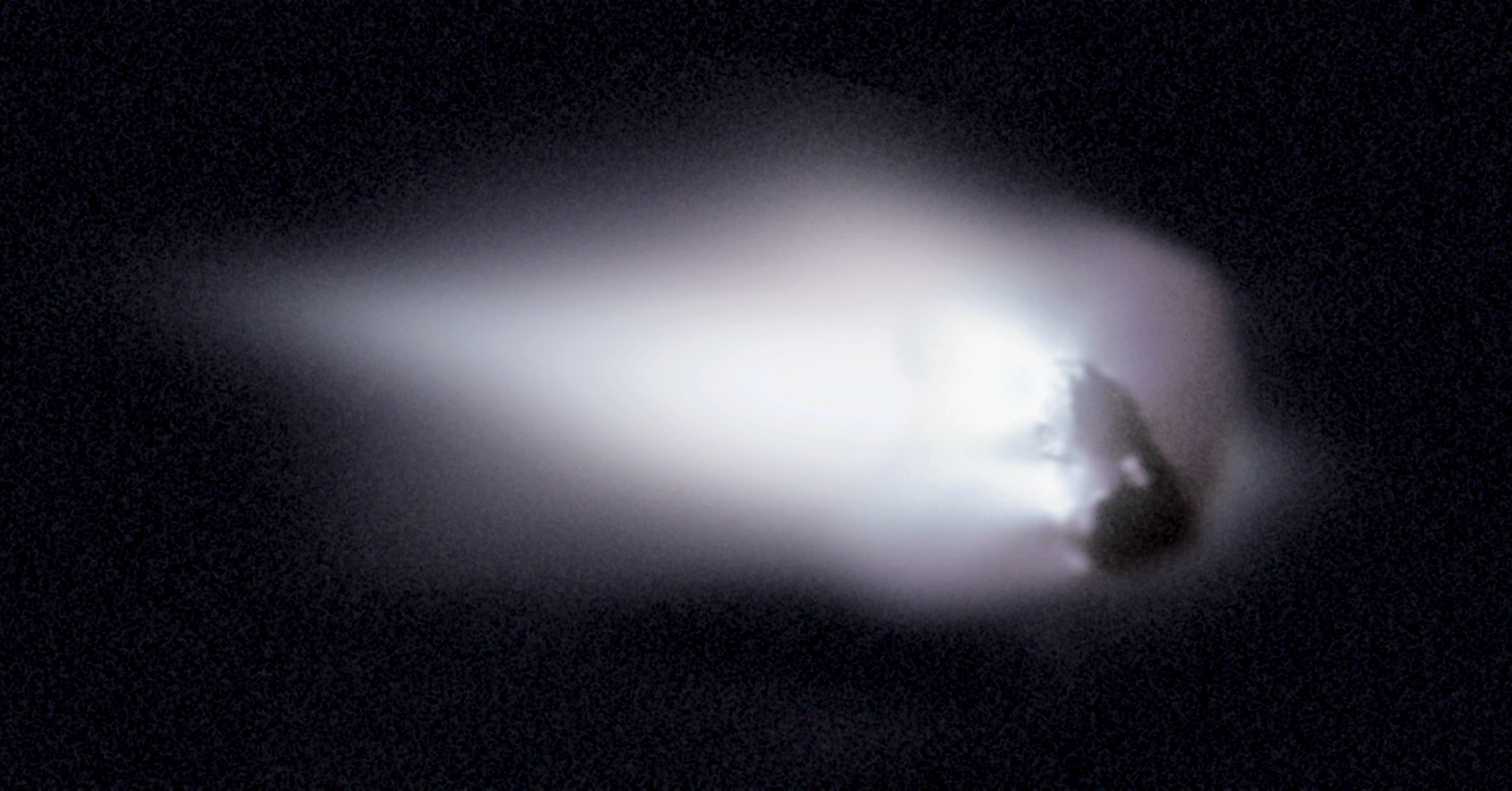
彗星の核はどのような形をしているのでしょうか?太陽系の原始物質から形成された彗星の核は、非常に汚れた氷山に似ていると考えられていました。しかし、地上望遠鏡では、太陽に接近する活動的な彗星の周囲のガスと塵の雲しか観測できず、彗星のコマと特徴的な彗星の尾しかはっきりと捉えることができませんでした。しかし、1986年、欧州宇宙機関の探査機ジオットは、ハレー彗星が太陽に接近する際にその核を通過し、撮影することで、彗星の核に遭遇して撮影した最初の探査機の1つとなりました。ジオットのカメラからのデータを使用して、直径約15キロメートルのジャガイモのような形をした核のこの高解像度画像が生成されました。暗い核の表面の特徴の一部は右側にあり、ハレー彗星のコマに流れ込むガスと塵は左側にあります。ハレー彗星は76年ごとに太陽系内側に戻ってきます。そのたびに、彗星の核は約6メートルもの厚さの氷と岩石の層を宇宙空間に放出します。ハレー彗星の核から放出されたこれらの破片は、やがて軌道を描いて広がり、毎年10月に見られるオリオン座流星群と、毎年5月に見られるみずがめ座η流星群の原因となります。
原文(English)
What does a comet nucleus look like? Formed from the primordial stuff of the Solar System, comet nuclei were thought to resemble very dirty icebergs. But ground-based telescopes revealed only the surrounding cloud of gas and dust of active comets nearing the Sun, clearly resolving only the comet's coma, and the characteristic cometary tails. In 1986, however, the European spacecraft Giotto became one of the first group of spacecraft ever to encounter and photograph the nucleus of a comet, passing and imaging Halley's nucleus as it approached the sun. Data from Giotto's camera were used to generate this enhanced image of the potato shaped nucleus that measures roughly 15 kilometers across. Some surface features on the dark nucleus are on the right, while gas and dust flowing into Halley's coma are on the left. Every 76 years Comet Halley returns to the inner Solar System and each time the nucleus sheds about a 6-meter deep layer of its ice and rock into space. This debris shed from Halley's nucleus eventually disperses into an orbiting trail responsible for the Orionids meteor shower, in October of every year, and the Eta Aquariids meteor shower every May.
\ この感動を宇宙仲間にシェア /
宇宙をXでシェア
© Halley Multicolor Camera Team,
Giotto Project,
ESA / APOD