
🚀 宇宙の記憶・カレンダー検索
🚀 象徴的な写真:
APOD第1回
🚀 創造の柱
🚀 スピリット火星着陸
🚀 ハッブル超深宇宙
🚀 地球へようこそ|ブルー・マーブル
🚀 エンケラドス
🚀 ベテルギウス
🚀 火星着陸
🚀 青い夕焼け
🚀 冥王星のハート
🚀 皆既日食
🚀 アースライズ再構築
🚀 ブラックホール
🚀 ウェッブ初画像
🚀 アポロ11着陸
APOD30周年(2025年6月16日)
NuSTAR X線望遠鏡が打ち上げられました
NuSTAR X-Ray Telescope Launched
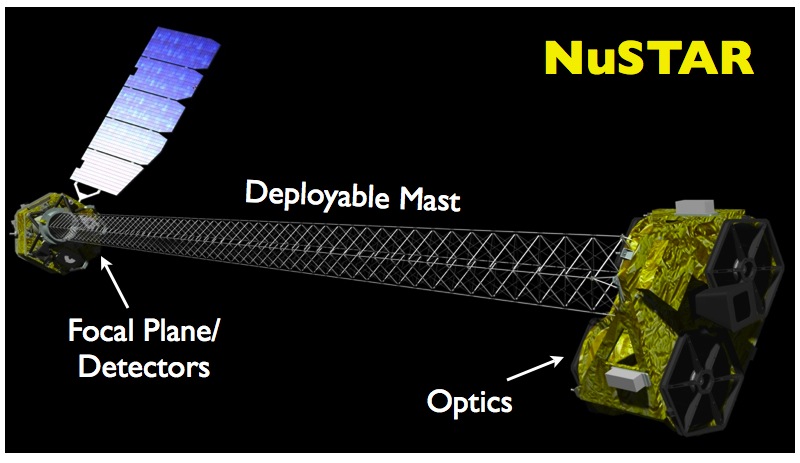
星が爆発した後には何が残るのでしょうか?その解明のため、NASAは先週、核分光望遠鏡アレイ(NuSTAR)衛星を地球軌道に打ち上げました。NuSTARは原子核から放出される硬X線を集束させる能力を持ち、超新星残骸の周囲を調査することで、超新星爆発がなぜ起こったのか、どのような天体が生成されたのか、そして周囲がなぜこれほど高温になるのかといったメカニズムをより深く理解することを目的としています。NuSTARはまた、太陽の高温コロナ、銀河団の高温ガス、そして銀河系の中心にある超大質量ブラックホールを、人類にこれまでにないほど詳細に観測する機会を提供します。上の図は、NuSTARの仕組みを描いたイラストです。歯科医院で使用されるようなX線が右側の望遠鏡に入り、2組の平行ミラーで反射して左側の検出器に集束されます。長く軽量なマストが2つの検出器を隔てており、全体の電力は左上にあるソーラーパネルによって供給されます。 NuSTARへの期待感は、観測が期待されるものだけでなく、宇宙を新たな視点から捉えることで、これまで全く知られていなかったものが発見される可能性にもあります。NuSTARの運用期間は2年間を予定しています。スライドセット(ASOW):NuSTAR、主任研究員フィオナ・ハリソン
原文(English)
What's left after a star explodes? To help find out, NASA launched the Nuclear Spectroscopic Telescope Array (NuSTAR) satellite into Earth orbit last week. NuSTAR's ability to focus hard X-rays emitted from the nuclei of atoms will be used, among other things, to inspect the surroundings of supernova remnants so as to better understand why these supernovas occurred, what types of objects resulted, and what mechanisms make their surroundings glow so hot. NuSTAR will also give humanity unprecedented looks at the hot corona of our Sun, hot gasses in clusters of galaxies, and the supermassive black hole in the center of our Galaxy. Pictured above is an artist's illustration depicting how NuSTAR works. X-rays similar to those used in your dentist's office enter the telescope on the right and skip off two sets of parallel mirrors that focus them onto the detectors on the left. A long but low-weight mast separates the two, and the whole thing is powered by solar panels on the upper left. Part of the excitement involving NuSTAR is not only what things it is expected to see, but by looking at the universe in a new way, what things that are completely unknown that might be discovered. NuSTAR has a planned two year lifetime. Slide Set (ASOW): NuSTAR by PI Fiona Harrison
\ この感動を宇宙仲間にシェア /
宇宙をXでシェア
© Fiona Harrison
et al.,
Caltech,
NASA / APOD