
🚀 宇宙の記憶・カレンダー検索
🚀 象徴的な写真:
APOD第1回
🚀 創造の柱
🚀 スピリット火星着陸
🚀 ハッブル超深宇宙
🚀 地球へようこそ|ブルー・マーブル
🚀 エンケラドス
🚀 ベテルギウス
🚀 火星着陸
🚀 青い夕焼け
🚀 冥王星のハート
🚀 皆既日食
🚀 アースライズ再構築
🚀 ブラックホール
🚀 ウェッブ初画像
🚀 アポロ11着陸
APOD30周年(2025年6月16日)
火星のヘベス・キャズマの崩壊
Collapse in Hebes Chasma on Mars
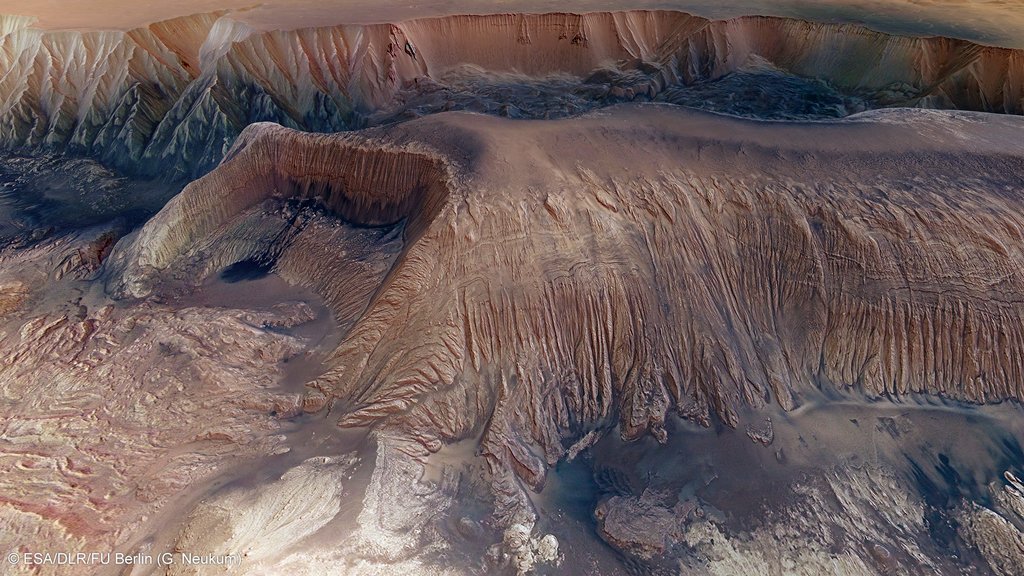
火星のヘベス峡谷で何が起こったのか? ヘベス峡谷は、巨大なマリネリス峡谷のすぐ北にある窪地です。この窪地は他の地表地形とは繋がっていないため、内部の物質がどこへ行ったのかは不明です。ヘベス峡谷の中には、高さ5キロメートルのメサであるヘベス・メンサがあり、珍しい部分的な崩壊が起こったようです。この崩壊が手がかりを与えてくれるかもしれません。火星を周回しているロボット探査機マーズ・エクスプレスが撮影した上の画像は、峡谷の詳細と中央のメサにある珍しい馬蹄形の窪みを示しています。メサからの物質が峡谷の底に流れ込んだようで、暗い層と思われるものが、下り坂の着陸地点にインクが溜まったように見えます。最近の仮説では、ヘベス峡谷の下層の一部は塩分を含んだ岩石で構成されており、塩分は溶けた氷の流れに溶け込み、穴を通って地下帯水層に流れ込んだとされています。 APODにご協力ください:APOD 2014カレンダー利用状況アンケートにご協力ください
原文(English)
What's happened in Hebes Chasma on Mars? Hebes Chasma is a depression just north of the enormous Valles Marineris canyon. Since the depression is unconnected to other surface features, it is unclear where the internal material went. Inside Hebes Chasma is Hebes Mensa, a 5 kilometer high mesa that appears to have undergone an unusual partial collapse -- a collapse that might be providing clues. The above image, taken by the robotic Mars Express spacecraft currently orbiting Mars, shows great details of the chasm and the unusual horseshoe shaped indentation in the central mesa. Material from the mesa appears to have flowed onto the floor of the chasm, while a possible dark layer appears to have pooled like ink on a downslope landing. A recent hypothesis holds that salty rock composes some lower layers in Hebes Chasma, with the salt dissolving in melted ice flows that drained through holes into an underground aquifer. Help APOD: Take the APOD 2014 Calendar Usage Poll
\ この感動を宇宙仲間にシェア /
宇宙をXでシェア
© ESA / APOD